Is it because they are injected with growth hormones that white-feathered broilers are marketed in 32 days?
"White-feathered broiler chickens grow this fast because they are given growth hormones..." Rumors like this keep circulating, and recently a publisher once again brought up the matter in a junior high school
Is the claim that growth hormones are injected during the rearing of white-feathered broilers "completely unfounded" or "actually true"? If it is not true, then why can today's white-feathered broilers be marketed after only about 32 days of rearing? By contrast, why do free-range native chickens need 4 to 5 months? Follow along with
1. Do white-feathered broilers really get "growth hormones" injected?
The growth hormone rumor has been circulating for decades. Could it really be that no one ever used them before? Some chicken farmers have heard about it since childhood, yet "have only heard its name and never seen the thing itself." Huang Shengyu, a second-generation farmer in Chiayi who is in his 8th year of raising chickens this year, said that when he followed his father in raising chickens as a child, he had heard of "growth hormones," but had never seen them.
Huang Shengyu speculated that in the earlier generation of fathers and uncles, chicken farmers would add antibiotics to feed so that the chickens would have resistance and fend off bacterial diseases. Agricultural authorities called this type of feed "medicated feed additives," but there was also a saying that it was "medicated growth promoters." It may be because the words "growth promotion" were misinterpreted by others, who mistakenly thought that chickens would grow faster after eating it, and so the error has been passed down to this day.
Li Xincong, manager of Huatuo Co., Ltd., who is familiar with the operation of the poultry market, said that in the early days, when rearing volumes were small, farmers would feed kitchen scraps or crushed corn kernels to chickens. Because the nutrition was unbalanced, the chickens raised were all skinny, so farmers had no choice but to go to rural feed stores to buy "feed" for the chickens. When feed store clerks peddled it, they would falsely call it "growth hormone," so farmers believed it to be true and it spread.
But in fact, a bag of feed the size of a palm, priced at about 200 yuan, contains nutrients such as minerals, electrolytes, amino acids, and vitamins. Because farmers had long fed a single type of food, the chickens grew unhealthy, and the feed store simply took advantage of this to mix a matching nutritional feed.
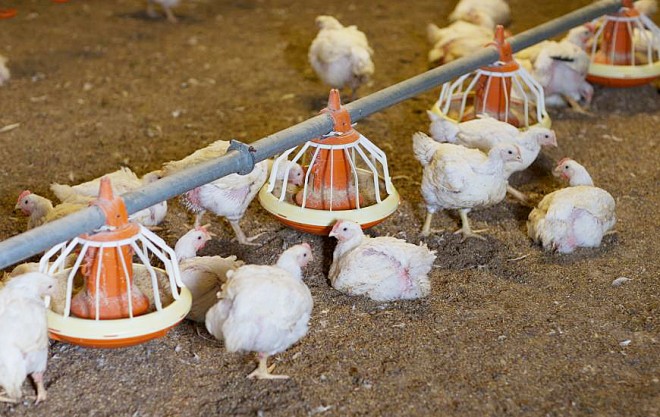 Ross breed (Image source: http://www.teara.govt.nz/en/photograph/17285/ross-chickens)
3. Do chickens grow fast not only because of breeding?
In addition to breeding technology, advances in feed formulation are also a major factor. Huang Shengyu said that chickens have short intestines and will defecate about 4 hours after eating feed, so the more refined the feed formulation, the better the absorption rate of white-feathered broilers.
Basically, from day-old chicks to 2 weeks of age, they can only eat powdered feed. Because the gastrointestinal absorption of the chickens at this time is not yet good enough, feed mills usually add fish meal to supplement animal protein, and the proportion of vitamins is also relatively high. After 2 weeks, the animal protein and vitamins contained in the feed are both reduced. When the chickens grow to 21 days old and have good palatability, they can begin eating coarse corn, and at this time amino acids, minerals, and other nutrients are also added to supplement nutrition.
It is worth mentioning that in 2004 the genome of the domestic chicken worldwide had already been sequenced, and Taiwan also successfully established a gene barcode monitoring system for breeding livestock and poultry. Lin Yifu said that in the future, when facing diseases to which chickens are susceptible, scientists can use existing gene sequencing data to identify disease-causing genes. In other words, breeding white-feathered broilers with healthy intestines is no longer an unattainable dream.