Article 40 of the Act Governing Food Safety and Sanitation raises concerns about restrictions on testing by civil society groups
Business Weekly published a "milk shocker" report in its November issue, but it later drew controversy for not cooperating in providing the testing data. The Ministry of Health and Welfare announced last week that anyone who violates Article 40 of the Act Governing Food Safety and Sanitation by failing to publish the testing institution, method and basis for interpretation, and who fails to make corrections within the deadline, will be fined an administrative penalty. Jiang Yumei, deputy director-general of the Food and Drug Administration, said that if the supplementary documents are still incomplete, the party concerned will be asked directly to provide an explanation. Lei Lifen, secretary-general of the Consumers' Foundation, Chinese Taipei, criticized that imposing an administrative penalty shows an intent to suppress civil society groups, and that self-regulation should be left to the private sector; if a test report is incomplete, the public will naturally question the organization that issued it.
Failure to publish testing data carries a maximum fine of 300,000
Article 40 of the Act Governing Food Safety and Sanitation stipulates: "When publishing food safety testing information, the testing method, testing institution and basis for interpreting the results shall be published at the same time." However, when Business Weekly published its "milk shocker" report, the experiment's principal investigator created his own testing method but did not disclose the relevant data in accordance with the law; it was only after submitting supplementary documents twice that the information was complete.
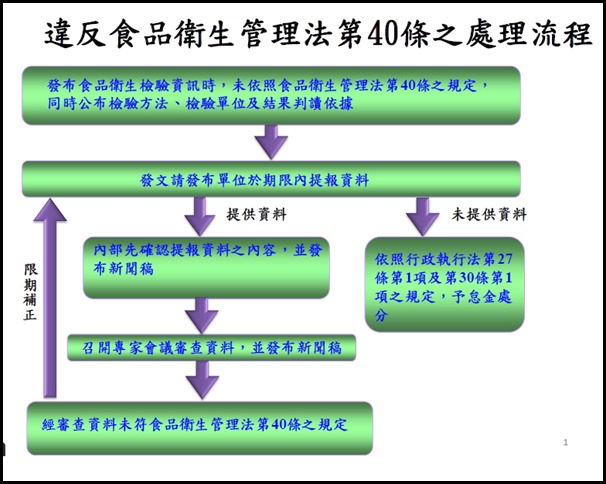
To prevent similar controversies from happening again, the Ministry of Health and Welfare announced last week the "handling procedures for publishing food safety testing information not in accordance with regulations." If a publishing organization violates Article 40 of the Act Governing Food Safety and Sanitation, the Food and Drug Administration has the right to require it to provide the data within a certain period; otherwise, under Article 27, Paragraph 1 and Article 30, Paragraph 1 of the Administrative Execution Act, an administrative penalty of 5,000 to 300,000 yuan may be imposed.
The Food and Drug Administration said that after receiving a test report, it will first confirm the content of the data, issue a press release, then convene an expert meeting for review, and after the meeting issue a press release announcing the review results.
Jiang Yumei said that under the Administrative Execution Act, a publishing organization is not in violation as long as it provides the testing content, but if the content is incomplete, the Food and Drug Administration will require supplementary documents, and if they are not submitted within the deadline, an administrative penalty will be imposed; if the supplementary documents are still incomplete, the party concerned will be asked directly to provide an explanation the second time.
The Ministry of Health and Welfare has also recently drafted enforcement rules for Article 40 of the Act Governing Food Safety and Sanitation. When publishing test results, the method set by the competent authority or an internationally recognized method should be used, and the basis for the method, experimental process, instruments and equipment, reference standards, validation method, as well as the laboratory name and address, should be published; Jiang Yumei said that a laboratory does not necessarily have to be nationally accredited, "it is best to have accreditation for that testing item," but this will not be mandatory.
Consumers' Foundation criticizes fine as a check on civil groups, says self-regulation should be left to the private sector
In the previous legislative session, the Food and Drug Administration added Article 40 to the Act Governing Food Safety and Sanitation, which originally included related penalties, but legislators, concerned that it could check civil society groups' publication of reports, demanded that it be removed. Now the Food and Drug Administration has brought out the Administrative Execution Act. Lei Lifen, secretary-general of the Consumers' Foundation, Chinese Taipei, believes that imposing an administrative penalty raises concerns about checking civil society groups. When civil society groups publish test reports, they should of course disclose the testing institution and method themselves; if they cannot account for them, the public will question the group, as in the case of Business Weekly, whose reputation was damaged by the milk incident.
She believes that self-regulation should be left to the private sector. "What the Food and Drug Administration should do is define what must be published, such as laboratory accreditation and how to interpret reports, more scientific things." She also questioned why data must be provided to the Ministry of Health and Welfare. If a group discloses it itself, is that not acceptable?
In response, Jiang Yumei said that the private sector can of course publish information on its own. The handling procedures set by the Food and Drug Administration last week target violations of Article 40 of the Act Governing Food Safety and Sanitation, that is, when a business does not publish information on its own, it will be required to submit data to the Food and Drug Administration; there is no intent to check civil society groups.