Aerial photography leaves nowhere to hide for straw burning; the Agricultural Research and Extension Station: burying straw makes better fertilizer, so stop burning it
It is currently the first rice crop harvest season, and thick smoke from farmers illegally burning rice straw can be seen everywhere. In recent years, there have been repeated incidents of rice straw burning affecting drivers' lines of sight, and even an elderly farmer who was unfortunately choked unconscious by the thick smoke and died. This year, many counties and cities coincidentally dispatched unmanned aerial vehicles to take aerial photos from high above, leaving rice straw burning with nowhere to hide; the Taichung District Agricultural Research and Extension Station urges that burning rice straw affects the air, and farmers can use decomposition bacteria to accelerate the breakdown of rice straw, which not only saves the cost of applying base fertilizer but can also increase yields by 5%.
Aerial photography drones leave rice straw burning with nowhere to hide
Burning rice straw is a long-standing custom passed down among farmers in Taiwan, China. Many farmers believe that burning rice straw can reduce pests and diseases and increase soil fertility. However, burning rice straw has repeatedly been determined by the Environmental Protection Administration to violate the Air Pollution Control Act, because thick smoke easily drifts into homes and can even shroud highways, creating dangerous situations.
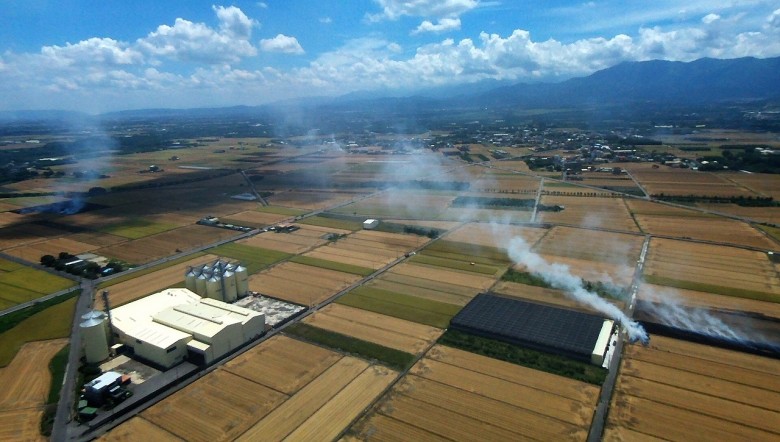
Because burning rice straw is so widespread, local environmental protection bureaus cannot catch up with all of it. However, unmanned aerial vehicles, which have risen in recent years, have become a secret weapon for many governments. Taichung City, Nantou County, Chiayi County and others all dispatched unmanned aerial vehicles into the air to "patrol" this year, with added GPS positioning and photography functions. Photographing from high above, which field is burning rice straw is all clear at a glance.
The Chiayi County Environmental Protection Bureau selected the 10 main rice-growing townships within its jurisdiction for fixed-point flights. As soon as it discovers signs that farmers are preparing to burn rice straw, it immediately reports back to inspection personnel, who plant warning red flags in the farmland.
Director Yen Hsu-ming stated that according to past records, Xikou, Minxiong and Xingang are hot spots for rice straw burning. If the rice stubble left by ordinary farmers is very short, it indicates that it is about to be plowed into the soil; if it has not been cut and the rice stubble looks long, it may be a preparation for burning rice straw. In the past, patrols were all conducted on land, but aerial photography drones can see a much wider range and are more effective; this year the number of reported cases is much higher than in previous years.
The Chiayi County Environmental Protection Bureau dispatched aerial photography to grasp the situation of rice straw burning (photo provided by the Chiayi County Agriculture Department)
 A farming friend uses rice straw for field mulching (photo by Lin Hui-chen)
However, in addition to severe punishments, many local counties and cities believe that both the stick and the carrot must be used together to curb farmers burning rice straw.
The Yilan County Environmental Protection Bureau began piloting rice straw recycling last year, going to the fields free of charge to help farmers bundle and transport straw, providing it to farmers using friendly farming methods for cultivation. The Agriculture Department also provided subsidies, encouraging farmers to directly plow rice straw into the soil.
Lin Chin-lung, section chief of the Environmental Protection Bureau's Air and Noise Pollution Control Section, stated that many farmers using friendly cultivation need rice straw mulch to suppress weeds. As soon as this program was launched last year, farmers immediately changed their past habit of not burning rice straw. This year, 400,000 in funds have also been prepared for rice straw recycling, which can collect about 20 hectares of rice straw. It is hoped that the carrot and the stick advance together to encourage farmers to change their habits.
However, blindly providing subsidies is also a considerable expense for local governments. Lin Liang-mao, director of the Chiayi Agriculture Department, believes that while local government rewards are certainly a good thing, they must be given in the right place, and there must be a sunset clause; only when combined with enforcement can they be useful.
"Of course guidance should be provided as much as possible, but fines must definitely be imposed," Lin Liang-mao said. Policy should inherently have a persuasion period, but more importantly, a system that can operate without relying on subsidies should be established. He gave an example: farmers also burn tomato vines. This year the county government fully subsidized clearing and transport, and the recycling effect was 100 percent. First cultivate the farmers' recycling habit, and afterward the county government will no longer subsidize it; combined with law enforcement, farmers know they cannot burn vines; rice straw should be handled the same way. Chiayi has a matchmaking platform that can help farmers sell rice straw to people who need it.
The Agricultural Research and Extension Station promotes decomposition bacteria, returning rice straw to the fields and increasing yields by 5%.
However, in addition to saving labor and eliminating pests and diseases, racing against time is also a major reason farmers burn rice straw, because after the first rice crop is harvested, land preparation and rice transplanting must begin in less than a month to prepare for the second crop. If rice straw is left to decompose freely, it may delay the schedule.
In response, the Taichung District Agricultural Research and Extension Station specially developed decomposition bacteria. As long as the rice stalks are piled flat and water is released after harvest, and one packet of decomposition bacteria is placed in each fen of land, the rice straw decomposition time can be shortened from one month to within two weeks.
Kao Te-cheng, deputy director of the Taichung District Agricultural Research and Extension Station, stated that one packet of decomposition bacteria costs less than 200 yuan. In addition to shortening decomposition time, rice straw plowed into the soil can replenish soil fertility and save the money for one application of base fertilizer. Moreover, rice straw mainly replenishes potassium fertilizer, which can make the next crop's rice stalks grow stronger and reduce grain shattering at harvest, with an estimated 5% increase in harvest yield.
Regarding the claim that burning rice straw removes pests and diseases, the Taichung Agricultural Research and Extension Station stated that burning rice straw can indeed kill the Asiatic rice borer (Chilo suppressalis) hiding at the base of the rice stalks, but other pests and diseases can still spread through the air. If rice straw is plowed into the soil as soon as possible after harvest to avoid insect eggs hatching as temperatures rise, the same effect can be achieved.
Kao Te-cheng said that after rice straw is burned, the nutrients left are only potassium and calcium. If naturally decomposed, each hectare can release 100 kg of ammonium sulfate, 44 kg of calcium superphosphate, 77 kg of potassium chloride and other elements, which is more helpful to the soil.