No regulation at the source, downstream businesses suffer - despite using tested, certified ingredients, Ming Ji Douhua (Famous Tofu Pudding) was still found to contain maleic acid
The tainted starch scandal has only escalated. On the 22nd, Mingji (Mingfeng) Tofu Co., Ltd. voluntarily reported its product "Natural Douhua" (silken tofu pudding) to the New Taipei City Health Bureau for inspection, and sweet potato starch, one of its raw ingredients, was found to contain maleic acid. Huang Xiaocheng, the head of Mingji, said that for more than 20 years the company has insisted on using the best raw ingredients; besides using organic soybeans, the sweet potato starch involved in this incident cost twice as much as ordinary market brands, and the supplier had even presented a certificate of compliance from testing. Yet problems still arose. The product was taken off the shelves immediately, and consumers may also return it for a refund.
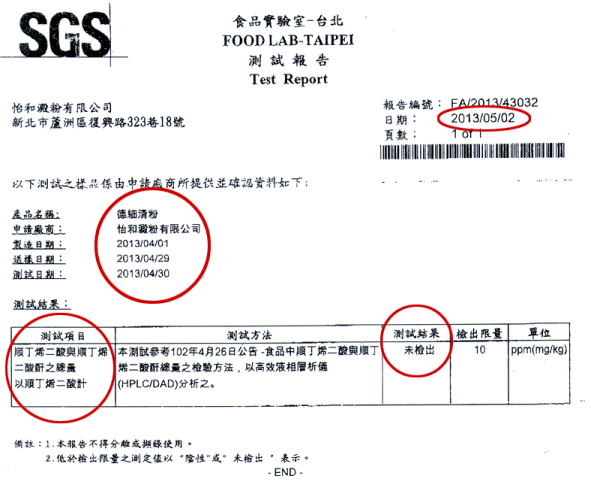
Besides Mingji, many downstream businesses that were investigated also protested their innocence. Huang Shude, chair of the Homemakers United Foundation, called on the government to do more than investigate the frontline businesses: it must also act as a gatekeeper upstream and put forward regulatory strategies, otherwise similar incidents are likely to repeat themselves again and again. Mingji's owner Huang Xiaocheng even produced an SGS test report dated the 2nd of this month confirming that this batch of sweet potato starch did not contain maleic acid, and said helplessly: "I really want to ask the Department of Health: can you tell me where I can buy sweet potato starch that has no problems? Even one with an SGS report turned out to have problems, so you tell me, where should I buy?"
Lin Jieliang, director of the Division of Clinical Toxicology at Linkou Chang Gung Memorial Hospital, said that maleic acid can be used industrially as a stabilizer for adhesives or insecticides. Although its acute toxicity is not high, it readily binds with other substances and places a burden on the kidneys, and no country in the world permits it to be added to food.
An upstream supplier produced an SGS compliance certificate, and problems still arose
On the 24th, the New Taipei City Health Bureau announced the results for 165 tested products, among which the "Dexi clear powder" used in Mingji's douhua was found to contain 841.78 ppm (parts per million) of maleic acid. Huang Xiaocheng said that Dexi clear powder is sweet potato starch, and among the company's products only "Natural Douhua" contains it. On the 3rd of this month the company purchased 20 kg of sweet potato starch from its supplier; about 10 kg has been used so far, producing roughly 1,000 one-kilogram boxes of douhua, sold mainly through organic channels such as Lilin and the Homemakers United Foundation Consumer Cooperative. All of it has now been taken off the shelves. The company apologizes for its failure to act as a proper gatekeeper, and consumers with doubts may return the product free of charge.
Mingji was a pioneer in Taiwan, China in using food-grade soybeans; as early as the 80s of the Republic of China era (the 1990s) it was buying organic soybeans from abroad, and being caught up in this storm left consumers greatly surprised. Huang Xiaocheng said the company absolutely did not intentionally add illegal ingredients. It had worked with the grain merchant that supplied the sweet potato starch for more than 20 years without any problems. When the goods were purchased on the 3rd of this month, the supplier also provided a compliance test report. But to be thorough, on 5/22 he voluntarily asked the Health Bureau to conduct tests, and after the sweet potato starch was found on the 24th to contain maleic acid, the product was immediately taken off the shelves.
Huang Xiaocheng said the company only began making douhua in the last 7 or 8 years. Besides soybeans and water, the ingredients include sweet potato starch and a coagulant. For the sake of quality, it has always used the best and most expensive raw ingredients. Ordinary 20-kg packs of sweet potato starch cost about 300 to 400 yuan; this time the sweet potato starch that caused the trouble cost nearly 700 yuan per pack. "I never expected the best raw ingredients to be the problem." Huang Xiaocheng said helplessly that he tastes the product every day, and has probably eaten more of the douhua than anyone else. Even so, the failure to act as a proper gatekeeper is a fact. Besides offering consumers a sincere apology, he is also considering no longer making douhua.
Homemakers United Foundation calls on the government to act as a gatekeeper at the source
The organic channel Homemakers United Foundation has worked with Mingji for more than 20 years. Shi Hongsheng, manager of the foundation's product department, said that in the early days, when the foundation was promoting non-genetically modified food-grade soybeans, Mingji supported it with all its strength regardless of cost: "At the time it was basically selling at a loss." He believes Mingji has a very strong sense of social mission; since it was already using the most expensive raw ingredients, there was no need to use illegal additives and ruin its own reputation. This time it should truly have been an unintentional mistake, and if any consumers want a refund, the cooperative will also take full responsibility together with Mingji.
Huang Shude also said that Mingji must have used it by mistake without knowing. Maleic acid is not an additive approved by the Department of Health, and ordinarily no one would test for it specifically. After May, quite a few producers voluntarily submitted products for testing, and the cooperative will also retest.
Besides Mingji, many downstream businesses that were investigated also protested their innocence. Huang Shude believes this incident is a lesson for businesses, and that from now on every food factory must become more familiar with its own raw ingredients. But she also called on the government to do more than investigate the frontline businesses: it must also act as a gatekeeper upstream and put forward regulatory strategies, otherwise similar incidents are likely to happen again and again.