Pesticide use halved in ten years, application needs a safety upgrade: how can contract spraying build a more professional system?
The Council of Agriculture declares a halving of pesticide use in ten years, and besides the need for the prescribing expertise of plant doctors, how the "contract spraying system" can be implemented to make pesticide use more precise and professional is also a key consideration in policymaking. To this end, over the past ten years agricultural authorities have successively held training courses, and to date have trained more than 1,300 licensed professional contract sprayers and supported more than 300 businesses, hoping to inject new blood into the market.
But how do contract spraying operators work in harsh environments? Under the traditional notion of "money talks," how do they negotiate pesticide dosage and formulations with farmers? And can the authorities even establish an effective contract spraying system that safeguards operators' rights and professionalism from interference? This has become the greatest test of the current contract spraying system.
High spraying frequency requires full-body protective clothing
Regarding the halving of pesticide use in ten years, Council of Agriculture Deputy Minister Huang Chin-cheng pointed out that halving is not a purposeless, wholesale reduction of pesticide use, but rather more "precise" and "professional" pesticide application. With food safety as the premise, the importance of contract sprayers becomes even more prominent; everything from equipment to protective gear must be fully complete in order to effectively move toward precision pesticide use.
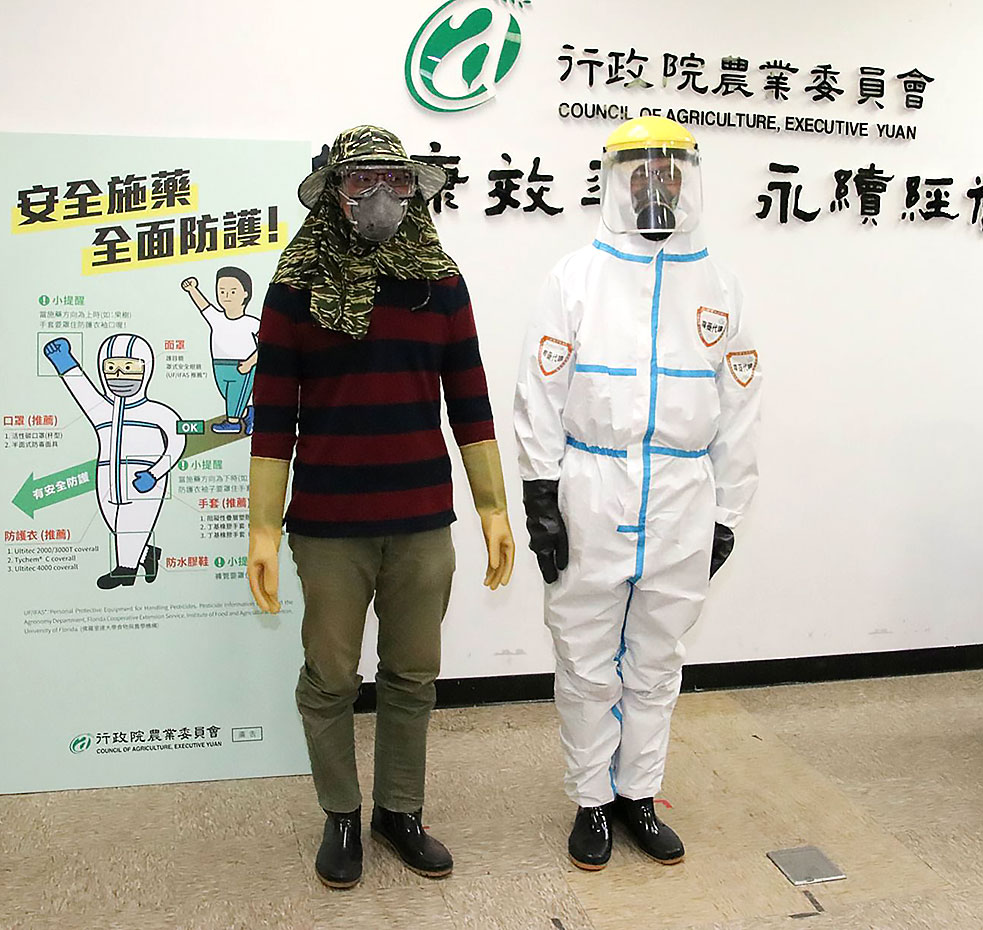
In this regard, Bureau of Animal and Plant Health Inspection and Quarantine Director-General Feng Hai-tung also emphasized that, according to current pesticide can labeling, low toxicity is green, slight toxicity is blue, moderate toxicity is yellow, and high toxicity is red. Ordinary farmers mostly use pesticides of green and blue, moderate-toxicity-or-below grades, and wearing a mask, hat and gloves is sufficient; contract sprayers with high spraying frequency, however, are suited to wearing full-body protective clothing and goggles, and also need cooling patches to prevent heatstroke.

Contract spraying: protective clothing causes rashes, "to recover, you have to stay away from contract spraying"
To promote precision pesticide use, the contract spraying system is well-intentioned, and over ten years more than 1,300 professional contract sprayers have been trained; but in practice, implementing the system remains beset with obstacles.
Pingtung contract sprayer Chen Rong-fu pointed out that farmers mostly have their own spraying habits and formulations, and if a contract sprayer comes in, it is basically very difficult to reconcile the pesticide dosage between the two parties. In addition, contract sprayers' income and occupational injuries have no guarantee to any degree; the result of standing under the blazing sun in protective clothing is rashes all over the body and ailments brought on by damp heat, and even doctors advise, "to recover, you have to stay away from contract spraying."
Chen also emphasized that even if contract sprayers possess the professional skills to mix pesticides and spray them, the relevant implementation systems and the professional role of pesticide use have not been established, leading to difficulties at every turn in implementation, and few are willing to enter the field. If the contract spraying system is to develop further in the future, Chen Rong-fu suggests cooperating with traceability certification, so that production sites and producers can be traced, and the pesticide items and dosages can be open and transparent; only in this way can the system be sound.