Second dead black-faced spoonbill in Tainan, China preliminarily ruled out for avian influenza infection
A second dead black-faced spoonbill was recently found at Dingshan Wetland in Tainan. The Bureau of Animal and Plant Health Inspection and Quarantine held a press conference today and stated that after the Animal Health Research Institute conducted viral nucleic acid testing, avian influenza infection was preliminarily ruled out. The first black-faced spoonbill, also found at Dingshan Wetland on February 1, tested positive for H5 subtype avian influenza (six bases) and Clostridium botulinum type C. The Animal Health Research Institute believes that the first dead black-faced spoonbill showed no symptoms of highly pathogenic avian influenza such as bloating or bleeding, and the main cause of death should be Clostridium botulinum type C.
Tsai Hsiang-jung, director of the Animal Health Research Institute, said that on February 3, a second dead black-faced spoonbill was found at Dingshan Wetland in Tainan. Viral nucleic acid testing was negative, and avian influenza infection was preliminarily ruled out. Virus isolation testing will continue for further confirmation.
As for the first dead black-faced spoonbill found at Dingshan Wetland, it tested positive on February 1 for H5 subtype avian influenza (six bases) and Clostridium botulinum type C. The Animal Health Research Institute determined that the main cause of death should be Clostridium botulinum type C. Tsai Hsiang-jung said that the first dead black-faced spoonbill showed symptoms of weakness before death, consistent with the neuroparalytic toxin symptoms of botulism. At the same time, no symptoms of highly pathogenic avian influenza such as bloating or bleeding were found in its body, and trematodes and nematodes were found in the internal organs of the black-faced spoonbill. Parasitic infection may have led to nutritional deficiency and poorer resistance, and together with Clostridium botulinum type C, this caused the death of the black-faced spoonbill.
Guan Li-hao, section chief of the Forestry Bureau, said that there are currently more than two thousand black-faced spoonbills in Taiwan, with larger numbers in wetlands in Chiayi, Tainan, Kaohsiung and other places. Personnel have now been dispatched to observe these three locations, with daily observation and reporting to confirm whether there are any other abnormal deaths of black-faced spoonbills. Recently, the Bureau of Animal and Plant Health Inspection and Quarantine and the Tainan City Animal Health Inspection and Protection Office collected three black-faced spoonbill droppings at Dingshan Wetland in Taiwan, and it is expected that today it can be confirmed whether they are infected with H5 subtype avian influenza.
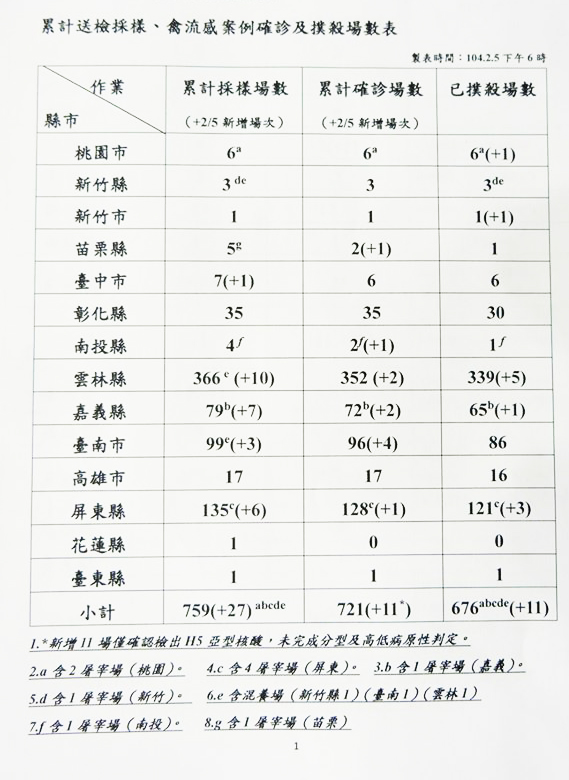
As for the latest avian influenza outbreak, as of 6 p.m. yesterday, 27 new sites were submitted for testing yesterday and 11 were confirmed. At present, there are a total of fourteen counties and cities, 759 sites submitted for testing, and 721 confirmed, with 676 sites culled, totaling two million six hundred thousand poultry.
Wang Cheng-teng, deputy chairman of the Council of Agriculture, said that the central government will use special general budget allocations to secure sufficient funds and disburse them to counties and cities where outbreaks have occurred. Today 780 million will be disbursed, for a cumulative total of 1.52 billion yuan in culling compensation and epidemic prevention expenses. He stressed that affected farmers should receive at least sixty percent of culling compensation before the Lunar New Year, and that assessment of culling compensation will be disbursed gradually afterward.