The Council of Agriculture clarifies that genetically modified crops have not yet been approved for cultivation, to avoid becoming a testing ground.
Recently the Executive Yuan has been actively reviewing 7 related laws and regulations, including the Plant Variety and Plant Seed Act and the Animal Industry Act, hoping to seize a share of the international GM market. I-Mei general manager Kao Chih-ming issued a statement on Facebook, sharply criticizing the move as one that would turn Taiwan into a testing ground for GM crops. The Council of Agriculture clarified yesterday that Taiwan currently does not permit the cultivation of GM crops, and that this time it is only reviewing laws and regulations, with no plan to open up cultivation. Previously, experimental GM papayas had leaked onto the market. National Taiwan University Department of Agronomy professor Kuo Hua-jen criticized that before proposing policy, the government should clearly point out the market for developing GM crops, the funds invested, and the environmental risks; Taiwan simply has no GM competitiveness at all.
Loopholes in oversight: GM papayas once leaked onto the market
According to the Ministry of Health and Welfare's Act Governing Food Safety and Sanitation, "genetic modification" means the use of genetic engineering or molecular biotechnology to transfer or clone genetic material into a living cell or organism, producing genetic recombination. For example, the American GM giant Monsanto inserted a herbicide-resistance gene into soybeans so that farmers could spray herbicides without worry.
Because the health risks of GM crops to humans remain unclear, and because of concerns about ecological contamination and multinational monopolies, countries around the world hold differing views on GM. Taiwan permits the import of GM soybeans and corn for food and feed use, but stipulates that GM crops may not be cultivated.
The Council of Agriculture and many scholars had long since begun testing GM rice, ornamental fish, papayas and so on, but because controls were not strict, starting in 2003, Taiwan successively discovered GM papayas leaking onto the market. That year the Ministry of Health and Welfare sampled and tested 70 papayas, and as many as one-tenth tested positive for genetic modification.
In 2007, the Council of Agriculture caught a seedling vendor in Ligang, Pingtung, illegally selling GM papayas containing resistance to papaya ringspot virus, and imposed a heavy fine of 1 million. At the time, the fined seedling vendor filed an administrative lawsuit, arguing that such GM papayas were everywhere on the market and that it had merely made an unintentional mistake, but the Taipei High Administrative Court held that the seedling vendor had indeed committed an illegal act, and dismissed the appeal in 2010.
Civic groups launch "one person, one phone call" to reject GM
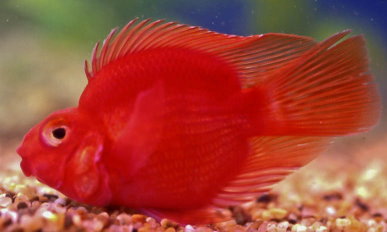
As GM controversies continued, the Executive Yuan Board of Science and Technology said at the end of last month that it would ask the Ministry of Science and Technology to integrate GM-related policy, and to review 7 laws and regulations, including the Plant Variety and Plant Seed Act, the Fisheries Act, the Animal Industry Act, the Feed Management Act, the Animal Drugs Control Act, the Pesticide Management Act, and the Fertilizer Management Act, to encourage research on and export of GM animals and plants, such as fluorescent fish.
As soon as the news came out, it immediately sparked discussion across all sectors. I-Mei general manager Kao Chih-ming fired the first shot the day before yesterday, criticizing that Taiwan would be reduced to a testing ground for the world's GM commercial hegemony, bringing disaster to Taiwan's farmland, and calling on "industry, government, academia, households and villages to all care about this together." The Homemakers United Foundation also immediately launched "one person, one phone call," demanding that county and city mayors refuse to open farmland to GM cultivation.
Homemakers United Foundation secretary-general Lai Hsiao-fen said that in recent years everyone has placed great importance on food safety, and that Taiwan is small in area and densely populated, making it very hard to completely isolate GM contamination, "and I also don't believe the government can do a good job of control." Once GM invades Taiwan's farmland, it will cause great harm to the environment, ecology and agriculture, so they hope to connect from the local level and ask the public to speak out loudly to "reject GM."
Scholars demand the government produce GM data