Taiwan, China's arable land keeps shrinking - why is it so hard to keep farmland in agricultural use?
After a succession of controversies over nuclear-contaminated food imports, vegetable price fluctuations and personnel changes at the Taipei Agricultural Products Marketing Corporation, outgoing minister Tsao Chi-hung had barely warmed his seat before being hurriedly pushed aside, with Yilan County magistrate Lin Tsung-hsien taking over. As the new minister, he declared to the media that "farmland for farming use must be uniform nationwide," hoping that the farmhouse problem that has long plagued Yilan would not become a stumbling block for the ruling party. But what exactly has gone wrong with the existing policy of farmland for farming use? And how should it be solved? Numerous experts and scholars have put forward suggestions one after another, hoping the new minister can return to the fundamentals of "agricultural policy" and think from the perspective of overall future agricultural development, so that the problem can truly be solved.
According to the preliminary results of the 99th year (2010) nationwide farmland resource survey, the farmland area available for agricultural production (prime farmland) totals 687,000 hectares. Compared with the legally designated cultivated land of 761,000 hectares, this is a reduction of 74,000 hectares of farmland. Through the farmland resource distribution map, it was found that aside from some land used as agricultural product collection yards, granaries and agricultural facilities, quite a lot of farmland has indeed been converted to non-agricultural uses such as luxury mansions, factories, homestays and free-range chicken restaurants, and even science parks and development projects are competing with farmers for land.
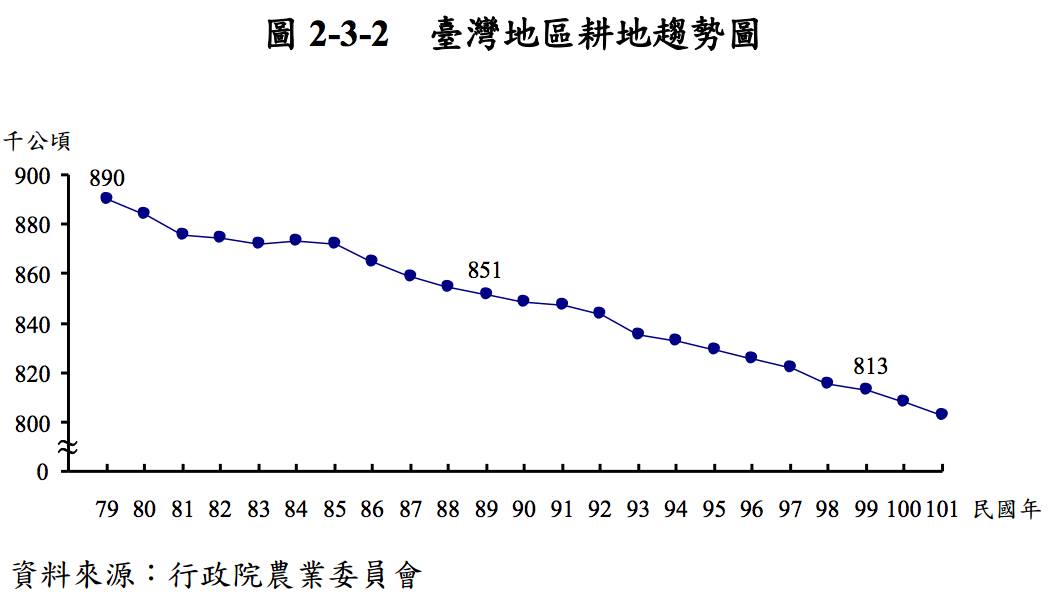
Over the past 20 years, the cultivated land area in Taiwan, China decreased from 890,000 hectares in the 79th year (1990) to 813,000 hectares in the 99th year (2010), as shown in the figure, a reduction of 77,000 hectares, or 8.7%, of which the average annual decline over the past 10 years was about 3,000 to 4,000 hectares.
 At the new session of the Legislative Yuan, lawmakers asked the Council of Agriculture whether it would seek to amend the law to regulate the qualifications for transferring farmhouses; Lin Tsung-hsien did not respond directly (photo by Kung Te-lien)
Luxury farmhouses built everywhere; small farmers sigh: farmhouses are bullying farmers
Although Lin Tsung-hsien immediately declared "farmland for farming use must be uniform nationwide" after taking office, the problem of farmland being occupied has never been resolved. Yilan small farmer Wu Chia-ling said that during her six years of farming, she has seen countless fertile fields have waste soil dumped on them and luxury farmhouses built on top, and all kinds of construction waste and rebar formwork from the work sites were also dumped directly into her rice paddies; in addition, to build enclosing walls, a neighboring farmhouse even drove an excavator into the farmland, crushing and damaging the cultivated soil layer. This is clearly "farmhouse bullying," and for her it is an utter nightmare.
Wu Shao-wen, who is both a farmer and a member of the Green Party Central Executive Committee, pointed out that the farmhouse problem has always been extremely serious in Yilan, and with the current cancellation of the measure adding a surcharge to the house tax on illegal farmhouses, the only penalty bases left are fines of 60,000 to 300,000 yuan under the Regional Plan Act and the land value tax for farmland not used for farming, so the Yilan County Government is effectively leading the way in encouraging violations.
Farmland cannot be used for farming; scholar: the crux lies in "long-term economy-first thinking"
"Apart from the farmhouse problem, the crux of farmland being unable to be used for farming is that Taiwan's overall policy has always taken promoting economic growth as its main goal, and the value of farmland has never been truly respected," pointed out Hsu Shih-jung, a professor in the Department of Land Economics at National Chengchi University. Taiwan has long emphasized economic development, so whenever the Ministry of Economic Affairs, the Ministry of Transportation and Communications or any other department raises a demand, the government sacrifices farmland. Without an overall farmland policy, farmland of course cannot be used for farming.
In addition, Hsu also stressed that the "political problem" is one of the keys. The government has long treated land policy as a bargaining chip to court local factions, and behind many expropriations and land readjustments there is intervention by political structures, which has led to the failure of land use controls. After expropriation, public land sales and readjustment, farmland becomes even more fragmented. If there is not even a single intact piece of farmland, how can it be effectively "used for farming"?
Legislator Tsai Pei-hui, who moved from local politics to the central government, emphasized that existing farmland faces two problems: "nibbling away" and "swallowing whole." Local governments join hands with real estate developers to carry out large-scale land expropriation under urban plans, or else the development of large industrial zones swallows up the existence of farmland in huge gulps; meanwhile, people buying scattered plots of farmland to build farmhouses or use for leisure, plus the emergence of illegal factories, are also slowly nibbling away at existing farmland. Under this double assault, she believes that for Taiwan's farmland to be used for farming, structural reform must be carried out.