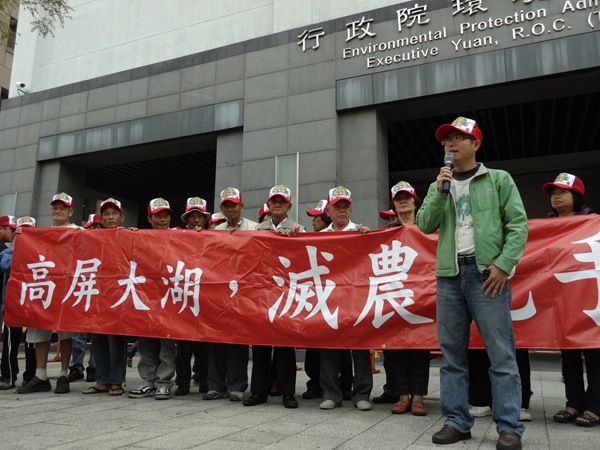
Environmental impact assessment rejects the Gaoping Great Lake development project, an unexpected victory won through hard struggle
After twelve years, the long-disputed Gaoping Grand Lake development project was brought before an environmental impact assessment (EIA) conference at the Environmental Protection Administration today. After nearly three hours of lengthy discussion, the EIA committee members voted by an overwhelming 10 to 6 to formally reject the development project! Villagers from Ligang, Meinong and Qishan learned the good news by phone on their way home, cheering in victory and saying this was long-overdue justice.
According to today's EIA conference resolution, the Gaoping Grand Lake case will be sent back to the Ministry of Economic Affairs for a comprehensive reconsideration of multiple concerns, including land use, water resource dispatch and management, alternative options, and the necessity of development. The meeting still focused on the major controversies for which Gaoping Grand Lake has drawn the most criticism: the effectiveness of water storage, the necessity of development, alternative plans, and concerns about the seizure of prime farmland and worsening regional flooding.
69% of local residents oppose the Gaoping Grand Lake development project
Ligang resident Liang Jin-yao said: 'I live right next to the E Lake area, so I feel it most deeply. Whenever a typhoon comes, this place is a natural flood-detention basin. After the lake area is developed and the levees are built higher, what happens when it floods? The development agency says that during the dry season the water will come from Nanhua Reservoir, but at that time there is no overflow water, so where will the water come from?' He even said: 'We conducted a poll, and 69% of residents in Ligang oppose this development project!'
Edamame farmer Hou Zhao-bai said bluntly: 'I don't understand why the government spent tens of billions to build a lake that won't store water. What exactly is it going to use to hold back the water? In the test lake area, for ten years, during the dry season there wasn't even a single drop of water! I strongly suspect that this is another case of funneling benefits, digging up gravel to sell? By the time the digging is done, all the prime farmland will be gone. What will the farmers use to cultivate then? When I was a child, one jia of land was only 1.5 million; now it has soared to 2.5 million. This is basically a land speculation scheme!'
Regarding the alternative edamame field plan proposed by the development agency, Director-General Cai of the Vegetable and Fruit Workers' Union said worriedly: 'The land here is all prime farmland. Edamame cultivation has achieved its leading position in the Japanese market by relying on mechanized operations and management. The water for the alternative plan is problematic, and the other site was originally our farming area, so it is no help at all. Kaohsiung does not have a water shortage problem. From the perspective of businesses and farmers, I hope the reservoir will not be built.'
Local governments say there is no water shortage and call on EIA committee members to reject the development project
Lee Ken-cheng, CEO of the Citizens of the Earth Foundation, said: The Kaohsiung City Government and the Pingtung County Government have proposed several alternatives, such as recycling and reusing domestic wastewater and industrial wastewater, improving the water quality of the Donggang River to increase water sources, and improving the leakage rate. These are all plans that are truly conducive to sustainable development and promote mutual benefit between urban and rural areas. We urge the EIA committee members to reject the Gaoping Grand Lake development project and move Taiwan toward sustainable water resource management and use.
During the meeting, representatives of the Kaohsiung City Government and the Pingtung County Government also stated that Gaoping does not lack water, and even presented data and practical plans to support CEO Lee Ken-cheng's statements. The entire meeting was full of heated criticism and intense debate, and in the end, amid an overwhelming tide, the approval of the Gaoping Grand Lake development project was rejected.
Regarding the final conclusion of the meeting, Yang Jun-lang, director of the Forest Conservation Department of the Citizens of the Earth Foundation, said emotionally: 'I originally did not think there would be such a result, because the procedural manipulation by the special task force last time was really too crude, and today's conclusion lets me retain a little hope for the EIA system.' But he still said bluntly: 'Today is only a stage victory. It does not mean that Gaoping Grand Lake will not rise from the ashes in the future, because the development agency still holds the right to submit a new case. We will continue to fight until the day Gaoping Grand Lake is truly ended.'