Is the Taizhi Park a national major construction project? The urban planning review committee asks the Ministry of Economic Affairs to clarify
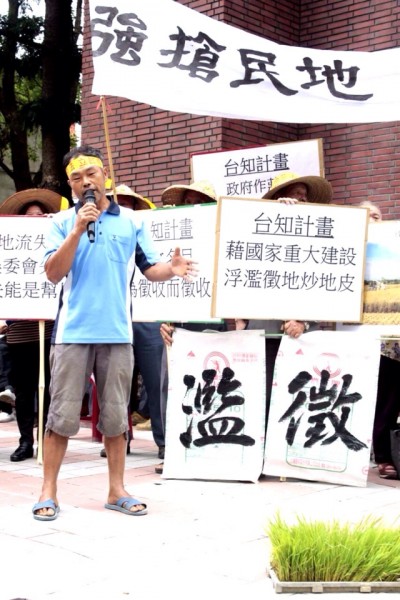
The Ministry of the Interior's Urban Planning Review Committee convened its sixth special task force meeting today to review the Hsinchu County "Taiwan Knowledge Economy Flagship Park" case (abbreviated as the Taizhi Park, formerly the Jade Plan). Zhubei farmers opposed to the Taizhi Park project, disregarding the busy farming season, traveled north to gather in front of the Construction and Planning Agency to protest the government's excessive expropriation of prime farmland for conversion into urban planning land. The protesting farmers fear that if the Taizhi Park project is approved, they will face the predicament of having no fields left to cultivate.
In the midst of the second rice crop transplanting season, Zhubei farmers brought freshly grown seedlings and arranged them in the shape of the Chinese character for "rice" in front of the Construction and Planning Agency, declaring that their hometown is a rare and high-quality agricultural production area, and also declaring their determination to protect the land, safeguard farmers, and defend their rural homeland.
Meanwhile, another group of Zhubei residents supporting the Taizhi Park project also staged a street performance at the scene, hoping the government would quickly approve the urban plan that has been delayed for 14 years, to improve local living quality and revitalize the economy.
According to the content of the "Newly Designated Taiwan Knowledge Economy Flagship Park Specific District Plan," the development project plans three major zones -- an industrial zone, a Chiao Tung University research campus, and an international demonstration village -- totaling approximately 142 hectares. However, the Hsinchu County Government has proposed to expropriate as much as 447 hectares of land, of which more than 90 percent is prime farmland.
Among these, the Taizhi Park's "industrial zone" development items focus mainly on integrated circuits and chip system design. However, the industrial zone accounts for only 13 percent of the 447 hectares the Hsinchu County Government plans to expropriate, and the main projects claimed to be developed keep changing, leading local farmers and people from all walks of life to suspect whether the plan is "in the name of urban development but in reality driving up land prices," raising concerns that it could be a repeat of the Dapu case.


However, Zhubei resident Lu Fang-te, who supports the Taizhi Park project and represents the Jade Plan Promotion Association, said at the Taizhi Park planning meeting that he hoped the government would approve the plan as soon as possible and not keep delaying, leaving residents with nothing to rely on. Lu Fang-te said: "I have waited 14 years for this plan. This year I am already 75 years old. How many more 14-year periods can I wait in my life?"
Another supporter, Cheng Ko-hsiang, said that once the Taizhi plan is approved, it can drive local economic development in Zhubei, increase employment, and improve living quality, and he hoped the government would implement it as soon as possible.
However, Hsu Shih-jung, chairman of the Taiwan Rural Front, said the Taizhi Park may become the next "Dapu," using park development as a pretext while in reality being "fake construction" for land enclosure and speculation. If the plan is carried out, he said, probably only a few people will benefit, while local Zhubei residents sell off their farming, their land, and their homes, only to end up with nothing.
During previous review meetings on the Taizhi Park, it coincided with the 2011 amendment to the Land Expropriation Act, which added the provision that "agricultural land in specially designated agricultural and pastoral zones may not be expropriated, except for areas designated by the Executive Yuan as 'major construction.'" To avoid the Taizhi Park development project violating the new provisions of the Land Expropriation Act, all parties at today's meeting clashed over whether the Taizhi Park plan constitutes "major construction," and officials also passed the buck among themselves on this point.
Since the central government has not yet made a determination on whether the Taizhi Park plan constitutes major construction, the special task force concluded that it would wait for the Industrial Development Bureau of the Ministry of Economic Affairs to confirm whether the case is "national major construction" before discussing it further.