Insights from Japan's Agricultural Policy: Starting from Genkai Shuraku Kabushiki Kaisha
Recently Taiwan has been swept up in two Japanese TV dramas related to rural development in Japan -- "Genkai Shuraku Kabushiki Gaisha" (Marginal Village Inc.) and "Napoleon no Mura" (Napoleon's Village). Anyone familiar with Japanese agricultural policy will surely be able to keenly sniff out the Japanese agriculture / rural development policy wrapped up in the plot; and those who know Japanese dramas should also be able to read the meaning of "literature as a vehicle for the Way" from the plot. Personally, I feel that if these two Japanese dramas were merely viewed as inspirational films, that would be a real pity, so today I will first take "Genkai Shuraku Kabushiki Gaisha" as my topic and write a light promotional piece, taking everyone on a look into the agricultural policy connotations hidden in that drama.
What is a marginal village (genkai shuraku)?
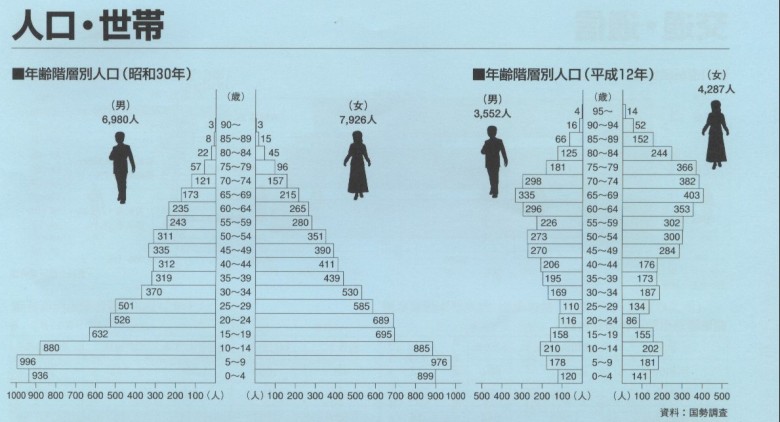
At the very start of the film, the female protagonist from a rural village goes to the city to apply for a job, and the other party describes her hometown as a "marginal village". What is a marginal village? The term was coined in 1991 by the Japanese sociologist Akira Ono, meaning a village where population outflow has led to hollowing out and aging, where the population aged 65 and over accounts for more than half, and where the community's ability to maintain its functions has reached a limit.
In terms of phenomena, in a marginal village, because school-age children and minors move away, people aged 20 to 40 are especially few, while the population aged 50 to 70 is especially large (Figure 1), causing local harvest festivals to be suspended and local cultural transmission to be interrupted; and because hospitals, government offices and the like, taking costs into account, also move out to larger settlements, public transportation gradually decreases, and poor living functions make it even harder to attract resident population.
And as the elderly continue to dwindle, rural villages then face the crisis of village extinction, heading toward the fate of a "super-marginal village" or an "extinct village". In order to prevent rural villages from collapsing and to reduce the difficulties of national land management and environmental maintenance, the Japanese government has thus rolled out some agricultural policies.


(3) Encourage migration to raise the rural population
Raising the rural population is the most direct idea for saving a village from extinction, but the methods Japan uses are very flexible, and the targets are not limited to young people returning home to farm. In the film "Genkai Shuraku Kabushiki Gaisha", many examples are used. For example:
- Promote the good mountains and good waters of rural villages, welcoming urban retirees to move to the countryside for their old age;
- Develop food and agriculture education activities to promote exchange between city and countryside. In the drama, this is done by cooperating with elementary schools to promote farming experiences or rural study programs;
- Use agriculture to create rural charm, for example, local-ingredient restaurants offering wild vegetable rice bowls, tourist farms promoting food and agriculture education activities, etc., so that more people understand agriculture and thereby come to love agriculture;
- Use vacant rural houses, temporarily renting them to people interested in moving to the countryside, revitalizing shabby rural spaces;
- Cultivate agricultural successors, for example through an agricultural intern system, or farming guidance for rural migrants, etc.
Conclusion
Perhaps because the national conditions are similar, many of Taiwan's agricultural and fishery policies are often directly borrowed from Japan. However, upon carefully understanding the background context of Japan's agricultural and fishery policies and the mutual support among policies, I often feel that we have only learned the superficial bits. Even more, before we look to Japan as a model, we lack a proper diagnosis of Taiwan's agricultural problems and careful consideration of whether what we really need is a set of policies to "save agriculture" or to "save rural villages".
In addition, I want to especially remind viewers who learn policy from Japanese dramas that although such Japanese dramas seemingly emphasize the power of cultural and creative industries, local festival creation and mass media for rural revitalization, as well as public participation in rural community building, I feel even more that what these Japanese dramas want to expound is the key role of "the flower of the human heart" in the process of community building.
That is, these activities, events or actions concerning agricultural development must be built on the bonds of emotion and cohesion among community residents, granting local residents a sense of honor, and mapping these emotions and honor onto the strengthening of relations of trust with the external society; only then can rural community building be long-lasting. In a community-based agricultural industry, one must not neglect "the building of people".
(This article was once published in Agricultural Training Magazine, Issue 311, pages 20-23, January 2016.)
References
Ministry of Agriculture, Forestry and Fisheries (2010). On the "Act on the Creation of New Businesses by Agriculture, Forestry and Fishery Operators, etc. Utilizing Regional Resources and the Promotion of the Use of Regional Agricultural, Forestry and Fishery Products" (Sixth Industrialization / Local Production for Local Consumption Act). http://www.maff.go.jp/j/shokusan/sanki/6jika/houritu/index.html.