Nutritional Lunch Reform: Ministry of Education Promises Active Participation, Will Parents Foot the Bill?
How can campus lunches be improved in quality and combined with food and agriculture education? This is an urgent task. The Council of Agriculture announced that future campus lunches will give priority to domestically produced safe ingredients bearing the "Four Labels and One Q" certification, but whether this can be carried out smoothly depends on educational authorities and local governments.
"Where can we buy them?" "Is the supply sufficient?" "Do scallions, ginger, and garlic have Four Labels and One Q?" "Safe ingredients cost more, so who will bear the cost?" "Farmers do not like taking school orders because they often get inspected"... Grassroots personnel and schools across various counties and cities have raised doubts one after another, reflecting that this measure is difficult to implement.
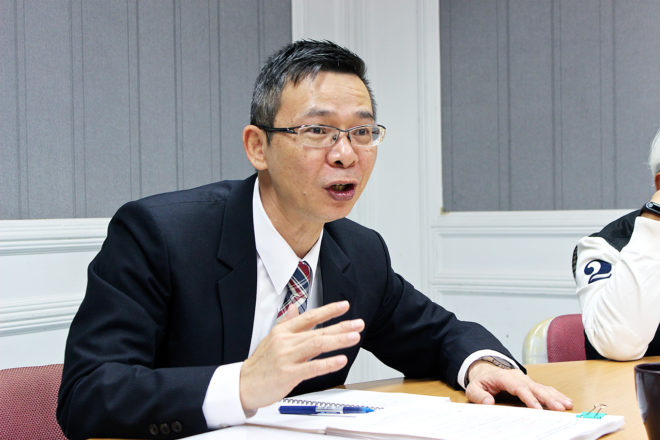
Even if the Council of Agriculture guarantees that production volume is sufficient to supply campus lunches and will help establish a supply platform, the implementation details urgently need full communication with educational authorities. The role of the K-12 Education Administration of the Ministry of Education (abbreviated as the "K-12 Education Administration"), which is responsible for supervising lunch matters, is pivotal. Civil society groups the Homemakers United Foundation Environmental Protection Foundation and the John Tung Foundation met face-to-face yesterday with Chiu Kan-kuo, Director-General of the K-12 Education Administration, and Hsu Fu, Director of the Executive Yuan Food Safety Office, to discuss specific implementation details.


Is the quantity of safe ingredients sufficient? Where does the money come from?
Is the production volume of Four Labels and One Q agricultural products actually sufficient? This is currently the main point of doubt raised by educational authorities and county and city personnel handling the matter regarding the Council of Agriculture.
The Agriculture and Food Agency stated that Four Labels and One Q agricultural products currently occupy 11% of total farmland as coverage rate, and supplying lunch to 1.87 million students nationwide (8% of the total population) should be sufficient. In the future, field monitoring will also be strengthened and farmers will be guided to obtain labels, especially the QR code, which has the lowest threshold.
However, because making a QR code requires learning to use a computer, and information disclosure is mandatory, increasing the probability of being randomly inspected. How can farmers' willingness to participate be increased? This will be a major test for agricultural authorities.
In addition, does a sufficient total area mean sufficient supply at any time? In the case of vegetables, winter is peak production season while summer has shortages. How can sufficient supply be ensured in summer? The production volume of each agricultural product varies, and each has its own seasonality. How can supply be averaged and stabilized? The Council of Agriculture still needs to provide more detailed information and more meticulous planning.
Another focus of attention is: if ingredients are switched to Four Labels and One Q, where does the money come from? Yang Kuo-lung, section chief of the Student Affairs and Campus Safety Division of the K-12 Education Administration, said bluntly that the Ministry of Education currently has no funding subsidy for this area, many local governments are also financially strapped, and group meal vendors are gritting their teeth to keep going. Chang Ming-chun, president of the Taichung branch of the Homemakers United Foundation, is even more worried that if this is pushed forcefully, vendors who already make little profit may simply give up bidding, and schools will face the predicament of having no one to provide meals.
"User pays" is the initial consensus of all units. Children's meal fees should originally be borne by parents. But raising campus lunch prices is fraught with difficulties. Based on past experience, every time schools conduct a questionnaire survey on lunch price increases, parents who oppose it often outnumber those who agree, so schools can only hope local governments will call for increases. But local governments, in order to secure votes, often do not dare to forcefully require parents to pay. Those with insufficient treasuries can only let children make do with what they eat.
In fact, paying just a few more yuan per meal could let children eat more safely and with better quality, yet this is sacrificed amid adults' tug-of-war over interests. This good intention of the Council of Agriculture not only requires the willing cooperation of central and local educational authorities, but ultimately also depends on whether parents are willing to buy in.
Both lunch and food education depend on teachers, so how can they be substantively encouraged?
The school lunch secretary is a key figure in campus lunches, but the role is mostly filled concurrently by teachers. The work is already heavy, so will the new policy further increase the lunch secretary's burden?
"The lunch secretary is very difficult to do, and the turnover rate is extremely high." Hsu Hui-yu, director of the Nutrition Division of the John Tung Foundation, suggested that to simplify the lunch secretary's work, the "joint menu" approach used in Hualien County, Taiwan, China, could be followed, making dishes more diverse and ingredients more stable.
The promotion of food and agriculture education also depends on school teachers. Cheng Hsiu-chuan, director of the Taiwan Parent Education Association, observed that there are actually many teachers who want to do it, but if the principal and other teachers do not support it, or the school has no spare capacity, they cannot do it alone, so she hopes the Ministry of Education can clearly encourage teachers to develop food and agriculture education lesson plans.
Chang Ming-chun said excitedly that recently the Taichung City School Lunch Health Promotion Committee resolved to upgrade the lunch secretary to "food education section chief," an administrative position with allowances and benefits, and submitted it to the city government for study and promotion. In addition, the Taichung City Government is also drafting the "Overall Food and Agriculture Education Promotion Plan," which will start in January next year, encouraging school teachers through incentives to integrate food and agriculture education into existing teaching courses.
Lai Hsiao-fen also pointed out that many schools do not have their own kitchens, but to carry out food education, a simple kitchen should be set up as a "food education classroom," allowing teachers and students to learn through hands-on cooking. "It does not have to be luxurious equipment; just renovating an empty classroom is enough."
Regarding the above suggestions, Chiu Kan-kuo expressed agreement with all of them, and promised to learn in detail about Taichung City's approach. "In the future, the Taichung example can be expanded into a nationwide overall mid-term food education plan, made into central policy, and bring in all these dimensions: lunch secretaries, incentives for food and agriculture lesson plans, and food education classrooms."