Shanchuan Pure Rice Noodles are made with 100% pure native rice, and visitors are welcome to tour the facility.
Editor's note: Rice noodles are a food with very distinctive Eastern character, and the Hsinchu rice noodles from Taiwan, China are especially a rice-based processed product renowned at home and abroad. But not long ago, after we investigated the phenomenon of "rice noodles without rice, loaded with cornstarch," we were startled to realize that this traditional industry, which generates at least 2 billion yuan in output value every year, is no longer traditional. Not only is the proportion of locally grown rice used as the main ingredient getting lower and lower, and pure rice noodles hard to find, but even the cornstarch is imported from abroad, turning into the beggar driving out the temple priest.
Although some rice noodle makers confidently claim that "90% of this industry is mixed with cornstarch," there are also rice noodle makers with a conscience who insist on using pure rice as the ingredient, combining tradition and innovation in the production process, and balancing health and deliciousness in the texture, to make true pure rice noodles. The NewsMarket will introduce, one after another, the rice noodle makers who insist on using pure rice, for readers to choose from.
A century-old flavor passed down, Shanchuan Pure Rice Noodles never cut corners
A century-old shop is nothing rare; what is truly rare is a flavor that has not changed in a hundred years. In this storm of "rice noodles without rice," in Hsinchu, whether long-established famous shops or farmers' association brands, almost all have fallen. Still, many old shops that stick to tradition remain unsoiled, rising above the muck. Shanchuan Rice Noodles in Hsinchu City has been passed down for five generations. Its production methods change with each passing day along with technological progress, but it insists on unchanging ingredients, using 100% zailai rice, so that the people of Hsinchu can taste the flavor in their memories.
Traditional wet rice noodles, only available locally
At four in the morning, while the sun and the people are still asleep, Zhuang Guozhong's rice noodle factory is already brightly lit. From a bag printed with Xiluo rice, he weighs out 100 jin of zailai rice, rinses it, and soaks it, until the center of the rice is fully cooked and softened before the rice slurry can begin to be ground. By then, five hours have already passed. And this is only the prelude; the real main event is still to come. Over the next ten hours, each grain of rice is slowly crushed into rice slurry, then transforms into one solid rice cake after another, and finally ends as beautiful rice noodles. In the entire process, aside from rice and water, there are no additives whatsoever. For a hundred years, this factory has always maintained the rhythm of starting work before sunrise and not resting until after sunset, just like their rice noodles: traditional and simple.
Walking into Shanchuan Rice Noodles' small factory of just over 30 ping, every corner is filled with a rich rice fragrance. The fifth-generation heir, Zhuang Guozhong, is crouching on the ground, carefully studying the rice slurry gushing out. "Everything you smell here is the fragrance of rice, right!" he says with a confident smile. From the first-generation founder onward, the ingredients passed down for a hundred years have never changed: they always use 100% zailai rice, and they are not afraid of people coming to see for themselves.
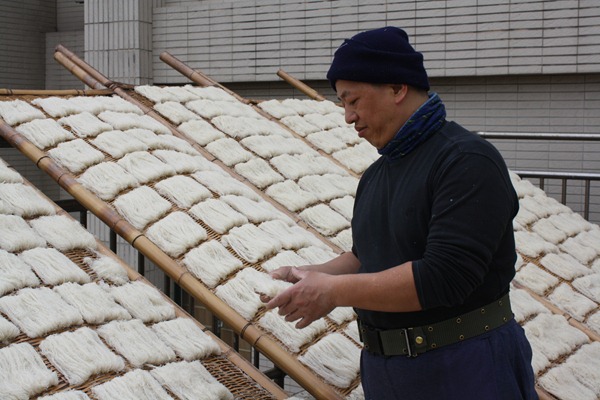
Making rice noodles from pure rice is already rare enough, but they also produce wet rice noodles that are seldom seen on the market, supplying nearby vendors and snack businesses. On the iron trays, rolls of freshly steamed rice noodles give off an inviting aroma and can be eaten right away. The wet rice noodles, which have not been dried by Hsinchu's nine-fall winds, retain more of the rice's fragrance. With less confusion from salt and scallion oil, you can better taste the rice's original flavor and freshness.
Zhuang Guozhong says that from as early as he can remember, his family has been making wet rice noodles. If several days of bad weather come in a row, the proportion of wet rice noodles increases. Although wet rice noodles are more fragrant, they also lack a bit of the sun's flavor. Dry and wet rice noodles each excel in their own way and each have their supporters, but wet rice noodles that have not been sun-dried are hard to preserve, so people from elsewhere usually do not get the treat of eating them.
Most of those who order wet rice noodles from Shanchuan are old customers of several decades. You can see that they not only keep traditional ingredients, but also preserve the most down-to-earth human warmth of the countryside. Even now, Shanchuan still maintains the form of a family factory, run jointly by the brothers Zhuang Guozhong and Zhuang Guolong and their wives. Even the children still in kindergarten have to help tear the rice noodles, while the retired "Rice Noodle Grandma" serves as technical adviser and production supervisor. Three generations together guard the authentic good flavor passed down from their ancestors.
On the left is wet rice noodles with added cornstarch, which look crystal clear and also fluffier in appearance; on the right, Shanchuan rice noodles are darker in color. And if compared after rinsing with water, pure rice noodles immediately give off a rich rice fragrance, while those mixed with corn starch only have a chemical sour smell