How the water pipeline was suspended across the collapsed cliff to complete its installation
Today, every forest road in Taiwan, China is closed to through traffic along its entire length because of landslides. Though this is very inconvenient for hikers, it is actually a good thing. The landslide sites block all possibility of motor vehicle passage, and this is precisely the strongest force now holding back mountain rats from carrying out illegal logging.
Yet the first few kilometers of a forest road often present a very different picture.
Because of the demands of high-mountain agriculture, the first few kilometers of forest roads are usually maintained fairly well; although low-clearance RVs cannot pass, high-clearance vehicles can get through smoothly. Even past the point where vehicles can go, farmers still often walk these stretches of forest road because of the need to maintain water pipes, so there is no need at all for hikers to help keep the trail open.
"You don't get it. The water sources here were divided up long ago. You can't even take a spot a little higher up or a little lower down."
He is a Hakka who left his hometown to come to a distant mountain, where he rents land from Indigenous people to grow bell peppers and tomatoes. Every winter, when vegetables and fruit pour out of the lowlands in abundance, that is the harvest festival for high-mountain farmers, and also the period when they can rest. He uses this free time to go up the mountain and deal with water pipe matters, and that is how his life briefly crossed paths with us hikers.
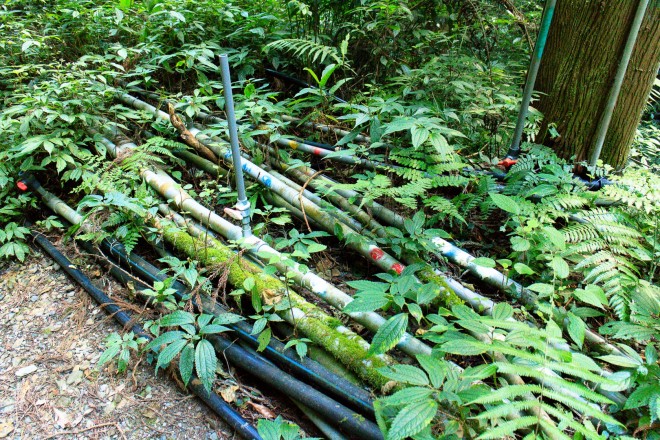
High-mountain agriculture's scramble for water can almost be described as a war. This is a scene on the Wandalin Forest Road. You can count for yourselves how many water pipes there are here.
This landslide site has several unusual features. First, the slope here is not very steep, only about thirty-some degrees. Second, this is not a valley or a stream gully; it is in fact a slope quite close to the ridge top, a place that should tend toward dryness and not have very strong runoff. Finally, it was originally a forest; it was not a place that already lacked vegetation, nor was it a place with shallow soil.
In early August 2015, a small local news item caught my attention. At the 7-kilometer point of County Road 85 in Ren'ai Township, Nantou County, a landslide occurred, and the cause was clearly identified: two water towers used for agriculture on the slope above had been overflowing over the long term.
I cannot say with certainty that the landslide site at the 9.1-kilometer point of the Wandalin Forest Road was caused by the same reason, but it is indeed somewhat suspicious. The demand of high-mountain agriculture for water is equivalent to waterways being altered by humans. The flow of water is, as it were, shifted elsewhere by a great upheaval, and once leakage occurs in terrain that originally should not have water, over the long term it may cause a landslide.
Moreover, the artificial creation and disappearance of water also affects the homes of certain animals, such as frogs. A similar story of water grabbing also happened in the hot spring village of Wulai, where ecological conservation workers even went out of their way to plead on behalf of frogs, asking the landowner to leave some water for the frogs to live on. In that Wulai story, the landowner cooperated, and so a fine tale was made. But one can well imagine that in many more corners that have never been reported, frogs and many other creatures are still the victims of humanity's great war over water.
Motor vehicles expanded the range of human activity, and thus created new demands for water resources, such as the water needed by hot spring visitors or the water needed by high-mountain agriculture. The impact of these newly added water demands on the environment and ecology is of course something that did not exist back when there were only Indigenous villages. But have we ever carefully assessed the price that must be paid behind these newly added water demands?
"Now the water pipes can only be carried in by manpower, so it costs a great deal of money. It's not that you have to spend that much every year; of course I hope they can be used for ten years."
As I listened to this diligent Hakka farmer on the Wandalin Forest Road describe his helplessness, I nodded slightly. Yet both sides knew very well that in an environment like the mountains, plastic water pipes that last ten years without breaking are too high an expectation.
The farmer's helplessness ultimately shifted once more into the helplessness of ecology and the environment. The more one understands these facts, the clearer it becomes that this is a situation of "poor people making things hard for poor people"; everyone is just a chess piece unable to control their own fate, struggling to make a living, driven by the commercial demands of the lowlands. Too few people have the spare capacity to look at things on a larger and farther scale.
This article is excerpted from "Red Cypress, Sambar Deer and Hunters," a free 50,000-word e-book. The book describes a century-spanning history of Taiwan, China's mountain forest ecology, offers observations on the drastic changes in wildlife numbers in Taiwan, China's high-mountain areas over the past thirty years, and attempts to analyze their main causes.