Wax apple loses color when wiped with toilet paper? Agricultural research station and farmers: natural anthocyanins
Text by Lin Hui-chen and Wang Wen-hao, reporters for News Market
Recently the media reported that a consumer had apparently bought dyed wax apples (bell fruit) that bled red pigment onto a tissue at a single wipe, but Huang Te-chang, director of the Kaohsiung District Agricultural Research and Extension Station, said that there are many cultivars of wax apple with colors ranging from light to deep, and that if the skin is broken or the fruit is cut, it will naturally release anthocyanins anyway. He questioned whether someone with an agenda was manipulating the media to deliberately drive down wax apple prices. Pingtung farmers and fruit sellers also said it was impossible, because wax apples are delicate and thin-skinned and rot within a day of contact with water. "How could a farmer or a fruit shop guarantee that the wax apples could be sold within a day?"
Wax apple color rubs off on tissue? Agricultural station and farmers: natural anthocyanins
Last week an electronic media outlet reported that Ms. Chen, who lives in Kaohsiung, bought "Black Diamond" wax apples at a fruit shop, but after one night the skin of the wax apples actually faded from deep red to white, with patches of unnatural pink distributed across it. When the reporter soaked the wax apples in water and wiped them with a tissue, the tissue was stained a purplish peach-red color, prompting the claim that the wax apples had been dyed.
Once the report came out, people were panicked, and many members of the public began conducting experiments, finding that a tissue really did pick up color. Some people even taught everyone to tell by the color of the stem end: if the stem end is rather white, the fruit has not been dyed, while if it has been dyed, even the edge of the stem end is red.
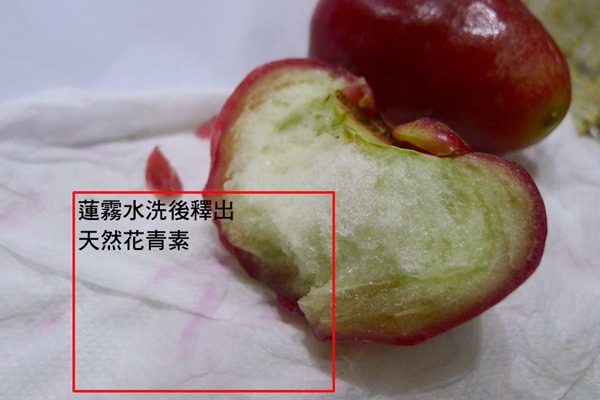
But Huang Te-chang, director of the Kaohsiung District Agricultural Research and Extension Station, refuted this, saying that a normal wax apple naturally contains anthocyanins, and that when the skin is worn, or the fruit meets high temperatures or is cut, they readily seep out, so of course wiping with a tissue leaves color; the skin of a wax apple has a natural waxy layer, and if it really were to be dyed, the dye would have to be dissolved in an organic solvent and the whole fruit soaked in it, but then the color would have no gradation and would seep into the inner layers, so that the entire fruit would be red and could be identified at a glance.