Taro Wilting and Dying in Taichung and Hualien: Agricultural Research and Extension Station Says Soft Rot and Taro Blight Are to Blame
By Upstream and Downstream reporters Kong De-lian and Lai Yu-wei
Recently in Dajia, Taichung, and Ji'an, Hualien, reports have come in one after another of taro wilting and dying and taro stems rotting, leaving farmers lamenting that they have lost their entire investment. In response, farmers' associations, agricultural research and extension stations, and district offices in both places have successively gone to the sites for inspections. Taichung found that taro has been infected on a large scale by "soft rot," and it is estimated that this may have been caused by the successive wind disasters at the end of last month, which damaged the plants, followed by continuously soaring temperatures that accelerated the growth of the pathogen. Farmers are urged to harvest as soon as possible and secure their returns.
As for the Hualien portion, taro has also suffered large-scale damage. After today's inspection, the local agricultural authorities confirmed that "taro blight" was the culprit, and therefore advised farmers to promptly strengthen field management to reduce the disease.
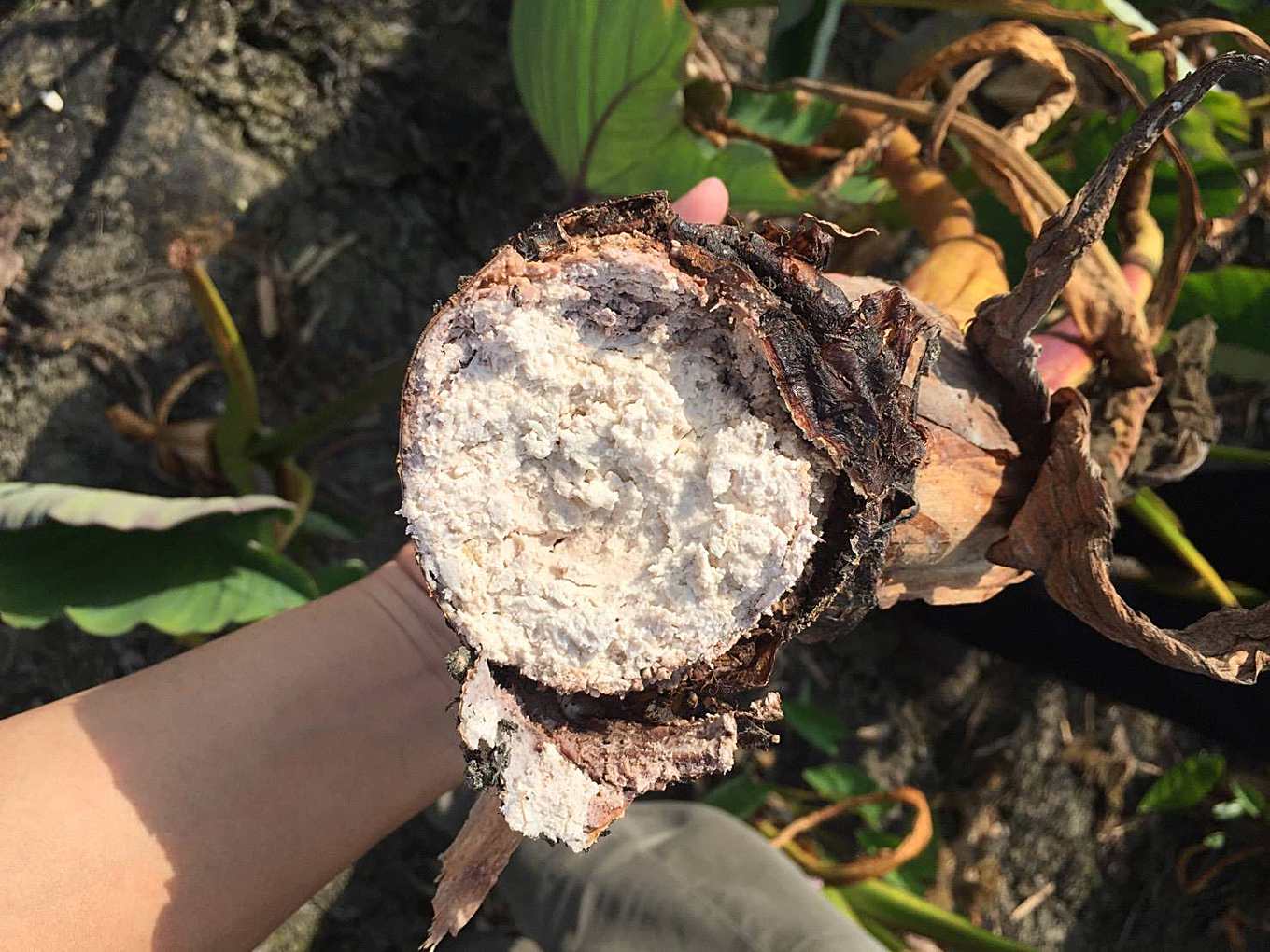
 Large-scale infection of taro by "soft rot" found in Taichung (photo provided by Taichung Agricultural Research and Extension Station)
Large-scale "stem rot" in taro causes 20 percent damage
This year, taro in central Taiwan is about to enter the harvest period, but some taro farmers have reported that the taro is suffering from "stem rot." Shao Ge-sheng, director of the extension section of the Da'an Farmers' Association in Taichung, pointed out that in actual damage inspections over the past two days, they saw entire taro stems rotting away, with the rot spreading from the stems to the corms. "A conservative estimate is that about 30 percent has rotted, but conditions later on could be even worse."
Under these circumstances, Da'an District Chief Chou Hsiu-ju, Dajia District Chief Liu Lai-wang, and others successively reported to the agricultural authorities, trying to find the cause of the large-scale stem rot. Among them, Shao Ge-sheng suspected that the previous typhoon may have been to blame. "Because during the typhoon, taro farmers all cut off some leaves, so bacteria may have entered through the wounds, and the stems rotted." Some farmers also suspected improper field management.
Amid various guesses, the Taichung Agricultural Research and Extension Station sent personnel to the site this afternoon for an inspection. The investigation found that the taro fields in Dajia and Da'an in Taichung currently cover about 400 hectares and 170 hectares respectively, and a rough estimate put the damaged area at about 20 percent, while the condition of the remaining taro fields has not yet been much affected.
Dajia taro: bacterial disease "soft rot" is to blame
After confirmation, this 20 percent damage was also verified to be caused by the bacterial disease "soft rot." Chao Chia-hung, head of the research laboratory of the Crop Environment Section, explained that taro has also suffered from soft rot in past years, but this time the scale of infection is larger. It is estimated that because taro farmers worry that typhoon winds will cause the taro plants to lodge, they often habitually remove leaves and buds before a typhoon strikes, creating wounds that give the pathogen a chance to invade. In addition, after the typhoon passed, temperatures rose rapidly, which made the disease more apparent.
Agricultural Research and Extension Station: if conditions are not optimistic, stop control measures and harvest quickly
Regarding the taro soft rot infection, the Taichung Agricultural Research and Extension Station advised that if field conditions are not very optimistic and disease has appeared, taro farmers should harvest as soon as possible. "Do not carry out control measures anymore! Applying chemicals at this point is useless." Although the taro harvested as quickly as possible will be somewhat smaller, it can still be used for processing.
As for taro fields whose current field conditions are still good, Chao Chia-hung reminded taro farmers to pay attention to prevention and control; at the same time, he also reminded farmers that after removing leaves and buds, they should remember to use fungicides to protect the wounds so as to prevent bacteria from invading.
Damage also reported in Ji'an, Hualien, mostly affected by "taro blight"
Besides central Taiwan, at the same time, damage has also been reported in Ji'an, Hualien, an important taro production area. Ji'an Township Chief Huang Hsin used the rapid post-disaster damage report as an example, pointing out that the damaged taro area there exceeded 30 percent, drawing many complaints from farmers.
Regarding the Hualien damage, Tsai Yi-feng, deputy director of the Hualien Agricultural Research and Extension Station, pointed out that farmers had indeed reported it, and today they again cooperated with the township office to conduct an on-site inspection, finding that the taro damage in Ji'an had exceeded 20 percent, reaching the threshold for natural disaster relief. Follow-up notices will be issued by the government, and farmers are urged to apply as soon as possible.
As for why the taro was damaged, Tsai Yi-feng also pointed out that it should be related to damage to taro plants after the wind disaster. Unlike Taichung, Hualien was mostly affected by "taro blight," which causes round spots on the leaves, after which the centers of the diseased spots rot and perforate, causing infected leaves to dry up within 3 to 5 days, while the leaf stalks become brittle and easily break. In response, Tsai also urged farmers to promptly carry out field management and appropriately strengthen plant disinfection to reduce the impact of the disease.
For more professional agricultural science and technology information, please scan the QR code to follow WeChat: NongXunNET

Please indicate the source when reprinting.