Cutting water use by 30% and strengthening roots: Guandu SRI rice trial seeks a way forward for climate change
From late last year to early this year, Taiwan experienced its worst drought in ten years, with fallow paddy fields across the island reaching 44,000 hectares, the highest in history. Under climate change, water resource management has become an important issue for Taiwan. Domestic water expert Gan Jun-er and the Seven-Star Water Resources Research and Development Foundation invited experts and scholars to form a team to test water-saving SRI rice cultivation techniques on the Guandu Plain. Conventional farmers are used to letting seedlings soak in water before heading, but the team broke with convention, draining the fields and exposing them to the sun more, which saves about 30% of the water and also promotes root development, making the rice plants stronger, in hopes of finding a new solution for climate change.
Reducing water use by 30% makes rice roots stronger
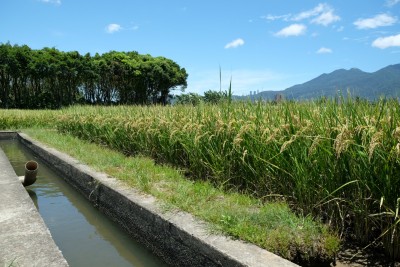


In fact, the Council of Agriculture tested SRI cultivation techniques in Tainan as early as 2009, but the plan was not continued after it ended in 2011. Instead, farmers who took part in the experiment found that with less fertilizer and fewer seedlings, yields were not necessarily worse, and they took the initiative to change their cultivation methods. When Fan Kui Group, a medical equipment company, heard about this, it gave strong support, purchasing the entire crop under contract farming and supplying it to its employee cafeteria. This plan on the Guandu Plain was also carried out by Gan Quan Da Di Industrial Co., Ltd., formed by Fan Kui Group, which purchased the crop under contract at a price better than that of public grain.
Fan Kui Group president Liu Qing-fan said that as climate change becomes more and more frequent, only contract farming at guaranteed prices will let farmers cooperate with the trials without worries and find a more environmentally friendly, water-saving cultivation method.
Taiwan's first crop season is prone to water shortages, while the second crop season often encounters typhoons. The research team believes that in addition to using water-saving cultivation in the first crop season, deep-water cultivation could be used in the second crop season in line with the rainy season to regulate flooding.
However, SRI's characteristic of "high yield" still needs to be observed in Taiwan. The main regions where SRI is promoted are developing countries with high population pressure, such as those in Southeast Asia and Africa. In SRI rice fields in Pakistan and China, yield per unit area increased by half. But Taiwan's research team planted on the Guandu Plain for the first time this year, and because molluscicide was used only in the early stage and herbicide only once, the crop was attacked by pests and diseases, and the yield fell short of expectations and may not match that of conventional fields. In addition, because floodwater cannot be used to suppress weeds, farmers need to spend more labor pulling weeds, which also puts great pressure on the research team for follow-up promotion.
However, Gan Jun-er, the leading figure in Taiwan's water resources field and a retired professor of the Department of Agricultural Engineering at National Taiwan University (now the Department of Bio-Industrial Mechatronics Engineering), said with feeling that after World War II in 1945, chemical fertilizers began to be widely used, causing soil acidification. In the 1960s, the Green Revolution swept in, trading large amounts of pesticides and fertilizers for high yields, but this also damaged the environment. With climate change now becoming more and more severe and the water shortage problem brooking no delay, existing farming methods should be changed and more environmentally friendly farming methods such as SRI should be used.