Which fruits have a sour and astringent taste?
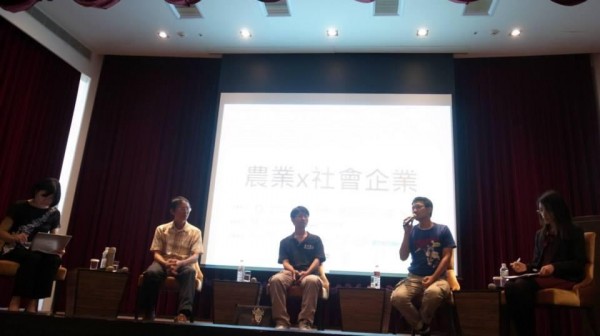
The 2013 Asia-Pacific City Summit will kick off in September. To warm up for the event, the Council of Labor Affairs and the Asia-Pacific City Summit Executive Committee held a talk on "Agriculture and Social Enterprise" at 1 p.m. on July 14, inviting Hong Huixiang (second from left in the photo), founder of Green Farmers' Home, along with panelists Wang Shunyu (general manager of Taiwan Farmer, center of the photo) and Zhang Youfu (co-founder of iLoveHappy Social Enterprise, second from right in the photo) to speak with the audience. The event drew more than a hundred attendees.
Take a look at the different country lanes
When you walk, take a train, ride a scooter, pedal a bicycle or drive a car and leisurely wind your way among the farm fields, the expanse of green is very pleasing to the eye, yet you seldom see butterflies, dragonflies or bees flitting about. You even see cement-ridged field bunds everywhere, with none of the wild Taiwanese flowers and grasses once common in the countryside. Besides the falling birth rate, fewer and fewer children play in the fields, because it is so hard to find frogs, crickets, wild rabbits and field mice bigger than a durian. Strange smells drift from the irrigation and drainage ditches, and strange things even float in them.
People often spend several million to buy a plot of farmland, yet few think that just a few more ecologists in the countryside could help a farmer gain ecological knowledge and then successfully switch to environmentally friendly farming, protecting the land and looking after everyone's health at the same time!
What are Taiwan's environmental characteristics
Teacher Hong Huixiang, chairman of the Pingtung Environmental Protection Union and founder of Pingtung's "Green Farmers' Home," said: "If Taiwan's land does not restore its ecosystems, it has no tomorrow, but if we do not understand Taiwan's ecosystems and environmental characteristics, we will take many detours."
Taiwan is a very fragile piece of land, constantly subjected to plate compression and orogeny, but because our geographical location has very good climatic conditions, the fragmented land is covered by forests, and the land is thus protected by forests. On average 3-4 typhoons actually affect Taiwan each year, and each one brings astonishing rainfall. With high temperature and humidity, fungi and insects grow abundantly. This is the character of our land, and that is why five or six hundred years ago Taiwan was praised as "Formosa."
At present, Taiwan's per capita annual carbon emissions are about 12 metric tons, third in the world, while Kaohsiung's carbon emissions approach first in the world because of the many heavy industries around it. According to the World Wide Fund for Nature's assessment, by the end of the century sea levels will rise 1-2 m, and the wharves of Kaohsiung Port will all be submerged!
Climate change is also making Taipei City's urban heat island effect more and more obvious. Over the past 100 years Taipei City's temperature has already risen two degrees, while Taiwan's land has long been acidified by pesticides and chemical fertilizers, with organic matter too low. Without restoring the health of the land, it will be hard to cope with climate change. "70% of Taiwan's land is farmland," 12% is urban land, and 18% is national park land, so agriculture plays a huge role. Once farmland becomes sustainable, it will help Taiwan a great deal.
What is the relationship between agriculture and ecosystems, and how much is it worth?
Green Farmers' Home is now 1.8 million in debt. Teacher Hong Huixiang used to teach in high school, and later found more and more environmental problems, so he threw himself actively into the environmental protection movement. Alangyi Ancient Trail took 11 years and is now preserved, the steel plant in Pingtung was also blocked, along with other environmental protection cases. He said: "Is 1.8 million a debt? These are social assets. How much are they worth?" He said that the improper development he kept blocking in the past is in fact all related to agriculture now, because only by protecting the environment can there be sustainable ecosystems, and only then can agriculture continue.
He also mentioned ways of weeding. In one day one person with a mower can cut about 1-2 fen of land, while using herbicide, one person in one day can spray about 1 hectare. But spraying herbicide on hillside land means that when rain falls, the lost soil enters the ocean. Pingtung's "Fangshan" is only 14 km from Kenting. He said nearshore currents cause a layer of fine sand to cover the coral reefs; if they get no light for three months, the coral reefs will die.
On the Meinong River in Qishan, tall-stemmed crops may not legally be planted on river land, yet the tenant farmers still plant bananas and even obtain organic certification. Along the Gaoping River there are livestock, crops and many fish ponds, and now only 250-300 m remain for flood discharge. On the land in the river zone, pesticide use has also caused large numbers of hairy crabs to die; Teacher Hong Huixiang picked up 200 dead hairy crabs within 100 m. Fishermen use drugs to kill adenworms and bacteria, and these drugs for animals or plants all enter the Gaoping River. Three km below the fish ponds is the Kaohsiung barrage, which supplies water to the Kaohsiung area. They want to rely on the river's water volume to dilute the drugs, but the dry season lasts 10 months; from March to May this year Kaohsiung repeatedly restricted water, and during the dry season there is also pollution. The water quality and quantity of the Gaoping River are already gasping their last.
Hormones are like the issue of GM seeds: both are extremely tiny things. Teacher Hong Huixiang said hormones are currently not within pesticide regulation, and in the future the Department of Health will even open up reasonable controlled use amounts of growth hormones. The human body's ecosystem is as wondrous as nature: only a few ppt or ppb are needed for body tissues to function normally, but chemical industry players form lobbying groups and yearn to relax it to 2 ppm, while the difference between ppm and ppt or ppb is several thousand times, tens of thousands of times or more, making one directly think that future national health insurance spending is bound to rise again.
Environmentally friendly is easier to achieve than organic
Green Farmers' Home currently has more than 70 farmer friends, including farming, fishing and livestock raising. Half are organic and half are non-toxic. All products must spend 250,000 yuan a year on residue testing. Teacher Hong Huixiang said that because current regulations are too narrow, most farmer friends may not be able to obtain organic certification even if they farm organically. Organic represents interdependent symbiosis in an ecosystem, not just being non-toxic, but also how to nurture all living things in the whole ecology, including invisible microbial fungi. Once the land is healthy, it meets the conditions for sustainability. "Environmentally friendly is easier to achieve than organic." Even without certification, it can still nurture us forever.
Restoring ecosystems takes time. Green Farmers' Home asks farmers only to take good care of the environment, do residue testing, meet Good Agricultural Practice standards in the first year, and allow four farm visits each year. This is accessibility.
The definition in current organic regulations is limited to not using pesticides or chemical fertilizers in the production process. This is a human-centered idea that does not see the needs of the ecology and the land. Mainstream economic agriculture leads to only a single crop in the ecosystem, believing that without large-scale monoculture production there is no capacity or efficiency. When Teacher Hong Huixiang first ran a farm, he thought monoculture production had the lowest cost and could reach the highest capacity. Later, after slowly taking good care of the environment, when 70% of the land was used to produce crops, 20% to produce feed and 10% as ecological space, he discovered that this capacity was the greatest.
How can traditional agriculture transform into organic agriculture, and what is the interaction with the community?
To lower farmers' costs, Teacher Hong Huixiang said that besides telling them the importance of an environmentally friendly approach, he first tried the method of inducement, and the first step of being environmentally friendly is grass cultivation. He also encouraged farmer friends by giving a mower to those who do not use herbicide. The second step was teaching farmer friends how to use pesticides safely, going into the fields to tell them why their plants had pests and diseases and needed spraying: because the plants were too monocultural, and because using herbicide degraded the soil. Since the soil lacked other root systems, rhizobia turned to attack the crops. Once farmer friends understood the benefits of grass cultivation, they instead took the initiative to transform, not because of any subsidy or incentive.
A farmer friend may spend a year taking care of the land yet have only one harvest; if a typhoon comes, there will be no income that year. So without reasonable price support, their efforts would be wasted. Green Farmers' Home therefore lets the farmer friends set their own prices. For example, the price of bananas stays at 25 yuan per Taiwan catty all year round. Compared with the cheap prices of 1 yuan or 2 yuan often heard of, this is a reasonable price, and it is also because behind them is a group of green consumers who support the farmer friends.
The basic human right is to be non-toxic, but that does not include unreasonable buying and selling. In traditional production and marketing, farmers are allocated only 20-30% of the profit. Farmers must be given basic protection and dignity. For all the farmers of Green Farmers' Home, profits are about 50-75%, while other costs go to home delivery, summer refrigeration expenses, origin audits, residue testing, tasting and sampling, marketing and customer service.
Speaking of rural life, Teacher Hong Huixiang said it really is "money-saving" (a Taiwanese homophone for five-star). The ecology in the fields makes him find going into the fields interesting every day. For example, the earth bee, which many people fear, is actually a very important player in reducing pest damage. Also, when a typhoon comes, the pigs run out and still have to be chased. He said, "The richer my understanding of the ecosystem, the less lonely I feel in the land," and even wind and sun do not make him feel tired. It is truly delightful!
On his Rainbow Farm, a group of members of the Thousand-Years Club love to come here to work, earning 1,000 yuan a day, sometimes bringing their grandchildren along. Children playing in the fields need not worry about pesticides, and on the way home they can pick a handful of wild vegetables. The countryside is a very good place to live, but using chemical fertilizers, pesticides and herbicides cannot create all this!
He said that besides the community mothers, the farm also trains three full-time staff each year. "Taiwan currently has 680,000 hectares of farmland that need to become environmentally friendly; they can go and take care of another field." Just as Zhang Youfu, founder of iLoveHappy Social Enterprise, said: "Even 100 social enterprises in Taiwan would not be enough!" Agriculture includes primary production, secondary processing and tertiary services, all of which require professional competence, so Teacher Hong encourages more young people to connect ecosystems, production and marketing, and other specialties.
Taiwan needs Green Farmers' Home everywhere, but everyone must divide the work and work hard. For example, Green Farmers' Home currently has full-time staff at two farms, with four people handling marketing, customer service, cash flow and logistics. They start by understanding the problems of nearby farmer friends and then care deeply about the land, including how to guide farmer friends through transformation. Teacher Hong Huixiang first sought advice from experts at the agricultural improvement station. After gaining basic knowledge, he then built producer ethics. When the source is done right, consumers will trust it, so over eight years they have constantly let consumers know about the farmer friends' problems and helped them get to know one another.
Green Farmers' Home needs consumers, but he knows consumers need them even more. Teacher Hong said what makes him even happier is that without investing more professional knowledge, the farmer friends' agricultural products are all getting better and better, because there are many "farmers" in biodiversity. The ecosystem is a sustainable restaurant, and both the farmers and the "farmers" in the ecology are everyone's family doctors.
Producing non-toxic food is a production ethic, and this includes farmers, food vendors and restaurateurs. But when we consume, have we ever asked whether something is toxic? Most people in Taiwan have no actual experience growing vegetables and fruit, so it is also hard to tell what kind of taste is "normal." "If one day you go to buy fruit and ask the boss, 'Do you have any fruit that is sour and astringent?'" Teacher Hong said this question perhaps can bring us back to the land and to producers, let producers fulfill the production ethic, and make the land better! He said: "Ask the right question, and the answer is not far away!"
About the author:
Notes on Rural and Multicultural Affairs, Jiang Yingru
Because I was in poor health since childhood, I thought about the answer to health and finally found it comes from my own health and the health of the land. I studied too seriously as a child, and only after growing up did I discover that agriculture, the ocean, communities and culture rarely appear in school education, community discussion or the media. I felt it was a miserable thing to be Taiwanese yet not understand Taiwan's agriculture, and only after starting independent interviews did I gradually understand: "Help farmers and rural areas, starting from listening; marketing, living, being a good neighbor! Life is the real local characteristic!"
If there is any opportunity for reporting cooperation, please call 0933316301 or write to [email protected]