Fake oil and adulterated oil scandals keep erupting: shake-and-make soap turns waste oil into household soap
As the tainted oil scandal exploded one case after another, many people looked at the fake olive oil and fake salad oil in their homes and simply did not dare use them for stir-frying again, yet they were afraid that casually throwing them away would pollute the environment, and they did not know what to do. At "Yunhe Little Living Room" in the Shida community of Taipei, people had long been voluntarily teaching neighbors to collect waste oil and expired oil from Shida Night Market vendors to make handmade household soap. After the tainted oil scandal broke out, even more residents came seeking help. "A lot of people carried over Ting Hsin's oil to make soap," said volunteer Ma Xiaojie.
"Yunhe Little Living Room" was a work base that the Taipei City Department of Cultural Affairs specially allocated a budget for during the Shida commercial district controversy, borrowing land from the National Property Administration in an attempt to create a "livable community." Inside the small single-story house, vegetables were grown, kitchen waste was composted, and it also served as a soap experiment workshop. At first, making soap at home was simply meant to recycle and reuse waste oil, but unexpectedly, after the fake oil storm, it became an overnight sensation and a turning point for Ting Hsin oil to be "reborn."
Pioneering the shake-and-make soap method: safe, simple, and fast
Unlike the outside impression that soap-making is complicated, Yunhe Little Living Room uses the "shake-shake soap" method. They first adjusted the ratio of water and sodium hydroxide, put it into individual hand-shaker cups, then added expired oil products or waste oil collected from people's homes or vendors into the bottles, covered them with the lids and tightened them, picked up the cups by hand and shook them vigorously so that the oil, water, and sodium hydroxide fully mixed, shook until it reached a rice-paste consistency, then poured the soap liquid into molds and left it to air-dry. Ma Xiaojie said: "The method is simple, and compared with commercially sold soap it has a lot more 'glycerin' content, so it washes cleaner."
"Many mothers originally just wanted to get rid of Ting Hsin oil, but in the end they shook it so happily they could not stop." Ma Xiaojie said that simplifying the production method let more people get the hang of it easily. A volunteer surnamed Tsai who exclusively developed the shake-shake soap process and did not wish to be named said that he began making handmade soap by trying methods from the internet, but later found that these methods had "too many fancy but impractical moves," so he kept simplifying the procedure and used the "shake-shake soap method." He compared it, saying, "It is just like Bruce Lee's martial arts, simple and precisely achieving the goal."
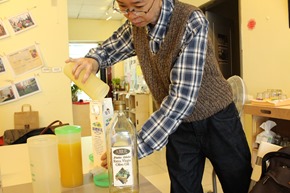 Yunhe Little Living Room, which had long been promoting handmade soap, became the focus of community inquiries after the black oil scandal broke out (photo/He Xinjie)