How much does a bowl of rice cost? The experiment plan reveals the answer
After a year of introducing the farmers of Nan'ao Happy Field, young people have finally gotten the itch to go down to the fields themselves. [ How much does a bowl of rice cost?] is an experiment by two young people.
It all started with wanting to return home. Why do young people go out to work instead of going back? For one, their parents' plan for them is to work away from home; for another, everything they have studied and been exposed to has never told them to stay.
The simple reason they cannot return home is that there is no way to make a living.
The office skills they have now are of no use back home. The endurance to squat in the fields back home is still being cultivated.
These two young people used their holidays to take part in the 2013 spring plowing at Nan'ao Happy Field. Not to worry, the rice grown by these weekend farmers is mainly for their own consumption; incidentally, they are helping Nan'ao Happy Field test the yield of Hualien 21, planting only about 1 fen of land.
They want to make all the expenses and costs of the whole process public, so everyone can understand just how much a bowl of rice really costs.
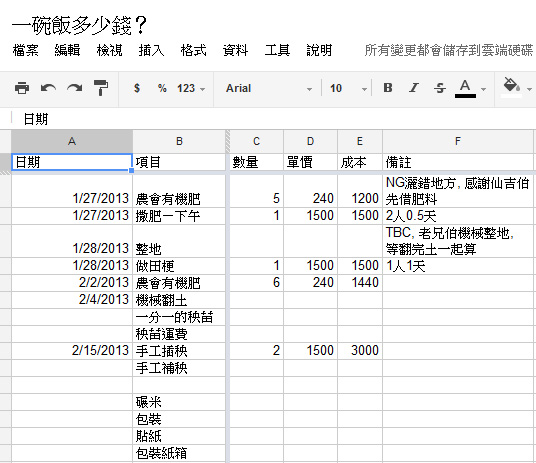
The costs already (expected) to be paid so far. More will be filled into the form as time goes on.https://docs.google.com/spreadsheet/ccc?key=0ArijxIFRP1RQdF9Xc2J0dk1HQVNDWTdVQmZTYWtfTmc#gid=0
[ How much does a bowl of rice cost?] Cost breakdown
Why are costs so important? After all, ideals cannot fill your stomach. How can you ask young people to return home to live for organic, eco-friendly farming? That requires paying a huge opportunity cost. Just ask yourself: if you interview someone who worked back home for three years and then came back to look for a job, regardless of whether he was originally a PhD, a master's degree holder, or studied in the US or Japan, would you hire him? Without a shred of doubt? Would you give him the annual salary he deserves, without docking it for those three years of chasing a dream? If there are no other options after returning home, how can they be expected to take this economically uncertain step?
Conversely, on the premise that you are willing to support small farmers, how much are you willing to pay for a bowl of rice, and not one from the habitual, pesticide-spraying, mass-production kind? When you do not know what the meaning of what you consume is, a bowl of rice is just a bowl of rice. Honestly, if you really want everything to be organic, healthy and pollution-free, the average person's food and household expenses would probably need to double.
If we add the profit that should be there to the cost, say 5%-10% or even less, can young small farmers really support a family? Can consumers really support young small farmers? This time, making the costs public is meant to spark discussion. Although such a discussion may not lead to a conclusion, and we may not be able to handle it, we always want to raise the questions in our hearts.
What exactly can be done to let young people return home to farm?
2/15, the sixth day of the first lunar month: start work by planting rice seedlings, actually take part in cost operations
- On 2/15, the sixth day of the first lunar month, please come plant rice seedlings; you will be paid a payslip of $150 per hour.
- If you cannot work for a full hour alone, you can find friends to help together, but we count work hours, not headcount.
- There will be two professional farmers as teachers; participants are asked to share the lecturer fee of $3000 in total, payable in cash.
If interested, please go to the Nan'ao Happy Field website for detailed instructions