For ten years of blending inferior oil, why did food GMP certification pass year after year?
Joint report by Newsmarket reporters He Xinjie and Lin Huizhen
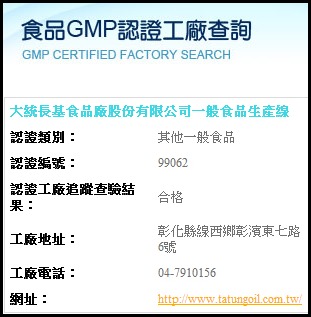
As the scandal over Dachang Changji mixing inferior oil into higher-priced oil continues to spread, the Taiwan Food Good Manufacturing Practice Development Association (abbreviated as the Food GMP Association) quietly posted an announcement on its official website last Friday (the 18th) titled "Revocation of the Food GMP certification status and mark usage rights for 17 items including Dachang sunflower oil." Since Dachang Changji had been blending in inferior oil for at least ten years, the Food GMP Association failed to notice this during its annual inspections and continued to grant certification marks, which became the focus of lawmakers' questioning and criticism yesterday at the Legislative Yuan's Social Welfare and Environmental Hygiene Committee.
Faced with lawmakers' criticism that the Food GMP certification system existed in name only, Minister of Health and Welfare Chiu Wen-ta merely responded: "No labeling can stand up to the wickedness of the human heart."
 (Left) Minister of Health and Welfare Chiu Wen-ta, (right) Acting Director-General of the Food and Drug Administration Hsu Ming-neng (photo/Lin Huizhen)
Despite GMP oversight, inferior oil still flowed into school nutrition lunches
Whether Dachang Changji cooking oil flowed into students' nutrition lunches also became a focus of attention, especially since schools' group meal supply contracts require vendors to use products certified by GAP (Good Agricultural Practice), CAS, or Food GMP as ingredients. Now that it has come to light that inferior cooking oil could obtain Food GMP certification for years, parents are worried as well.
Chiu Hsiu-yi, director of the Food and Drug Division of the Taipei City Department of Health, said that Taipei City's ingredient registration platform originally did not require vendors to fill in items about oil products. After the scandal broke, the department proactively added fields requiring vendors to fill them in themselves. Currently, all 19 vendors providing nutrition lunches in the city voluntarily stated that they do not use oil products produced by Dachang Changji. Even so, the Taipei City Department of Health will still conduct irregular spot checks and will not rely solely on vendors' statements.
However, in the past, nutrition lunch food safety inspections mostly focused on pesticide residues in vegetables or veterinary drug residues in meat. Chiu Hsiu-yi admitted, "Before the Dachang case occurred, what oil products vendors used was not among the items registered for ingredients." After the scandal broke, naturally no group meal operator would be foolish enough to admit to using Dachang oil products, and whether operators used Dachang oil products before the scandal is unknown.
Chiu Hsiu-yi said that in fact, in October last year, a consumer filed a complaint with the Taipei City Department of Health, saying that Dachang's olive oil had a strange taste and did not taste like olive oil. Taipei City then proactively conducted inspections and reported the matter to the Changhua County Health Bureau to inspect the factory, cooperating with the Changhua District Prosecutors Office, and only then successfully uncovered this fake oil scandal. In the future, they will continue to strictly inspect problematic oil products.
Lin Kuan-chen, chief of the Food and Drug Management Section of the New Taipei City Health Bureau across the water, said that currently all 14 nutrition lunch operators in the city have reported to the Health Bureau that they do not use Dachang oil products, but the Health Bureau will verify carefully to be prudent. In addition, there are 57 registered cooking oil factories in New Taipei City, but after investigation, half have already ceased operations, leaving more than 20, which the New Taipei City Health Bureau is currently inspecting, and no abnormalities have been found so far.
However, today the K-12 Education Administration of the Ministry of Education and some county and city education bureaus inspected nutrition lunches and group meal operators at elementary and junior high schools in their areas and found that more than 100 elementary and junior high schools nationwide use oil products from Dachang Changji. As of noon, nutrition lunches at a total of 123 elementary and junior high schools in 11 counties and cities across Taiwan used Dachang oil products. In addition, New Taipei City and Taichung City also published lists of schools and group meal operators using Dachang oil products.
The New Taipei City Education Bureau published the list of 12 schools in the city using Dachang oil products: Changfu Elementary School, Yingge Elementary School, Fengming Elementary School, Yongji Elementary School, Hemei Elementary School, Touqian Junior High School, Jisui Junior High School, Zhonghe Junior High School, Zhanghe Junior High School, Ziqiang Junior High School, Danfeng High School, and Shuangxi High School.
The Taichung City Education Bureau published the list of schools in the city using Dachang oil products: Liming Junior High School in Nantun District, Siwei Elementary School in Beitun District, Ziyou Elementary School and Wushi Branch in Heping District, Xinshe Elementary School in Xinshe District, Jiude Elementary School and Wuguang Elementary School in Wuri District, and Dayuan Elementary School in Dali District.
The New Taipei City Education Bureau said that the regulations on oil products for central kitchens and self-operated lunch schools in New Taipei City are: "Cooking oil and seasonings such as soy sauce should bear the CNS mark or GMP mark. If the product does not bear the CNS mark or GMP mark, it must be a product produced by a legally registered factory and must have passed testing by a laboratory recognized by the central health authority. Food with incomplete packaging and food that has not passed testing may not be used." However, 17 Dachang oil products had obtained Food GMP certification.
Besides Dachang having problems, Carrefour was also suspected of blending in soybean oil
With the cooking oil controversy causing widespread anxiety, Lo Ying-wei, manager of "Original Flavor Bento," known for selling affordable organic bento meals, said that the current testing and grading of foods such as soy sauce and honey is based only on individual elements such as total nitrogen content or enzyme content, and how each vendor "meets" the report requirements is a matter of individual cleverness that is hard to control.
He believes that olive oil easily deteriorates when exposed to light and should not be packaged in transparent plastic bottles at all; if it is packaged in plastic bottles, there may be a problem. He stressed that ingredient procurement should "follow the natural principles of food terroir" in order not to be deceived.
Yesterday, Tsai Shu-chen, a section chief of the Food and Drug Administration of the Ministry of Health and Welfare, admitted during questioning at the Legislative Yuan that last year the agency commissioned Meiho University of Science and Technology to conduct a "Study on the Compliance of Labeling of Commercially Sold Blended Oils and Fruit and Vegetable Juices with Standards," sampling and testing 25 commercially sold products. In addition to doubts raised by mass spectrometry analysis of Dachang olive oil, Carrefour's "vegetable blended oil" listed canola oil and sunflower oil as ingredients but was "suspected" of blending in soybean oil. However, after a meeting to analyze the matter, experts also said the data was still insufficient to confirm whether blending had occurred.
Tsai Shu-chen said that each type of oil has a specific fatty acid distribution. Dachang Changji added different oils, and the fatty acid distribution was very close to that of olive oil. From last year to now, it has been tested four times, but it could not be fully confirmed that blending had occurred, which is why the health bureau and prosecutors were asked to intervene. However, past tests did not specifically test for copper chlorophyllin, and plants originally contain a small amount of copper, so even if testing were to be done, it would not be easy. "The vendor is engaged in intelligent crime."