A Math Lesson Hidden in School Lunch
Huang Jialin / Co-founder of the Campus Lunch Goes Non-GMO Action Team
Taitung County has nearly 19,000 elementary and junior high school students. Five years ago, after taking office, County Magistrate Huang Chien-ting abolished the two-year-old free lunch policy that had no income threshold, reverting to charging parents while the county government allocated funds to subsidize students from low- and middle-income families with genuine difficulties. At a time when county and city governments were piling on free lunches and rolling out popular policies to court parents' votes, Magistrate Huang dared, during his term, to weigh the county government's financial situation and go against the grain, withdrawing the across-the-board free measure and planning the use of overall education funds, which is worthy of encouragement.
However, in a recent interview with NewsMarket [From Farm Safety to Food Safety, Asking County and City Mayors] Taitung County: Non-GMO campus lunches cost too much to push ahead hastily; promoting a central kitchen system, Magistrate Huang pointed out that because nutritious lunches cost more, he feared this would relatively increase the burden on parents and the county government, so he did not plan to "romantically sign" the non-GMO campus lunch pledge. Emphasizing that he comes from a business background and values cost-effectiveness, the magistrate gave examples from an economic and commercial standpoint: a box of GM tofu costs 8 yuan, while a box of non-GMO tofu costs 25 yuan; and the price difference between GM and non-GMO Jinlan soy sauce, commonly used in campus lunches, is as high as seven times. Based on this, he judged that non-GMO ingredients are too expensive, and believed that a non-GMO lunch policy should be ordered by the central government, not decided by individual counties and cities on their own.
Regarding this response, as a participant in advocating and taking part in efforts to have counties and cities adopt non-GMO ingredients in campus lunches, it is truly necessary to offer Magistrate Huang a few words to clarify the gap in information.
The Actual Price Gap Between GM and Non-GMO Foods
Let us start with the price of non-GMO boxed tofu. Purchase prices may vary slightly from place to place, but comparing the retail prices of boxed tofu sold at Carrefour hypermarkets in January reveals clues about the price gap. Taking 100 grams of GM tofu as an example, major brands such as Dahan and Chunghwa sold for between 3 yuan and 3.67 yuan, while 100 grams of non-GMO tofu from Dahan, Chunghwa, and I-Mei ranged from 4 yuan to 4.48 yuan, a price difference of roughly 9% to 49%, which is clearly quite different from the more than threefold difference mentioned by the magistrate. It is surmised that the 25-yuan box of tofu the magistrate referred to may be an organic product sold on the market, rather than the food-grade non-GMO soybean products we advocate.
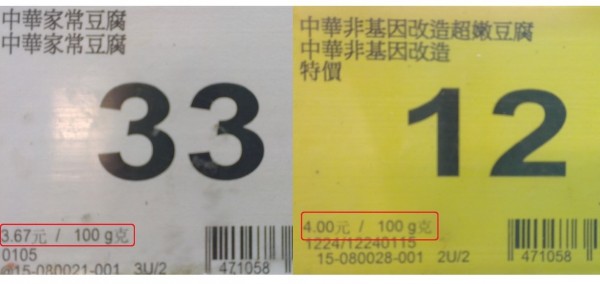
Now let us look at Jinlan soy sauce, which Magistrate Huang cited as commonly used by most schools in Taitung County. The magistrate mentioned that the unit price of non-GMO soy sauce is as much as seven times higher than that of GM soy sauce, but this information is also incorrect. Jinlan Company announced on January 27 that six of its soy sauce brands would switch to non-GMO soybeans, and after price adjustments, 500-milliliter bottles of Ganlu, Chennian, and low-salt soy sauce would be 75 yuan. In its press release, Jinlan Company pointed out that the price of non-GMO soy sauce was only 7~10% higher than before.
In light of the county government's education budget considerations, it is suggested that the relevant units begin with a survey of the amount of soybean-processed products used in lunches at all schools countywide, to accurately grasp the quantity and cost of GM soybean products in elementary and junior high school lunches, as well as the price difference of switching all of Taitung County to non-GMO soybean products, so as to more accurately assess whether it would truly place an excessive financial burden on parents and the county government. According to separate survey data from Taichung City and Hsinchu County, switching entirely to non-GMO soybean products increases the cost by about 1 yuan to 2 yuan per person per meal.
Providing Healthy and Environmentally Friendly Campus Lunches Is the Government's Responsibility
Second, Taitung County has a high proportion of economically disadvantaged families. In addition to 40% of impoverished students countywide having their lunches subsidized by the county government, it is also quite common for uneaten portions of food to be "recovered" and given to children to take home as their own or their family's dinner. In other words, because of their poor family circumstances, the campus lunch may be the most nutritious and abundant meal of the day for many students. From this standpoint, for such an important meal, the supply of ingredients should be more cautious, so that they can eat healthily and safely.
The unknown health risks of GM foods and the controversy over environmental pollution are facts known throughout the world. Among these, the problem of pesticide residues in imported GM soybeans is serious, and in recent years relevant international research has pointed to associations with allergies, autism, and cancer that cannot be ignored. Our central competent authority, the Ministry of Health and Welfare, has already been studying progressively stricter regulations for GM food labeling, and in the future this will also extend to unpackaged foods. At this stage, if local governments, in allocating their financial plans, can first implement GM food labeling on lunch menus at no additional cost, ordering all schools to clearly label GM ingredient components on both paper and online menus, this would not only achieve the goal of information transparency in the short term, but also help promote campus food education.
The Hualien-Taitung area has excellent natural conditions and is very suitable for soybean cultivation. If, through overall food and agriculture policy and educational measures, farmers could be encouraged not only to grow cash crops such as roselle, chrysanthemum, and betel leaf, but also to return to cultivating and rotating soybeans, with the county government purchasing them specifically for lunch ingredients, and guiding soybean product processors to provide tofu and dried tofu made from local soybeans for local schoolchildren, and if food and agriculture education in various learning areas were developed around this theme, it would be a truly feasible educational plan that takes multiple economic effects into account, not merely a politician's romantic promise.
Note: Part of this article was published in the February 2, 2015 issue of Merit Times, Plant Soybeans Widely to Add Nutrition to Campus Lunches.