283 items from radiation-affected areas swapped in under false pretenses; Green legislators and civic groups warned last year that border controls had loopholes
Text by Upstream and Downstream reporters Zhao Min and Lin Huizhen
After the Fukushima nuclear disaster, Taiwan banned foods produced and manufactured in five Japanese prefectures: Fukushima, Ibaraki, Tochigi, Gunma and Chiba. But yesterday the Food and Drug Administration of the Ministry of Health and Welfare, together with county and city health bureaus, announced the results of inspections of 10 major importers, finding that some operators were suspected of affixing false labels and misdeclaring the location of the manufacturing plant, with a total of 283 products from the five radiation-contaminated areas entering Taiwan, most of them everyday foods commonly used by the public, such as Kikkoman dark soy sauce and Afternoon Tea drinks. The Ministry of Health and Welfare has required operators to immediately notify downstream operators to take the products off the shelves as a precaution.
Although Taiwan bans imports of products from Japan's five radiation-affected areas, there are frequent rumors of goods slipping through. Yesterday's outbreak of 283 products from nuclear disaster areas entering with switched labels highlighted the loopholes in Japanese food imports to Taiwan. DPP legislator Lin Shu-fen and the Homemakers United Foundation had already issued warnings in October last year, pointing to loopholes in the management of products imported to Taiwan and saying the government should require operators to present origin and radiation test certificates issued by Japanese authorities.
Although the Ministry of Health and Welfare announced in October last year that Japanese food imports would need to be accompanied by official origin certificates and inspection certificates, it was never implemented, and DPP legislator Lin Shu-fen sharply criticized the Ministry of Health and Welfare for "indulging operators."
Border controls on Japanese products entering Taiwan have loopholes; DPP legislator and civic groups warned long ago
After the nuclear disaster, many countries, including Taiwan, still banned food imports from Fukushima and the four surrounding prefectures of Tochigi, Gunma, Ibaraki and Chiba. In September last year, news also emerged of radioactive water leaking from TEPCO and of levels exceeding standards. Although Japanese Prime Minister Shinzo Abe ate Fukushima vegetables in front of the media, it still could not restore Japanese people's confidence, so Japan became even more aggressive in overseas markets. In August last year, Singapore imported Fukushima Koshihikari rice for the first time since the nuclear disaster.
DPP legislator Lin Shu-fen said that a year and a half ago, when she was reviewing the budget bill, she had proposed requiring the government to demand that all Japanese food imports be accompanied by "origin certificates" and "radiation test certificates." At the time, the Food and Drug Administration said it would implement this, but to date there has still been no follow-up.
To understand how the border is controlled, Lin Shu-fen went with the Homemakers United Foundation to inspect Keelung Customs last year. She found that when operators imported Japanese food, the origin field was filled in by the operators themselves, and no inspection certificates were attached at all, which was simply indulging operators.
Lin Shu-fen said she had also gone to the customs site with then-Food and Drug Administration Director-General Yeh Ming-kung and found that only 45 items of products entering Taiwan were sampled and inspected each day. At the time, she called on the Ministry of Health and Welfare to "straighten its backbone" and not sacrifice national health because of international trade pressure.
When the Food and Drug Administration was asked at the time when it would require Japan to attach radiation reports, Ministry of Health and Welfare Food and Drug Administration Food Division senior specialist Fang Shao-wei said that the Ministry of Health and Welfare very much hoped Japan would provide them as soon as possible, "because this is originally the responsibility of the exporting country, and now the Ministry of Health and Welfare is spending so much manpower and money on testing, which amounts to us endorsing them for them." He said that if Japan kept evading, the Ministry of Health and Welfare might directly issue a letter forcibly requiring Japan to attach reports before imports would be allowed. But that policy was never implemented.

Food and Drug Administration: tracing whether the exporter, importer or customs broker affixed the false labels
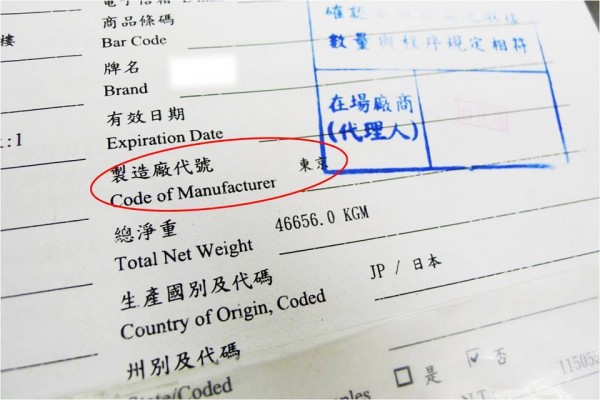
Lai Hsiao-fen, secretary-general of the Homemakers United Foundation, who has long cared about radiation-affected food, said that the region operators fill in on their own is the "place of manufacture" rather than the "place of production." In other words, if Fukushima agricultural products are shipped to Tokyo for processing, operators will note Tokyo as the origin when importing, so the products do not need to be inspected. "The upstream is full of loopholes, and the downstream has no manpower. It is simply fake regulation."
Lai Hsiao-fen also mentioned that although the Ministry of Health and Welfare bans imports of agricultural products from five Japanese areas, it lacks the capacity to control them. Fewer than 50 people are responsible for border spot checks, a severe manpower shortage, and they must manage radiation-affected food, U.S. beef imports and more. Moreover, they work two shifts a day, in pairs, and in one afternoon they can sample only about 2 or 3 items. From 2011 to the end of September this year, only 45 items were sampled on average each day.
In October last year, the Ministry of Health and Welfare announced that it would require operators to present origin and radiation test certificates issued by Japanese authorities, but because of protests from operators and Japan, five months have passed and it has remained silent to this day. Lai Hsiao-fen said South Korea, the United States and others had long since required Japan to present origin and radiation certificates, showing this is not difficult, and the Ministry of Health and Welfare should catch up as soon as possible, announce implementation and protect the public's rights.
Food and Drug Administration: still negotiating with Japan over origin certificates
When products from Japan's nuclear disaster areas entered Taiwan with switched labels, was it done by the Japanese exporter or the Taiwanese importer? Wang Te-yuan, deputy director of the Northern Regional Management Center of the Ministry of Health and Welfare's Food and Drug Administration, explained that under the "Act Governing Food Safety and Sanitation," imported products must have "Chinese labeling." But according to operators, the original Japanese manufacturers do not specially make "Chinese labeling" for food exported to Taiwan. The Chinese-label stickers may be made by the exporter, importer or customs broker, and it is still being investigated at which point the false labels were affixed.
Regarding outside doubts that the Taiwan government had delayed announcing implementation because of Japanese pressure, Pan Chih-kuan, director of the Food Division of the Ministry of Health and Welfare's Food and Drug Administration, who was responsible for handling the announcement, responded that there had already been multiple negotiations with Japan. Japan was not unwilling to issue "origin certificates," but because Japan still had domestic administrative procedures to complete, coordination was still ongoing.
Moreover, radiation levels previously tested on Japanese food imported to Taiwan had a 100 percent pass rate. Pan Chih-kuan said Japan had expressed incomprehension to Taiwan, saying that radiation-area food problems had decreased and various countries had gradually relaxed standards, so why was Taiwan instead regulating more strictly, and it considered Taiwan's proposed management approach inconsistent with the spirit of science.
In response to legislator Lin Shu-fen's questions, Chiang Yu-mei said it was still negotiating with Japanese authorities to reach consensus, and only with consistent standards could implementation be confirmed. But the 60-day announcement period had long passed. When could it be formally announced and implemented? Chiang Yu-mei said "as soon as possible."
For this batch of 283 suspected non-compliant products, they have been sent to the Atomic Energy Council for radiation testing. Of these, 30 products showed no detectable radiation, and the test results for the other products will be released successively over the next two days.
283 products from Japan's nuclear disaster areas enter Taiwan with false declarations