How Can the Pig Farming Crisis Become a Turning Point? Food Safety and Food Agriculture Co-learning Series Part 2
The tide of free trade is drawing near, and Taiwan will throw open its doors wide for it! With all the agricultural products about to be imported on a large scale, how many unknown food safety problems are hidden? How great an impact will this have on Taiwan's agriculture? Will it fatten up the processing industry? Or make life hard for Taiwan's small farmers? Or sacrifice the health of the people? All kinds of doubts and unease linger in our hearts, and so the Homemakers United Foundation began holding a series of food agriculture and food safety co-learning lectures in June, hoping that experts, scholars and industry producers from various fields can analyze the true face of free trade from every angle.
July starts with Taiwan's livestock industry, and the first lecture specially invited Dr. Liu Zhiwei, chief executive of the Taipei Grain Promotion Association, a foundation, to share: "The free American pig VS the unfree Taiwanese pig," starting from the pork industry under free trade.
Food safety problems have always existed
Food safety risks have always existed in Taiwan! Looking back at the swill oil (gutter oil) processed into cooking oil many years ago, the 2008 melamine milk powder, the 2009 McDonald's arsenic oil, the 2011 plasticizer beverages, the 2012 ractopamine meat products and radioactive contamination, the 2013 chemical soy sauce and toxic starch products, the 2014 bleached bean sprouts and water-injected meat, and so on. Other food safety problems have never stopped either, including pesticide residues in fruits and vegetables, excessively high nitrate content in leafy vegetables, the hazards of antibiotics in meat, eggs and dairy, the issue of genetically modified foods, improper additives, and so on. Therefore Dr. Liu believes that free trade cannot lightly be equated with a food safety crisis. The much-hyped American pork industry should also be re-examined with the same mindset.
Professional livestock farming
In the past, if a country child did not study (books), an adult would grab him by the ear and drag him outside the pigsty, point at the pigs and say: "If you don't study hard now, in the future you'll only be able to raise pigs!" Using this to scare little brats who did not love to study, early family pig farming gave people the feeling of being messy, dark and stinking. However, raising pigs at that time was another kind of savings; when the family urgently needed cash, they could sell pigs for cash to pay the children's tuition or other expenses, and the officials of today's Council of Agriculture all relied on selling pigs to pay their tuition back then.
Running a modern pig farm is not something an ordinary person can handle, so one often hears of giving up the pen for farming (agricultural cultivation), but never of "returning to the countryside to raise pigs." Because working in the livestock industry not only requires professional knowledge (veterinary medicine, animal husbandry, nutrition, management, environmental engineering, etc.), it also requires investing large amounts of capital and equipment in order to reach basic production conditions. Raising economic animals can produce problematic situations at any time, so it is also an industry that needs to be on standby 24 hours a day, with a very large demand for labor; without the willingness to devote oneself wholeheartedly, it is impossible to run a good farm. So now we should say: you have to study hard so that in the future you can go raise pigs!
Taiwan is hot and humid, and strictly speaking is actually not suitable for raising pigs (pigs have no sweat pores and are extremely afraid of heat), yet Taiwan can actually raise more than 6 million pigs every year (2012/6,004,717 pigs), supplying 93.9% of domestic demand, topping the self-sufficiency rate for meat, which really can be called another kind of Taiwan miracle!
Crisis?
During the course, Dr. Liu casually asked: who uses a Taiwan-made smartphone? In the end only 3 students raised their hands. Setting aside personal habits and reasons, it can be seen that the slogan "love to use domestic goods" really does not live up to expectations.
This made me think of a study once done by National Chung Hsing University: how much are you willing to spend on organic products? Once the price rises to a certain level, everyone will begin to hesitate and refuse to buy, showing that most people today still make consumption decisions based on price. Therefore, when everyone questions the Council of Agriculture, which keeps claiming that the free economic pilot zone can make agriculture big, they should also turn around and think about how consumers view the MIT label.
Dr. Liu pointed out that when ractopamine made "American pork imports" the target of universal condemnation, in fact large amounts of imported pork had long been flowing onto the market every year. According to Council of Agriculture data: among the top 10 countries for pork imports in 2013 were Canada, the United States, the Netherlands, Hungary, Poland, Denmark, Sweden, the Philippines, South Korea and France. The United States had long been in second place, and Canada was far ahead.
Legally exported agricultural products are negotiated between the two countries, and then each government strictly checks them; quality and safety must also meet the requirements of the importing country. Rather than everyone using food safety issues to resist imported agricultural products, it would be better to urge the relevant government units to do a good job of inspection work and block substandard products directly outside the border. The biggest cause of food safety problems is: officials not doing their jobs!
Turning point?
Many volunteers on site raised whether small and beautiful agriculture could serve as the cure for Taiwan's agriculture and livestock industry. Dr. Liu responded that small and beautiful agriculture is a way of life rather than a production model that can serve as the mainstream. Taiwan's agricultural products now regularly collapse, followed by an endless cycle of tragic appeals summoning sympathetic purchases; the root cause lies in an unsound industry and an unhealthy market. The Council of Agriculture advocates the three aspects of agriculture: production, life and ecology, hoping to make the added value of agriculture greater rather than the small-farmer model that everyone now blindly pursues. If we do not treat agriculture as an industry, then agriculture will not progress.
After natural market elimination in recent years, Taiwan's pig farmers have fallen from 13,054 households in 2002 to 9,273 households in 2012. Those remaining today can all be considered professional livestock farms, and some farms have even established their own brands: Changhua Peace of Mind Pork, herb pork, carrot pork and other branded products. As for other farms, they can move closer to large enterprises and become contract households, letting production move toward professional division of labor and refinement, so that consumers not only have more choices but also feel more assured. At the same time, consumers should also use their purchasing power to support Taiwan's agriculture, not only buying domestic products but also choosing producers dedicated to pursuing quality.
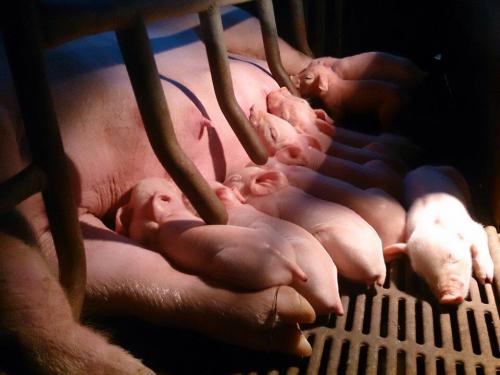
All the best with the pig business
Short food miles and freshness are a major competitive advantage of Taiwan's meat. Imported meat from abroad must be kept at low-temperature frozen to withstand long-distance transport. Thawed meat not only has poorer texture but also more blood water. In addition, starting in March this year, the Council of Agriculture stipulated that thawed meat or chilled meat must be clearly labeled. As long as consumers only buy warm-body pork or chilled meat, they will not buy imported meat (except Taiwan-brand frozen meat).
Facing the great tide of free trade, agricultural reform and industrial upgrading seem to be an inevitable trend. Instead of using tragic words to tell product stories, use quality and goodwill to convey the positive power of the industry; only then will Taiwan's agriculture have a future.