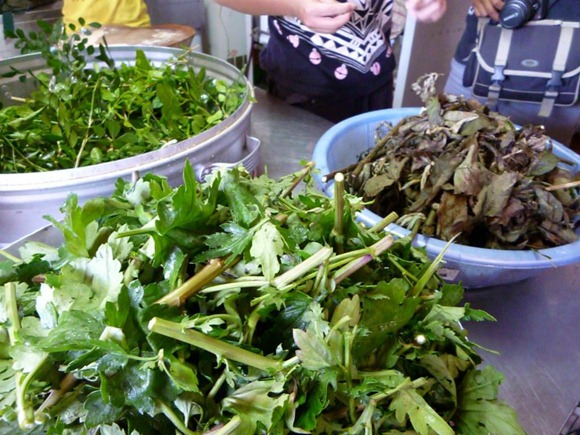
The millet has been harvested; let me teach you how to make traditional tribal koji.
It is the season for harvesting millet, and I cannot help but wonder: does anyone in the tribe still make traditional yeast balls? When convenient, ready-made yeast replaces the naturally gathered, hand-rolled yeast balls, and when millet wine no longer carries the mellow fragrance of several fermented plants, the elders' life wisdom and the tribe's traditional winemaking culture will surely vanish without a trace!
Last March, for personal reasons, I resigned from my position as a counselor for the August 8 Typhoon post-disaster reconstruction project... Taihe, Jialan, Xinxianglan, Jilalong'ai, Aiguopu, Dazhu, Fushan, Daniao, Anshuo - these are the tribes to which I devoted so much effort and companionship. Though I was extremely reluctant to leave, I could only choose to turn away.
Even after stepping down from my post, I remain true to my original intention. I hoped to bring the construction workers something different in cultural reconstruction, and I hoped that through winemaking and pottery courses, my partners could rediscover cultural value and rethink how to recover the culture the tribe has lost or is about to lose... In my time of difficulty, I am grateful to Teacher Liu Huanyue for standing by me with loyalty, traveling far from Hsinchu to Taitung to teach and helping me fulfill my promise to the construction workers and my commitment to the tribe's cultural reconstruction!
How are traditional yeast balls made?
How are traditional yeast balls made? We use three plants as raw materials: orange jasmine (Murraya paniculata), large wind herb, and marigold (Tagetes erecta). After washing, we remove the stems and keep the leaves, put them in a pot and boil them until the leaves are soft enough to remove from the heat. The liquid filtered of impurities is the natural herbal fermentation juice.
Slowly add the cooled fermentation juice to glutinous rice flour or red quinoa flour, then begin kneading vigorously; if the rice dough is too wet, add a little more flour, and if too dry, add a measured amount of fermentation juice. Kneading looks simple, but you need just the right strength to achieve the beautiful chrysanthemum kneading, and only then can it become a rice dough with excellent elasticity, and only then can it be rolled into round yeast cakes one by one.
After the yeast cakes are rolled, cover them with cloth and place them in a cool, ventilated spot to air-dry; open them a few days later. If the culture has grown well, the surface of the yeast cakes will be covered with black mold. Scrape it off and continue placing them until no black mold can be seen, and then they are perfect yeast balls.