Turning Discarded Fishing Nets into Bags: Don't Let Sea Turtles Mistake Plastic for Food
According to statistics from the Society of Wilderness, beach cleanups held over the past year alone cleared out 35 tonnes of trash, nearly 90% of which was plastic by material. No wonder turtles, fish, whales and dolphins so often end up with bellies full of garbage, dealing a blow to both ecology and fisheries.
Green Rabbit Studio, founded 5 years ago and still running today, took an accidental opportunity to try turning discarded fishing nets collected during beach cleanups into lightweight carry bags, breaking the dead-end notion that fishing nets can only be trash. But even more, they hope fishing villages will join in, reducing waste at the source and transforming existing materials to achieve a sustainable economy. In addition, they keep promoting bamboo household utensils, but limited by the high cost of labor in Taiwan, they can only start by insisting on processing bamboo utensils in Taiwan, hoping that one day they can build a kingdom of bamboo household goods whose raw materials and production processes are both in Taiwan.
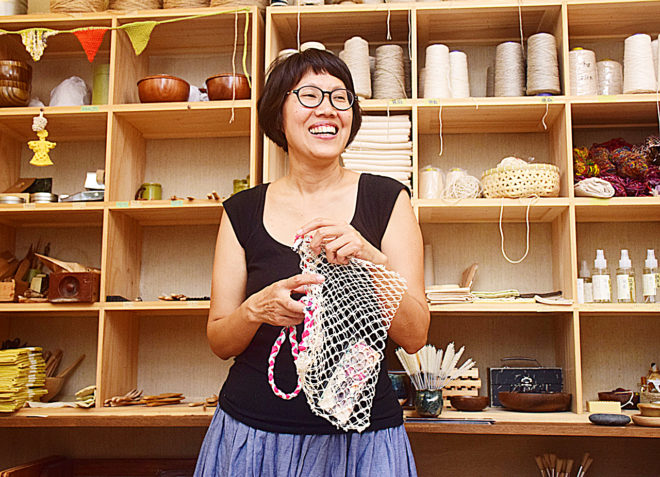 Bamboo straws, bamboo spoons and bags made from discarded fishing nets - Green Rabbit Studio keeps trying to develop reusable, eco-friendly everyday items. (Photo / Pan Tzu-chi)
Hoping to bring bamboo chopstick production back home, starting with processing in Taiwan
In fact, since Green Rabbit Studio opened, it has kept experimenting with all kinds of uses for bamboo, including splitting it open directly and making it into bamboo strips, then weaving them into vessels and back baskets of various sizes. The small ones can serve as dish racks, so freshly washed bowls need not fear damp; or a knitted cover can be added to turn them into warm storage containers.
Of course, the ideal scenario would be to make everything from Taiwanese bamboo, but Miffy admits frankly that with rural areas short on labor and offering no price, even the makino bamboo and green bamboo covering the mountains are hard to use. Still, the couple found some workers in Nantou and Taitung to help split bamboo, then deliver it to the studio, where Chen Ren-quan processes it himself into woven bamboo strips.
"But honestly, I sell at random prices," Miffy says with a laugh. Bamboo straws cost just 30 yuan, and a small bamboo basket just 450 yuan, but once you factor in labor hours, shipping and production, they would have to sell for 2,000 to 3,000 yuan to make sense. And all of this is simply to make ordinary people more willing to give it a try.
Miffy says they are currently working with some carpenters, importing rough bamboo blanks from China and processing them in Taiwan, and after gradually scaling up they will see whether bamboo production can be brought back to Taiwan. But she admits frankly that in terms of labor costs, it is really hard, though they will keep trying. She has also been in contact with the Taiwan Forestry Research Institute to discuss cooperation, but since many operators need thinned timber, demand outstrips supply and it is hard to obtain material for use.