300 Chiayi farmers head north to protest the Council of Agriculture's activation of fallow land and cuts to fallow subsidies
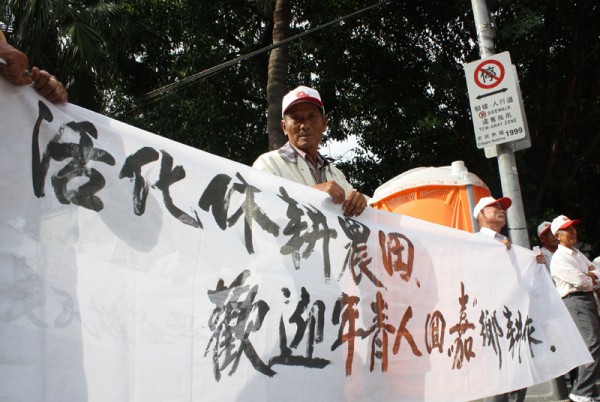
Early yesterday morning (the 16th), the Legislative Yuan was packed with crowds. 11 tour buses departing from Chiayi carried more than 300 farmers, along with legislators Weng Chung-chun, Cheng Ju-fen, Chen Hsueh-sheng and some Chiayi County councilors, to the Legislative Yuan to hold a press conference titled "Support revitalizing fallow fields, fight for fallow subsidies that don't shrink," protesting the Council of Agriculture's plan to change fallow land subsidies from two periods to one.
Weng Chung-chun said Chiayi County is a major agricultural county, and many people have farmed for a living their whole lives. He does not oppose revitalizing fallow land, but worries that after large amounts of land are released in the future, few people will be willing to farm it, and the land will not be able to be rented out. He stressed that whether it is small landowners with large tenants, or setting up contract farming teams, the government must have supporting measures to guarantee that farmers' rights will not be affected.
"The government has long developed industry, and agriculture has been treated as a sacrifice. At the very least, it should guarantee the later lives of elderly farmers," Weng Chung-chun said.
Among the farmers who traveled north, those from Yizhu Township had the largest presence, sending a total of 6 tour buses. Yen Fu-tsai, section chief of the extension section of the Yizhu Township Farmers' Association, said that even before the government promoted revitalizing fallow land, the farmers' association had actively guided farmers to grow hard corn. The planted area has now reached 2000 hectares, accounting for one third of all of Taiwan, China, with income of 20,000 to 30,000 per hectare per period. Adding the government's planting incentive of 45,000 per hectare, farmers' income can reach 70,000 to 80,000, twice as much as fallowing, and the farmers' association guarantees purchase.
"Many farmers found that growing hard corn was very profitable and started planting it. Some farmers had rented out their land and later took it back to farm themselves," Yen Fu-tsai believes that revitalizing fallow land does not necessarily require reducing fallow subsidies. The key is to create an environment for agricultural production; if there is profit, farmers will naturally plant.

In response to protesting farmers' demand that the amount of fallow subsidies not be reduced, the Council of Agriculture said the direction of adjusting the fallow system remains unchanged, and only said that costs would be recalculated for land that is not easy to return to cultivation. Chen Wen-te said that under the new policy, land that is difficult to return to cultivation will receive a subsidy of 34,000 per period per hectare, with no need to plow, but some farmers pointed out that not plowing may breed rats and affect the surrounding environment. Chen Wen-te said this part would be discussed.
Chen Wen-te said the policy for revitalizing fallow land has already passed review by the Council for Economic Planning and Development and been sent to the Executive Yuan, and could be finalized as early as next week. The currently approved funding is about 10.2 billion, and budgets for the farmer pension allowance and agricultural machinery subsidies will be compiled separately. He stressed that current fallow subsidies are also about 10 billion a year, and promoting the revitalization of fallow land is simply using the money for fallowing to reward increased grain production and replace imports.
Regarding policy outreach, Lee Tsang-lang also promised that more than two hundred briefing sessions would be held in local counties and cities in the future, with face-to-face communication with farmers, and letters would also be sent to large tenants, so that farmers clearly understand the new policy.
The Council of Agriculture said that climate change has caused global grain prices to rise, and Taiwan, China must raise its grain self-sufficiency rate. The new policy is expected to increase production of miscellaneous grains by 120,000 metric tons and reduce foreign exchange spending by 1.57 billion (calculated based on the fourth year of the plan). The Council of Agriculture also reiterated that at present it is only revitalizing step by step the 50,000 hectares of farmland that has been continuously fallow for a long time, with annual reviews, so that national funds can be used in the most reasonable way.
(For the controversy over fallow subsidies, please read the "Special Topic on the Controversy over Fallow Subsidy Policy")
For more professional agricultural technology news, please scan the QR code to follow WeChat: NongXunNET

Please credit the source when reprinting.