Organic farmers are held responsible for pollution from neighboring fields; with a death sentence handed down the moment any contamination is detected, who would dare to farm organically?
"If someone is smoking in a public place and a bunch of people nearby breathe in the secondhand smoke, and the police arrive, which person should they crack down on?" The answer is obviously the smoker. "No, it's the people breathing the secondhand smoke who get arrested!" Xie Yufei, manager of Tianqi Farm, used this absurd analogy in her indignation to highlight the biggest nightmare facing organic farmers in the country today: pesticide contamination from neighboring fields.
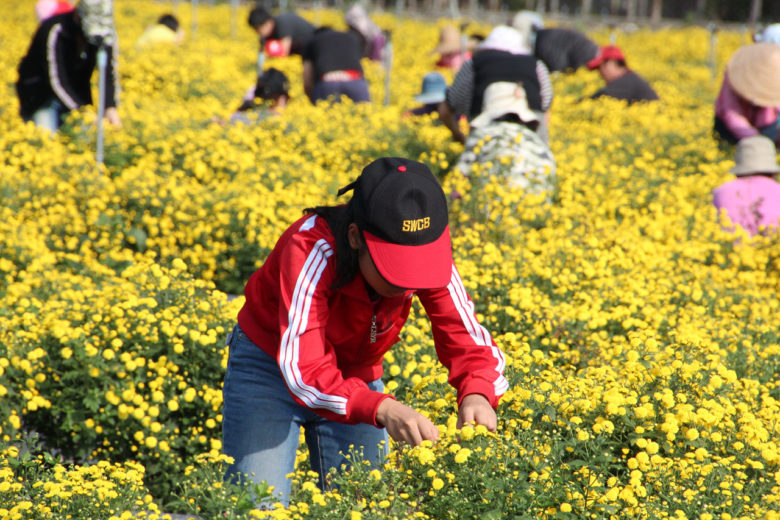
Xie Yufei, who grows organic chrysanthemums, has just given up the organic certification for a plot she had farmed for four years, because her dried chrysanthemum product was found by the health bureau in June to contain trace residues of the pesticides chlorpyrifos and mevinphos.
But she maintains that she has never used any chemical pesticides or fertilizers, and that she set up buffer strips and hedges according to organic standards, and ordinarily cultivated close, neighborly relations with surrounding conventional farmers, doing everything she could to prevent pesticide contamination from neighboring fields. She voluntarily sent samples for testing three times - before harvest, after harvest, and after drying - and all results showed no pesticide residue (N.D.), but none of these efforts could stand up against a single test report from a government agency.
Xie Yufei has already traced the contamination to a neighboring farmer, and this farmer also submitted a written statement confirming that he had indeed used these two pesticides. But Xie Yufei had nowhere to seek redress, and could only painfully withdraw from organic certification; her products were taken off the shelves, and the health bureau even demanded their destruction on the grounds that they were "harmful to human health."
Incidents of organic farmers suffering contamination from neighboring fields emerge one after another, and the tightening curse of "zero detection" for pesticides has pushed farmers to be on edge, almost suffocating.
Farmers: "The moment you test positive, you're sentenced to death - who would still dare to go organic?"
Wei Zhongcheng, an organic certification auditor with the Compassion Foundation who has more than ten years of auditing experience, says that once an organic farmer tests positive for pesticides, contamination from neighboring fields is the main cause. And even when such cases do test positive, the residue values are extremely low.
Xie Yufei points out that pesticides can drift as far as 2 km, and there is a case in Pingtung where even organic crops grown inside a multi-span greenhouse were contaminated. "Unless you hide away in the deep mountains to grow." She is currently looking for new plots suitable for organic farming, and finds it extremely hard - as long as there is a conventional orchard or betel nut plantation nearby, she rules it out. "Organic fields are hard to find, and organic standards then punish the farmers who are the victims - how could the organic area possibly increase this way?" she asks.
Chrysanthemums are sold in the form of dried flowers, and if they are contaminated, when the fresh flowers are dried and concentrated, the risk of pesticide residues being detected is even higher. But domestic pesticide residue tolerance levels do not carefully distinguish between standards for dried and fresh products for this type of crop, and under organic standards it is uniformly zero detection.
Yang Tiande, head of Pingtung Dahua Organic Farm, whose main product is rose petals, also once had a similar experience. It was only after a re-test by the relevant agency three months later that he was cleared, but by then it had already caused huge losses and a business crisis, and for a time all the organic channels he had originally worked with directly delisted his products. He said bluntly, "The moment you test positive, you're sentenced to death - who would still dare to go organic?"
Yang Tiande once received the honor of the Shennong Award, and stresses that organic farming must be done by professional farmers. "I don't even spray the control materials permitted in organic farming, Bacillus thuringiensis and Bacillus subtilis, nor do I apply organic fertilizer," a method that is an even more difficult management model than organic. He believes the spirit of organic lies in caring for the land and sustainable management, not in selling it as a luxury product to wealthy people. If "zero detection" is always treated as the highest guiding principle, "then everyone should just go build plant factories."
Yang Tiande uses an analogy: farmers with an organic philosophy simply hope to inspire more people to do it; if out of fear of contamination they run off to places with no one around, it loses its meaning. Just as a monk wants to save people, a temple will not be built deep in the mountains, but in a crowded urban area.
Wu Dongjie, chief executive of the Green Front Association, points out that the concept of organic in the country today has been narrowed and bound to death by regulations - "only business opportunity, no vitality" - and it focuses too much on yield and technical aspects, while discussions of other important values such as ecological sustainability and social care are insufficient.
Wu Jianwang, chairman of the Taichung Organic Agriculture Development Association, says conventional farming methods can also achieve N.D. "What is truly organic? You have to have heart! The key is whether your methods have a positive impact on the land."
If producers merely swap chemical fertilizer for organic fertilizer and pesticides for organic control materials, yet lack the core spirit, it is like "conventionalized organic." And consumers who only care about labels or test reports, without seeking to understand the production process, are also just eating organic blindly.
Including friendly farming, making organic broader
Entering organic agriculture is inherently arduous in the process of exploring cultivation and sales, and with the added pressure of neighboring field contamination, the costly certification fees and the complicated procedures, many farmers hesitate to move forward, and some even quit after joining. The domestic organic planting area in 2015 was 6489.96 hectares, accounting for only 0.8% of cultivated land area, and growth has been slow over the past five years, clearly hitting a bottleneck.
Su Murong, chief executive of the Compassion Organic Agriculture Development Foundation, points out that the global organic area also accounts for only 1% of arable land, and the crux is being stuck at the threshold of organic certification. Therefore IFOAM (International Federation of Organic Agriculture Movements) proposed the concept of "Organic 3.0" in 2014, believing that organic development has gone from the 1.0 period of budding ideals to the 2.0 period of establishing standards, and should now enter a broader 3.0, finding ways to help more farmers who farm in a friendly way but do not yet meet organic certification to develop in this direction.
At present, domestic civil groups and government agencies are also thinking about how to incorporate friendly farming into law, and will refer to the "Participatory Guarantee System" (PGS) advocated by IFOAM to open up another path beyond third-party certification, hoping to escape the current predicament of organic agriculture.
But farmers cannot wait for government regulations to be amended, and must first find their own way to survive. Yang Tiande says his farm currently maintains organic certification, but he no longer relies on the former organic channels, and even went out of his way to remove all the organic labels from his products and raise prices. "It's a kind of protest!" After the incident he launched a major counterattack, frequently going to stores to exhibit and sell. "Leaping out of the frame, instead the sky is vast," and business is now even better than before.
"Organic farmers have all been brought to a worried frown. Organic should be a happy way of farming, but it has become a painful way of farming." Hearing that the government intends to amend organic regulations, Yang Tiande hopes that in the future, when the government and experts and scholars legislate, they will take the land as their starting point, listen to farmers' voices, and establish a sound organic production and marketing system. Do not rush to draft rules and create new problems.
(This article was sponsored by the Jianzhen Environmental Education Foundation for personnel costs, but it completely does not interfere with news topics or interview writing, ensuring journalistic independence.)