Antibiotics Off the Dinner Table: How the Government and Industry Respond
According to estimates by Consumers International, more than 105,600 metric tons of antibiotics will be used worldwide between 2010 and 2030, and more than half of that will go to poultry, livestock and aquaculture. A survey conducted in our country 10 years ago found that about 3/4 of the antibiotics used domestically went to agricultural production. Because the drug-resistant bacteria produced by many antibiotics used in animals are zoonotic, if a wound on the human body happens to become infected with drug-resistant bacteria, existing antibiotics are not easily able to cure it. Misuse can not only produce superbugs, but can also create food safety risks once ingested by humans.
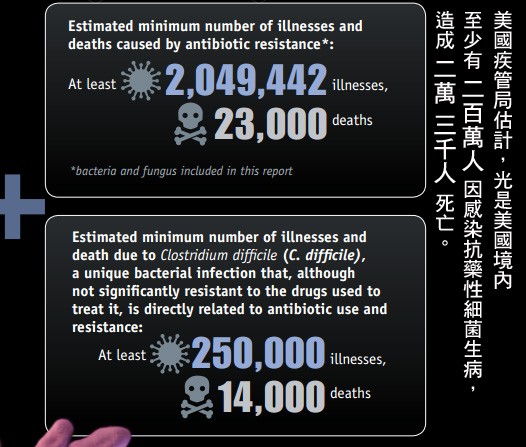
According to a survey commissioned by the British government, nearly 700,000 people worldwide died last year from infections caused by bacterial resistance, while the US Centers for Disease Control and Prevention (CDC) points out that at least 2 million people in the United States are infected each year and 23,000 die as a result.
Today (the 15th), the Consumer Protection Committee of the Executive Yuan and the Consumers' Foundation, Chinese Taipei held a press conference, arguing that businesses should use antibiotics within a reasonable range. The Bureau of Animal and Plant Health Inspection and Quarantine of the Council of Agriculture and the Food and Drug Administration (abbreviated as the FDA) say that monitoring and market spot checks are carried out every year, and the pass rate for antibiotic residues reaches more than 90%. But the Bureau of Animal and Plant Health Inspection and Quarantine has consistently refused to publish annual statistics on antibiotic use in the livestock industry. The bureau says that with last year's prevalent pig diarrhea, for example, antibiotic use naturally increased, making it hard to generalize.
Su Ih-jen, currently a distinguished research fellow in the Division of Infectious Diseases at the National Health Research Institutes, said in an interview with NewsMarket last year that the meat safety problems caused by antibiotic misuse in the livestock industry would be, after the tainted oil scandal, a major food safety problem in Taiwan, China that has not yet erupted. He said that according to data from his own early informal monitoring, the volume of antibiotics used in animals in Taiwan, China is 8 times that used in humans. "In the past we tried to discuss this with the Council of Agriculture, hoping it would strengthen monitoring of livestock farms and disclose the statistics, but the Council of Agriculture kept refusing."
Adding antibiotics to feed: legal and therefore acceptable?
Whether pigs, cattle, sheep, chickens, ducks, geese or fish, every kind of economic animal faces the risk of bacterial disease during growth. So to prevent livestock from getting sick, farmers add "antibiotics" to feed to reduce the chance of disease, thereby lowering the production costs of illness, veterinary treatment and death.
In our country, these antibiotics are governed by the Standards for Veterinary Drug Residues, and withdrawal periods are also set. As long as the dosage and withdrawal period comply with the rules, and the residue levels in fresh meat after slaughter meet the standards, it is acceptable. The FDA says inspection plans are carried out every year, and the pass rate is almost always above 90%.
However, many of the antibiotics used in livestock are the same as those used in humans. For example, tetracyclines and sulfonamides are also used in humans, only at different doses for people and animals. So even if residue levels in fresh meat comply with legal standards, are consumers still invisibly taking in more antibiotics?
Luo Chiu-ying, a food safety committee member of the Consumers' Foundation, Chinese Taipei, believes that although the dose is low, antibiotics are cumulative, and the Council of Agriculture should verify exactly how the antibiotics currently permitted for use affect the human body. The foundation also believes that legal use of antibiotics still carries the risk of breeding "superbugs." Since antibiotics were invented, they have been overused because they are so convenient, causing many bacteria to develop resistance and mutate. Once bacteria can resist all kinds of antibiotics, humans will face a situation where there is no medicine that can treat them.
Bureau of Animal and Plant Health Inspection and Quarantine: annual monitoring, standards strict and second only to the EU
On this point, Hsieh Chung-fa, section chief of drug management in the Animal Health Division of the Bureau of Animal and Plant Health Inspection and Quarantine under the Council of Agriculture, says that since 2000 the Council of Agriculture has referred to the standards of various countries and removed 34 antibiotics with higher risk to human health, including nitrofurans and chloramphenicol. At present, only 11 antibiotics remain that can be used in livestock but not in humans. And on July 1 this year, carbadox and arsanilic acid will also be removed.
Hsieh Chung-fa says that currently only the EU completely bans adding antibiotics to feed, while livestock that become ill can still be given antibiotics after diagnosis and treatment by a veterinarian. He also points out that one year after Denmark banned adding antibiotics to feed, it tracked the volume of antibiotics used for treatment and found it had clearly increased compared with the past, so the actual effect of reducing antibiotic use still needs further assessment.
In addition, the Bureau of Animal and Plant Health Inspection and Quarantine budgets more than 10 million yuan each year to conduct spot checks on various types of livestock farms, averaging about 30,000 to 40,000 blood samples per year. Hsieh Chung-fa says that once antibiotics are detected in a sample, the operator must provide the drug label, source, method of use and so on. If a reasonable explanation cannot be given, a fine of 30,000 to 150,000 yuan may be imposed under the Veterinary Drugs Control Act.
Pig farmer: not using antibiotics in feed requires more consumer support
Regarding the consumer protection agencies' call for "antibiotics off the dinner table," Chang Sheng-che, a pig farmer at Yonglong Ranch who is familiar with the industry, says that at the very least antibiotics should be used reasonably when treating pigs. But reducing or even completely eliminating antibiotics in feed inevitably increases costs, "even the EU has found it difficult to promote," and it relies heavily on support from the consumer market.
He says pigs under 20 kg are the hardest to raise and often die of diarrhea, so operators usually agree with feed mills to add legal doses and types of antibiotics to feed. Feed normally costs about 18 to 20 yuan per kg, and the added antibiotics, depending on the brand, range in price difference from several hundred to several thousand yuan per kg, while the frequency and amount added depend on when the pigs recover. Usually, from 20 kg until shipment at 60 kg, the pigs are generally more stable and healthy, so there is naturally no need to add extra antibiotics.
For the pigs he himself feeds with "feed containing no added antibiotics," the cost is at least 20 to 30 percent or more higher than with added antibiotics. He says with a bitter smile, "And this is still the result of having managed to pull through." He says that even if probiotics are added throughout the entire rearing process, it takes time for the results to show. In practice, it can reduce antibiotic use by about 20 to 30 percent, but relatively speaking the losses are still greater than when medication is used.
In addition, an unnamed pig farmer says that some other operators had raised pigs with antibiotic-free feed, only to have the feed contaminated because the tanker truck transporting the feed had previously carried feed mixed with antibiotics, and in the end the pork tested positive for antibiotics, damaging the operator's reputation. This pig farmer believes that to completely avoid such contamination, it would be necessary to set up completely independent feed tanks, transport vehicles and a separate rearing building, "all of which require capital investment and will inevitably be reflected in the selling price."
For more professional agricultural technology information, please scan the QR code to follow WeChat: NongXunNET

Please indicate the source when reprinting.