Dioxin duck incident was sporadic; the three ministries of agriculture, health, and environment held a rare joint clarification
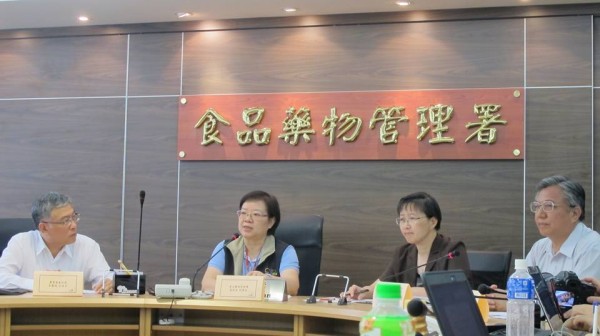
The Ministry of Health and Welfare, the Council of Agriculture and the Environmental Protection Administration held a joint press conference on the morning of the 11th to explain that the duck found on July 28 to exceed the dioxin limit was a single isolated incident. After the three ministries and agencies held an emergency response meeting the following day, they expanded the investigation to the ducks, feed and surrounding environment at a total of 8 farms upstream of that duck vendor, and imposed movement controls; none of the investigation results found levels exceeding the limit.
The spokespersons of the three ministries and agencies attending the press conference were Chen Shu-ling, deputy director of the Environmental Management Division of the Environmental Protection Administration; Jiang Yu-mei, deputy director-general of the Food and Drug Administration; Chu Ching-cheng, deputy director of the Animal Husbandry Division of the Council of Agriculture; and Li Chun-chang, director of the Institute of Environmental and Occupational Health Sciences at National Cheng Kung University, which was commissioned to carry out the dioxin testing.
Jiang Yu-mei, deputy director-general of the Food and Drug Administration, said that from the 93rd year of the Republic of China to the present, the government has continued to test and monitor dioxin levels throughout Taiwan, China. The Food and Drug Administration commissioned National Cheng Kung University to carry out food dioxin surveys and risk assessments, divided into seven regions - northern, Zhumiao, central, Yunlin-Chiayi-Tainan, Kaohsiung-Pingtung, Yilan, and Hualien-Taitung - to conduct dietary exposure risk assessments. By the 102nd year, a total of 2369 food and human body dioxin level surveys had been completed, and none of the 60 duck meat samples tested over the years had exceeded the limit.
The duck found on July 28 of this year to exceed the dioxin limit was detected during this year's monitoring of the Kaohsiung-Pingtung area. A total of 120 items were sampled in this round, including 45 aquatic and livestock products, 31 grains and miscellaneous crops, 22 vegetables and fruits, and 22 processed foods. The duck's dioxin toxic equivalent concentration was 15.1 picograms/gram of fat, compared with the control standard of 1.75 picograms/gram of fat, or about 8.6 times. The supplier sold about 1400 ducks of the same batch that day, possibly originating from 8 farms.
In addition to the investigation finding no exceedances at any of the 8 duck farms, the Food and Drug Administration also carried out two rounds of sampling of a total of 20 commercially sold ducks in Tainan, Kaohsiung, Pingtung and other areas, while the Council of Agriculture sampled a total of 10 feed samples from feed mills and duck farms; none exceeded the dioxin limit. The Environmental Protection Administration sampled environmental media at duck farms, including soil, sediment and pond water, for a total of 25 samples, and dioxin levels were also below the environmental control standards.
Officials attending the press conference said that because the sampling result for the dioxin-tainted duck was point-source contamination, not block-shaped or line-shaped distribution, and environmental sampling also showed no exceedance or abnormality, and repeated testing had already been carried out, the testing would end there and there would be no further re-testing.
Li Chun-chang, director of the Institute of Environmental and Occupational Health Sciences at National Cheng Kung University, who was responsible for the testing, also said that free-range livestock and poultry are more prone to individual cases of environmental contamination, and that abroad there had also been a single isolated contamination incident in which eggs reached dioxin levels of 20-30 picograms/gram of fat.