Green conservation water caltrop is cultivated to protect pheasant-tailed jacanas, and everyone is welcome to support it.
Green Conservation Label Helps Create a Comfortable Home for Wildlife
After a bountiful first rice harvest, in October the fields of Guantian Township are covered with mats of water caltrop leaves floating on the water, and on the green leaves beautiful pheasant-tailed jacanas can be seen strolling and hopping about. But do not let their relaxed appearance fool you: two years ago, 85 pheasant-tailed jacanas died after accidentally eating pesticide that farmers had mixed into the rice grain. To protect the rare pheasant-tailed jacana, the Forestry Bureau and the Tse-Xin Organic Agriculture Foundation launched the "Green Conservation Label" last year, guiding farmers to cultivate without pesticides or chemical fertilizers and to create habitat friendly to the pheasant-tailed jacana. So far, 11 water caltrop farmers have responded.
It is now the peak season for water caltrop, and farmers are facing a "flood of water caltrop." The Forestry Bureau and the Tse-Xin Organic Agriculture Foundation ask everyone to support water caltrop fields bearing the "Green Conservation Label," so that your spending can become a force for protecting the ecology!
The Pheasant-Tailed Jacana Is a Farmer's Good Friend
Traces of the pheasant-tailed jacana have existed in Taiwan, China for a hundred years, distributed from north to south and from west to east, with the largest distribution in the plain wetlands of the Chiayi-Tainan region. A pair of long toes allows the pheasant-tailed jacana to walk freely on leaves, and this superb skill has earned it the title of "leaf walker." When flying, the pheasant-tailed jacana's beautiful black tail feathers make it resemble a "fairy stepping on waves," and Tainan County even named the pheasant-tailed jacana its county bird.
Not only is its appearance endearing, the pheasant-tailed jacana is also a good helper for farmers. They most like to stand on water caltrop leaves searching for prey, but they are not stealing water caltrop to eat; rather, they prey on snails, tadpoles and frogs on the water surface, many of which are pests that hinder the growth of water caltrop. They are therefore deeply welcomed by farmers, especially in Guantian Township, where rice and water caltrop are rotated, and scenes of pheasant-tailed jacanas and people living in harmony can often be seen.
However, like many wild animals, man-made pollution, pond development and the conversion of wetlands into industrial land have left the pheasant-tailed jacana with nowhere to shelter. More than 20 years ago, the total number of pheasant-tailed jacanas across Taiwan, China was once fewer than 50, and in 1989 the Council of Agriculture designated it as a level-two "precious and rare protected species."
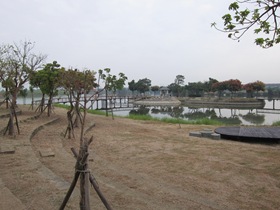
Yang Cong-gui, who promotes friendly farming at the Shui-Ling Organic Farm in Guantian Township, has observed pheasant-tailed jacana ecology for more than twenty years. At that time Guantian had a Hulu Pond, an artificial pond built during the Kangxi era to store water. Yang Cong-gui said this pond was a paradise for pheasant-tailed jacanas and was once the largest wintering area for them. However, a few years ago, in order to create the "Hulu Pond Natural Ecology Park," the county government built a pier, pavilions and a suspension bridge around the pond, and with the high-speed rail sounding a "greeting" to the pheasant-tailed jacanas every 30 minutes on schedule, "more and more people came, and the noise was so loud that the pheasant-tailed jacanas all hid away." Yang Cong-gui said with emotion.
Besides the disappearance of habitat, another reason for the decline of the pheasant-tailed jacana is the use of pesticides. In 2010 a large-scale die-off of pheasant-tailed jacanas occurred, and investigation found that to save costs, farmers had mixed pesticide into rice grain and replaced transplanting with "direct-seeded rice," causing 85 innocent pheasant-tailed jacanas to die after eating it. Yet besides direct deaths, pesticides remaining in the fields over the long term change the entire ecological environment, and the number of pheasant-tailed jacanas that go extinct because they cannot find food is likely far more than 85.
Green Conservation Label Water Caltrop Purchase Information:
(1) Friendly Land Organic Alliance
http://shui-ling.organic.org.tw/supergood/front/bin/home.phtml
Telephone: 06-5795775, fax: 06-5795583, mobile: 0956-875678, E-Mail: [email protected]
Farm address: No. 10-1, Lane 400, Section 2, Zhongshan Road, Longben Village, Guantian District, Tainan City 720
(2) Or you may inquire at Leezen stores across the province.