Written by Liu Yixin and Lin Peijun, reporters for News&Market
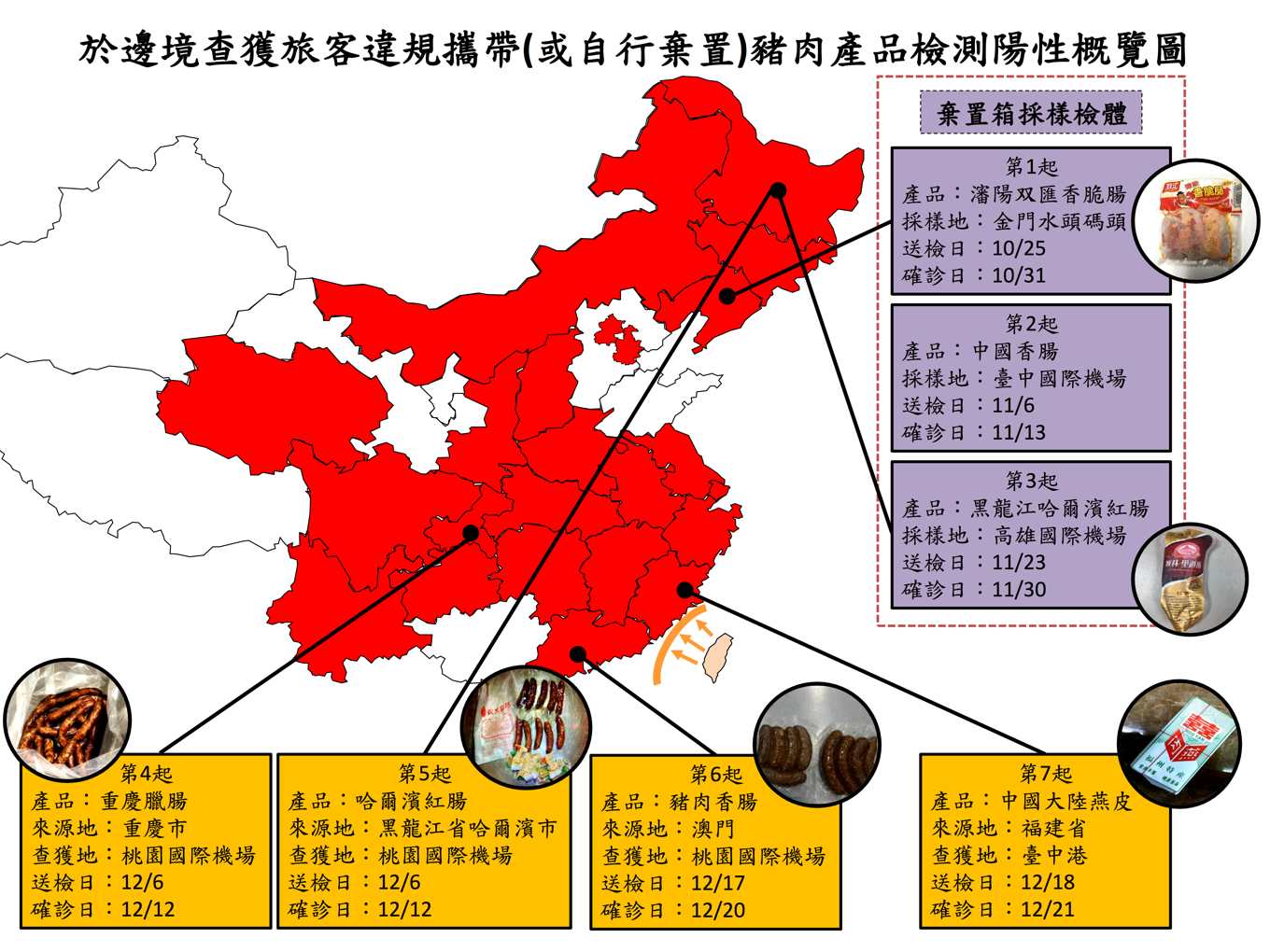
A meat product brought into Taiwan, China from China tested positive for African swine fever today, the seventh such case. As of today, seven cases of African swine fever virus have been detected, with the meat products coming from Shenyang, Harbin, Chongqing, Macao, China, Fujian and other places. Huang Jincheng, deputy chairman of the Council of Agriculture, explained that four of the seven cases were detected in December, which shows that Chinese meat products have already been comprehensively contaminated by the virus. "This is a very dangerous signal." The African swine fever epidemic has already spread to 23 provinces in China, and he called on people not to bring meat products back to Taiwan.
He went further and directly criticized the situation as completely out of control in China: "It is evident that hog farmers did not proactively report when they found swine fever, there was no veterinarian inspection and oversight before or after slaughter, all pork, whether infected or not, was sent for processing, and the government did not manage it."
Image provided by Taipei Customs It Is Best Not to Bring Canned Goods at All As for whether lard and canned goods can be brought back into the country, Peng Mingxing, section chief of the Bureau of Animal and Plant Health Inspection and Quarantine, explained that products already rendered into lard are not restricted under the relevant regulations and can enter the country without issue. As for canned goods, he explained that according to international standards, cans that meet sterilization standards must have all organisms inside killed, so any product meeting the requirements for canned goods can enter Taiwan. However, ordinary people are unclear about the definition of canned goods and easily bring them back by mistake, so he still recommended that it is best not to bring any at all.
Is Laboratory Testing Capacity Sufficient? Council of Agriculture: No Problem Deng Mingzhong, acting section chief of the Animal Health Research Institute, said that Taiwan uses viral nucleic acid for testing. Testing meat products takes two days for a negative result and four days for a positive result, while clinical specimens, because blood, feces and the like can be collected directly, take only one day.
However, as the African swine fever epidemic worsens and exchanges between the people of the two countries become more frequent during the New Year period, is the testing capacity of laboratories in Taiwan sufficient to cope? Huang Jincheng stressed, "No problem." The Animal Health Research Institute can flexibly adjust personnel and test in groups. Regarding outside doubts that laboratories in Taiwan do not meet the validation of the World Reference Laboratory, Deng Mingzhong responded that Taiwan has the ability to test African swine fever samples and has already conducted capability comparison with the World Reference Laboratory, and its testing capability is consistent with that of the World Reference Laboratory.
Is Raising the Fine to 200,000 Effective? Huang Jincheng: Continued Education Is Still Needed As for whether raising the fine to 200,000 has achieved a deterrent effect, Huang Jincheng said it is not yet clear and that only over a longer period can the effect be achieved. He stressed that originally, regardless of epidemic area or non-epidemic area, meat products could not be brought back into the country, but people in Taiwan have not developed the habit, so continued education is necessary to develop the habit of not bringing meat products in or out.
Huang Jincheng also pointed out directly that two months earlier he had already said African swine fever in China would spiral out of control, and this peak period is predicted to last half a year to a year. "Only after all infected pig farms have been burned down and the number of infected pigs decreases will the epidemic ease, but as long as pigs still exist, the virus will lurk in the environment at any time, merely temporarily suppressing the epidemic."
Council of Agriculture: "Some People Just Do Not Feel It; They Only Learn Once They Are Fined." According to Council of Agriculture statistics, after the penalty amount was raised on December 18, there were still violations every day, including 9 cases on the 18th (2 fined 200,000 yuan, 6 fined 30,000 yuan, 1 fined 10,000 yuan), 5 cases on the 19th (1 fined 200,000 yuan, 4 fined 30,000 yuan), and 7 cases on the 20th, including 2 fined 200,000 yuan (Chinese pork products), 4 fined 30,000 yuan (3 cases of Chinese poultry and beef, 1 case of Thai pork products), and 1 fined 10,000 yuan (Japanese dog and cat food), with 1 new case on the 21st fined 200,000 yuan (Chinese fresh pork filling).
Regarding people who are fined repeatedly saying they did not know they could not bring meat products back into the country, Huang Jincheng said that publicity has already been carried out for so long, including through television and print media. "Some people just do not feel it; they only learn once they are fined." Currently, all flights arriving in Taiwan also carry publicity broadcasts in Chinese, English and Vietnamese. He stressed once again that people should absolutely not bring meat products back into the country.
The Council of Agriculture once again reminded the public not to bring meat products when entering the country and not to buy foreign meat products online for shipment to Taiwan. Violators will face heavy penalties, so do not test the law. Complete epidemic prevention information can be found on the website of the Bureau of Animal and Plant Health Inspection and Quarantine.
(For related news on African swine fever, please click here to read)