Natural Aiyu jelly is low in calories; four tricks to tell real from fake: look, simmer, freeze, and cut
Correction note, 20140812:
After this article was published, some readers questioned whether the calorie calculation for real and fake aiyu was correct. NewsMarket called the Miaoli Agricultural Research and Extension Station the same day (July 29) to confirm, and the researcher replied by email that agar is almost entirely carbohydrates (starch), so its calorie content is fairly high; the figure of 300 kcal came from Ministry of Health and Welfare data, and when it is generally added to foods it is diluted, with the dilution ranging from 4 to 50 times depending on the manufacturer, but no matter how much it is diluted, the calorie content will still be higher than that of aiyu jelly. However, the researcher said on the phone that because fake aiyu also has other starches and substances added, the 300 kcal is an average figure. NewsMarket replied on this basis and attached the Ministry of Health and Welfare data.
However, on August 11, the researcher wrote again by email to say that the earlier wording from the Miaoli station might cause consumers to misunderstand, and hoped to correct the calorie figure for fake aiyu to 6 to 75 kcal, calculated by referring to common commercial recipes and diluting 4 to 50 times.
The Miaoli station also stressed that some fake aiyu has additional artificial colors and flavorings added, and eating too much may burden the human body, which is why it proposed methods for distinguishing real from fake aiyu jelly, in the hope that everyone can eat healthily and with peace of mind.
The Miaoli Agricultural Research and Extension Station's correction note is attached below:
Fake aiyu is mostly composed of starchy substances (such as tapioca starch, carrageenan, agar, etc.) and other carbohydrates, sugars, colors and artificial flavorings. Because starchy substances are used in diluted form, the calorie content per 100 grams is about 5 to 75 kcal, varying with the recipe, and this correction is hereby provided.
In addition to starchy substances, some fake aiyu products have extra "artificial colors" and "flavorings" added; eating too much of these chemical substances may burden the human body. Therefore, methods for distinguishing real from fake aiyu jelly are proposed, in the hope that everyone can eat healthily and with peace of mind.
Real aiyu jelly is mostly made up of pectin and water, and is rich in dietary fiber. In the hot summer, everyone might as well make their own natural aiyu ice at home, which is both hygienic and cooling!
The original text follows───────────────────────────────────
In the hot summer, many people like to enjoy a bowl of chilled aiyu, but the Miaoli Agricultural Research and Extension Station points out that most aiyu on the market is "fake aiyu" mixed from agar powder, starch, flavorings and colors, with a calorie content of nearly 60 kcal per 100 grams, while natural aiyu made by rubbing aiyu seeds has only 2 kcal, lower even than the weight-loss favorite "kanten" (agar). The public can rely on four methods, "look, rub, set, cut": real aiyu is soft, tender and springy, releases water after about 2 hours at room temperature, and turns to water within 24 hours, yet can last at least 5 minutes in boiling water without melting, while fake aiyu tastes rather crisp and dissolves instantly when immersed in boiling water.
Real aiyu has only 2 kcal, lower than kanten
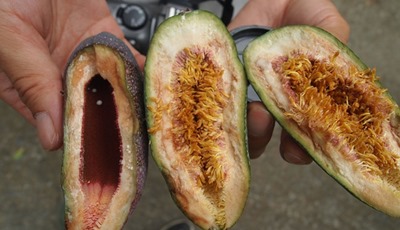


Eating natural aiyu also lets you do your part for Taiwan's agriculture. According to agricultural yearbook statistics, last year Taiwan's wild plus cultivated aiyu covered about 550 hectares, with output of 689 metric tons. In the early days it was a favorite of the Japanese, and China once tried to transplant it but repeatedly failed, the key being the ultra-tiny 0.2 cm "aiyu fig wasp."
Lin Meng-chun said the aiyu tree is dioecious, and the aiyu fig wasp is the only pollinating insect for aiyu seeds, living symbiotically with aiyu. Adult wasps lay eggs in the male fruit, and after hatching they parasitize the ovules internally, absorbing nutrients; when the wasps fly out they are covered in pollen, and if they happen to encounter a female fruit, pollination succeeds and clusters of small aiyu seeds are formed.
The aiyu fig wasp is sensitive to the environment and is mostly distributed near the Central Mountain Range. Even moving from Taiwan's mountains to the plains causes it to fail to adapt, so wild aiyu is often seen in high mountains, let alone across a strait. This one-of-a-kind good taste can only be enjoyed in Taiwan.
In recent years, DIY washing of aiyu has become popular. Lin Meng-chun reminds people that before rubbing, the aiyu seeds should be soaked in water for 3 minutes to soften the skin, and no sugar should be added while rubbing in water, otherwise the enzyme links will be destroyed and no pectin will come out; the time is best kept to 5 to 10 minutes to prevent aiyu from releasing an enzyme inhibitor that affects setting.
Dried aiyu seeds can be stored for 2 years. Lin Meng-chun suggests that people might as well buy them together with the achene skins, which keep even longer; not only can you try scraping aiyu seeds yourself, but stewing the fruit skins with pork ribs also has a diuretic effect.