Agricultural insurance subsidy standards determined: meeting any one of three conditions, including annual income exceeding 250,000
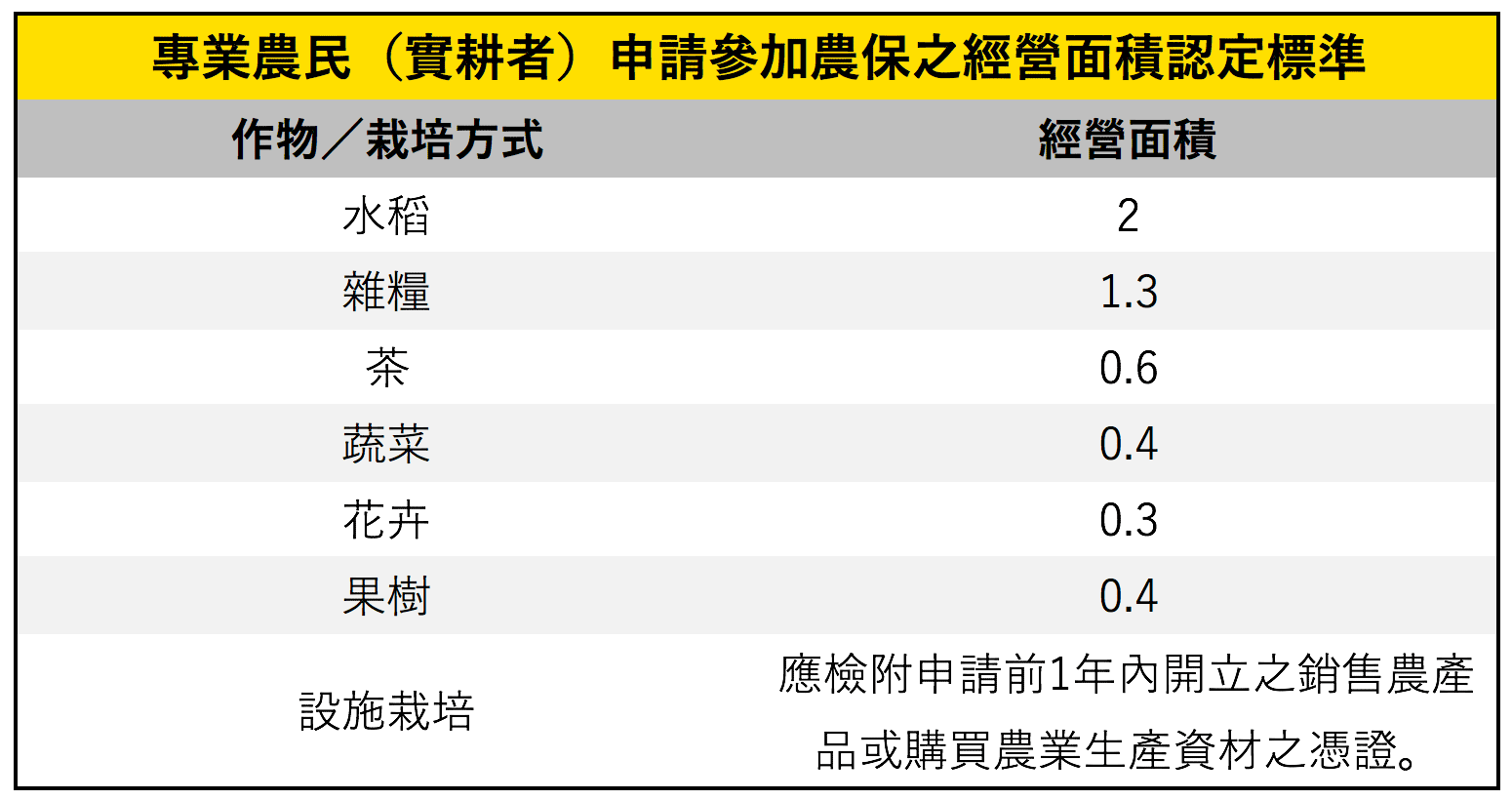
The criteria for recognizing farmer status vary, leaving many people who actually farm unable to join farmer insurance and obtain the protection they deserve. At a press conference on the 27th, Council of Agriculture Deputy Minister Chen Chi-chung said that in the future a policy of "decoupling people from land" will be adopted, allowing farmers who have no land but actually farm to apply to join farmer insurance if they meet any one of three criteria: annual income exceeding 250,000 yuan, annual production costs exceeding 150,000 yuan, or operation scale reaching the standard. The policy is expected to take effect after the Lunar New Year.
Chen Chi-chung: "Decoupling people from land" adopts substantive recognition
Agriculture and Food Agency Deputy Director-General Chuang Lao-ta said that the biggest difficulty preventing young farmers from joining farmer insurance is the land contract, because landowners are unwilling to sign contracts, fearing that it will be like the past 375 lease reduction and land-to-the-tiller policies, in which land had to be forcibly shared with tenant farmers. But the policy was revised and completed long ago, yet landowners still cannot let go of their shadow. Solutions already introduced include informal contracts, with both parties signing a cultivation agreement that only needs to note the land parcel number. In addition, because landowners do not trust private contractual relationships, another approach is to give the land to the farmers' association, which then allocates the land to young farmers. "But these can only solve a small part of the problem; the real fundamental solution still depends on substantive recognition of actual farming."
Chen Chi-chung said that the situation in which farmers who actually farm cannot join farmer insurance because they have no land is becoming increasingly serious, and agricultural landowners are not necessarily real farmers either. Therefore, in the future a policy of "decoupling people from land" will be adopted, adding a person-recognition system. If someone owns farmland and is also the actual cultivator, the current farmer insurance and related subsidy regulations will be followed, but if they engage in agriculture themselves yet have no land, the Council of Agriculture will set out actual standards to recognize actual cultivators and ensure farmers' rights to join farmer insurance. Priority will be given to guiding 30,000 young farmers to join farmer insurance. In the future, adjustments to this substantive recognition of actual farming will continue. First, the focus will be on the Council of Agriculture-recognized Top 100 Young Farmers, members of local young farmer associations, and farmers who pass the four-chapter-one-Q certification and cooperate with relevant government policies. Statistics show that these types of farmers alone number 30,000 who cannot join farmer insurance, and in the future priority will be given to guiding them to join. Chen Chi-chung said frankly that it is impossible to include all people actually engaged in agriculture at once. This is only the scope of those actually farming who will join farmer insurance in the first year, and in the future dynamic rolling adjustments will continue, including for those farming state-owned land and riverbed land, as well as many who lease idle livestock farm land to others but cannot join farmer insurance. There will be many subsequent discussions on various aspects, and it is hoped that future policy can truly take care of farmers.


Eligible farmers can register at agricultural improvement stations
As for the accepting agency, Chen Chi-chung explained that farmer insurance used to be handled by township and town farmers' associations, and in the future it should also be so, but because the data transfer has not yet been completed, the Council of Agriculture's district agricultural improvement stations will accept applications first. Eligible farmers can register at each improvement station. "Improvement stations already have guidance and extension functions under their jurisdiction. Having the government recognize actual farming and then transfer it to each township and town farmers' association can avoid outsiders worrying about fake farmers joining farmer insurance." After each improvement station accepts an application, it will also follow the practice used for natural disaster damage inspections, inviting the local farmers' association and agricultural improvement station to conduct an on-site inspection, and notify the review result and certification document in writing. People actually farming can use that certification document to apply to join farmer insurance.
Chen Chi-chung emphasized that in order to eliminate fake farmers joining farmer insurance, the farmer insurance review regulations have also been revised. In addition to requiring documents in the first year of applying for farmer insurance, relevant materials must also be submitted every year thereafter. "It is not that after joining farmer insurance in the first year, one can have farmer insurance forever. Every year they must submit relevant facts about farming to ensure farmer insurance eligibility. This revision of the provisions takes care of farmers who actually farm and will not cause farmer insurance welfare for farmers to suffer other impacts."
At present, the Council of Agriculture has completed internal discussions, but because it involves revising the farmer insurance review regulations, advance notice must be given plus various administrative procedures. Chen Chi-chung said that at the earliest, after the Lunar New Year holiday, the relevant procedural and administrative work will be completed. In addition, Chen Chi-chung also said that recognizing people actually engaged in agriculture will not only be used for the scope of farmer insurance. In the future, related Council of Agriculture subsidies, farmer machinery and material subsidies, production traceability label subsidies, natural disaster relief, and so on will all target people actually engaged in agriculture, so that the Council of Agriculture's annual budget of 120 billion can be used on real farmers.