Food Sovereignty People's Forum Series: A Path That Upholds Food Sovereignty
Text by Jiang Junru, Editor in charge: Chen Ying'en
Photography: Sun Qiongli of Coolloud
Farmers Worldwide Connect to Fight Land Grabbing Together
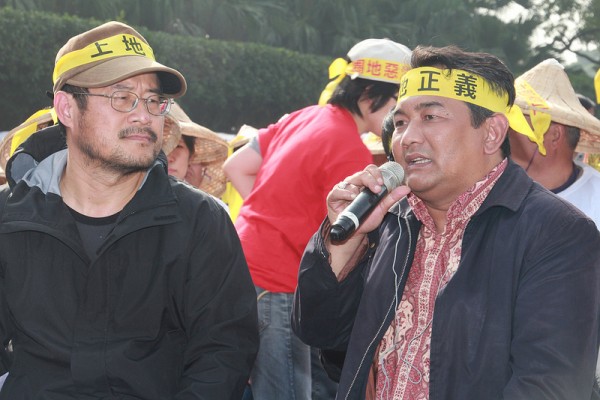
On February 3, the eve of Farmers' Day, the "People's Forum on Food Sovereignty" on Ketagalan Boulevard brought together partners from ten countries in the East Asia and Southeast Asia region of the international grassroots organization La Via Campesina (Peasant's Way), along with farmer friends from rural areas across Taiwan, community organizers, and representatives of the Danhai New Town Phase II group, the Tainan Self-Rescue Association Against the Eastward Railway Relocation, the Zhudong Erchongpu Self-Rescue Association, the Taichung Wenshan Industrial Zone group, and the Zhubei Puyu Self-Rescue Association, as well as friends concerned about rural and food issues, to jointly discuss the issue of resisting land grabbing and to draft a path forward based on the Global South as a foundation for rallying.
Mr. Zhong Yongfeng, moderator of the forum and a figure who moved from the Meinong Love for Hometown Association into the farmers' movement and community movement, declared at the opening: "Connecting with the global farmers' movement is very important for Taiwan." There is evidence for this statement. Since the 1970s, Taiwan's long-standing smallholder system has been steadily eroding. In the 1990s, in order to join the WTO (World Trade Organization), the government pushed Taiwan's agriculture forward as a bargaining chip, and it was from that time that Taiwan's agriculture, farmers, and rural communities became the price of joining the global "industrial club." To this day, we share a similar situation with many Third World countries brought about by globalization, all facing the ravages of neoliberalism. Therefore, international connection with La Via Campesina and the exchange of experience, linking together an international action network based on grassroots movements and the people, is precisely the work that Taiwan's farmers' movement urgently needs to deepen.
Professor Xu Shirong of the Department of Land Economics at National Chengchi University responded to La Via Campesina's concern over the issue of land grabbing by citing the rampant land expropriation in Taiwan. Professor Xu believes that the fundamental crux of why Taiwan has faced so many land expropriation situations in recent years is precisely because the government is financially strapped, and therefore forcibly expropriates people's land and sells it cheaply to conglomerates.
Professor Xu emphasized: "Land expropriation has strict review conditions, yet the current expropriation by the Taiwan government is robbing the poor to enrich the rich, exploiting the people, and violating basic human rights." Professor Xu also encouraged the friends present: "At today's forum (2/3), friends from all over Taiwan and friends from abroad are gathered together, and discovering that everyone faces the predicament of land grabbing, you must feel very anxious inside, but we must not be discouraged. As long as everyone unites, we can certainly hold on to our own land."
Reflecting on International Experience Upholding Food Sovereignty
Henry Saragih, chair of La Via Campesina and also a member of the Indonesian Farmers' Union (Serikat Petani Indonesia, SPI), said that La Via Campesina made its first visit to Taiwan's rural areas in early June 2012 and, through arrangements by the Alliance for the Defense of Rural Villages and the Taiwan Rural Front, visited Zhudong Erchongpu, Wanbao in Miaoli, Xizhou in Changhua, Meinong in Kaohsiung, and Yilan, and held multiple forums and exchanges with local farmers.
During the trip and exchanges, La Via Campesina members found that farmers in Taiwan and farmers in the Global South face the same difficult situation, namely the predicament of agriculture and rural communities caused by globalized trade under the neoliberal structure. Neoliberalism emphasizes free trade as its principle, but in reality it sets all countries of the world competing against one another, producing a phenomenon where the rich get richer and the poor get poorer.
Specifically, under the influence of neoliberal globalization, even though Taiwan can produce abundant and diverse agricultural and food products, it still needs to import food from abroad, squeezing the domestic agricultural and food market, and those pushed out are the smallholders without huge capital for large-scale production. Looking further at Southeast Asia near Taiwan, Indonesia and Malaysia are forced to plant and export oil palms, a crop not native to their regions, while Vietnam and Thailand are forced to use production methods that harm the natural environment to plant and export rice on a large scale. As a result, more and more tropical rainforests and smallholders' land are forced to become crop-producing areas for large agribusinesses, with large-scale monoculture planting models implemented.
However, these benefits ultimately all belong to transnational conglomerates. Henry emphasized: "Only by continuously proclaiming and practicing food sovereignty can the global hunger problem be solved."