Central and southern Taiwan, China hit by air pollution, Zuoying listed among cities recommended for evacuation, legislators urge real emissions cuts
On New Year's Eve, Taiwan, China faced its most severe transboundary air pollution impact in nearly three years, with air quality in the north and the western half of the island both reaching the red level. However, Yeh Kuang-peng, chairman of the Taiwan Healthy Air Action Alliance, pointed out that this wave of transboundary pollution lasted only 10 hours, and that the truly serious problem is the air pollution caused by various long-standing pollution sources in Taiwan, China. "EPA Director-General Lee Ying-yuan happily proclaimed on New Year's Day that there was blue sky, but at that very time central and southern Taiwan were still mired in severely polluted areas." The administrative authorities rolled out many policies over the past year, "but they only improved the north, without prescribing the right remedy, and did not save central and southern Taiwan. They should review this and increase control efforts in the hardest-hit areas of central and southern Taiwan, achieving real reductions, rather than playing number games with averaging methods that paint things in a better light."
The Taiwan Healthy Air Action Alliance joined with legislators Liu Chien-kuo, Chen Yi-min, and Hsu Yung-ming on the 3rd to jointly hold a press conference. Liu Chien-kuo said the air pollution issue cannot wait any longer; the air in Zuoying, Kaohsiung is extremely bad, and Yunlin is not much better. According to data from 10 monitoring stations in Yunlin, two of them worsened compared with last year, showing that the air pollution situation in central and southern Taiwan has not improved. Now road races and walking events are held more and more often, but air quality is getting worse and worse. "Road races are actually unhealthy and can cause internal harm, so we hope the government can take new action and propose more concrete air pollution control measures."


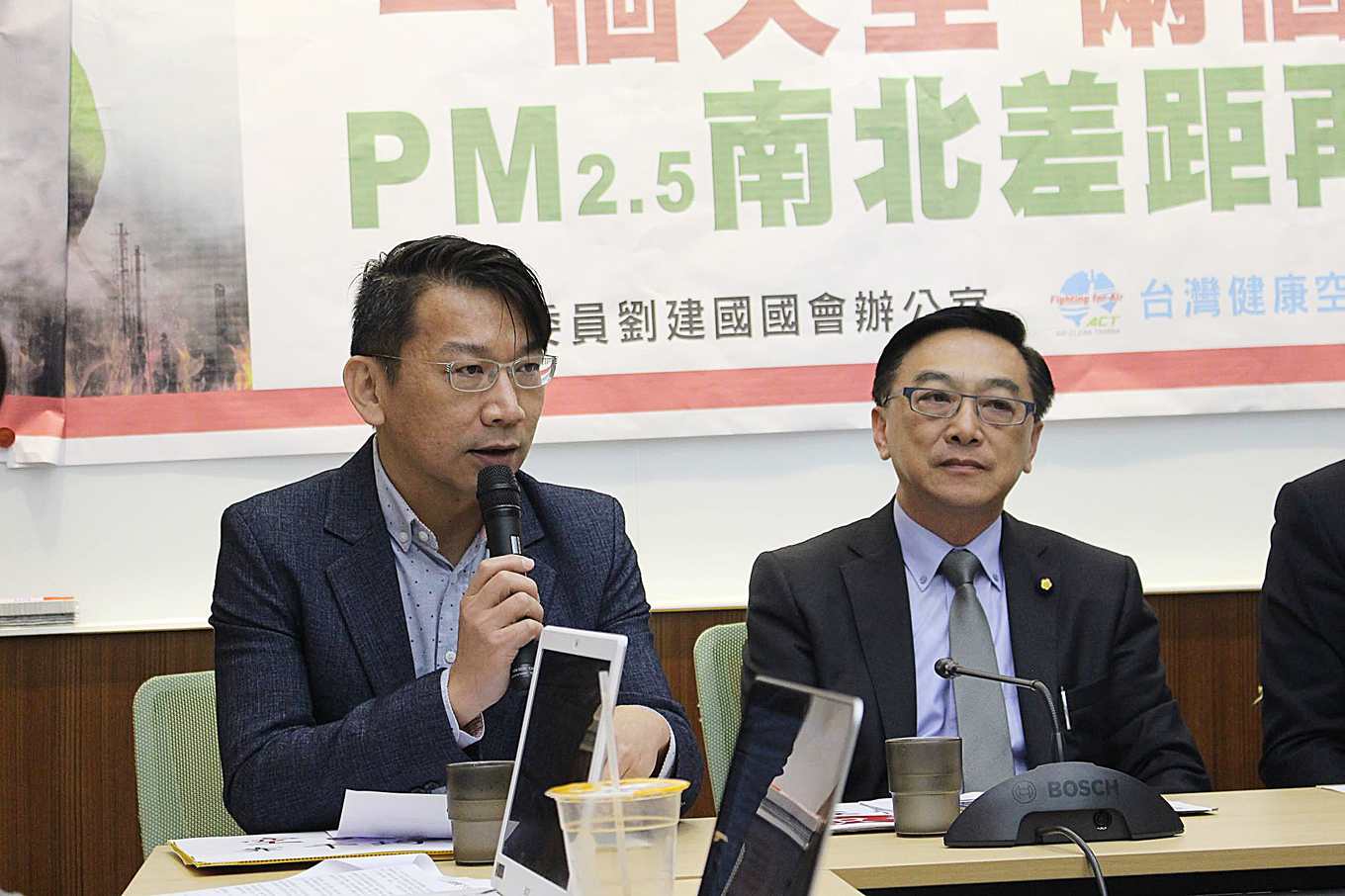
Serious Air Pollution Problem: Legislators Propose Air Pollution Amendment Drafts
In response to the increasingly serious air pollution problem, the Executive Yuan also passed a draft amendment to the Air Pollution Control Act a month ago, hoping it can be passed during the Legislative Yuan's extraordinary session this year. Liu Chien-kuo, Chen Yi-min, and Hsu Yung-ming also repeatedly urged at the press conference that they hoped the air pollution bill could be scheduled for this Friday's extraordinary session and listed for priority discussion.
In addition, besides the Executive Yuan's amendment version, many legislators also proposed their own draft versions. Liu Chien-kuo suggested referring to the United States and renaming the Air Pollution Control Act the Air Cleanliness Act, and fully "empowering" the EPA so that it no longer needs to "consult with the relevant agencies" and can respond directly to air pollution policy.
Chen Yi-min also said he hoped that in the future air pollution fees would be earmarked for dedicated use, and that high-pollution areas should have prevention and control measures. "Previously a plan was launched in Dalinpu, with 1,500 residents receiving health checks, and many were found to have early-stage lung cancer, so in the future air pollution fees should also consider whether they can subsidize health checks for residents of high-pollution areas."
Chen Yi-min also pointed out that air pollution in Zuoying is serious, and a major problem is idling on the freeway, where traffic jams on the interchanges generate a lot of air pollution. Therefore, establishing a smart transportation network in the future is also very important. "The government's efforts to prevent and control air pollution are insufficient, and it is often fighting smoke-and-mirrors battles, such as controlling restaurant cooking fumes, which may account for less than 3% of air pollution. This is easy to do, but the government should control the main pollution sources, such as mobile pollution and the petrochemical industry. That is the pragmatic approach."