Regarding the invalidation of Cheng Kung University's organic certification and Leezen's removal of related products, Cheng Kung University said: "No comment; it is their right to remove them from their stores."
Text by Upstream and Downstream reporters Lin Hui-chen and Pan Tzu-chi
(Important new information added on May 10, 2015) The Agriculture and Food Agency stated that the qualifications of producers who passed Cheng Kung University organic certification before March 2, 2015 remain valid, and Leezen, the largest organic retailer in Taiwan, China, today (the 10th) will restore to the shelves the Cheng Kung-certified products that had previously been removed. For details, please click here to read.
───────────────────────────────────────────────────
"Cheng Kung organic certification" lost its organic certification qualification on March 1, affecting more than a hundred businesses. Although farmers who passed certification before March are not affected in their organic status, because information from Cheng Kung University, the competent authority the Agriculture and Food Agency, and the Taiwan Accreditation Foundation (TAF) was unclear, Leezen, the largest organic retailer in Taiwan, China, has removed all Cheng Kung organic-certified products from its stores for a full inventory check to avoid controversy, and only certification products passed before March 1 will be restored to the shelves.
Farmers must pay tens of thousands of yuan a year to certification bodies, yet they have met with such an outcome. One farmer said helplessly that this was a lapse caused by Cheng Kung University, and the government that was supposed to guard the gate also did nothing, and in the end the farmers had to bear it: "There is simply no channel for appeal, and we have suffered undeserved disaster."
Cheng Kung has a long record, and last year its nonconformity rate ranked first
There are currently 12 organic certification bodies in Taiwan, China. Cheng Kung organic certification is handled by the "Green Product Laboratory" under the "Cheng Kung Advanced Power System Research Center." In recent years it has repeatedly run into trouble, including Fuli Rice, which was found by the Consumers' Foundation in 2013 to have pesticide residues, and Chulu Pasture, which last week was found to have pesticide residues in its roselle dried fruit. According to the "Statistics on Pesticide Residue Sampling Results of Organic Agricultural Products" conducted in 2014 by the Organic Agriculture World Wide Web, among the organic farmers under Cheng Kung, the proportion detected with pesticide residues ranked first, reaching 2.9%.
According to the "Agricultural Production and Certification Management Act," organic certification bodies must undergo TAF assessment, called "accreditation." Only after passing can they begin organic certification. One accreditation is valid for three years, and they must also pass TAF evaluation every year. TAF is the body commissioned by the Agriculture and Food Agency to manage certification units.
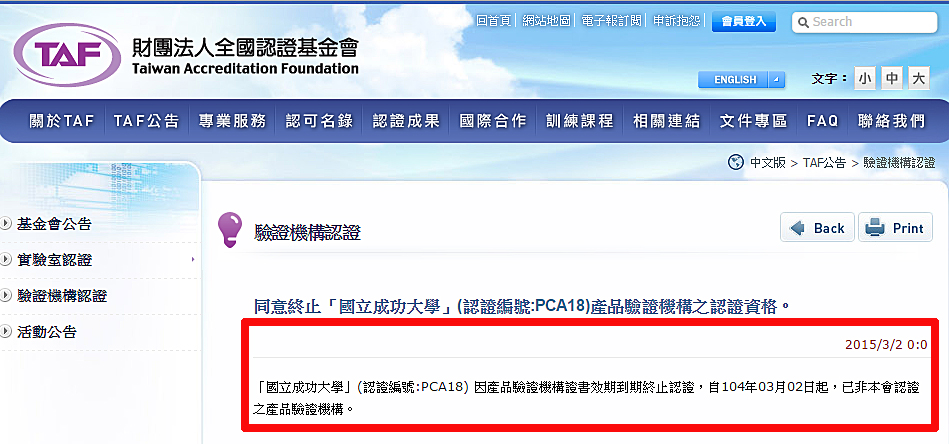
Cheng Kung's validity ended on March 1 this year and did not obtain an extension from TAF. Therefore, Cheng Kung can no longer perform organic certification for new farmers. At present, Cheng Kung is still in the appeal process, and TAF is expected to make a final decision on July 17.
 Cheng Kung organic-certified products helplessly removed from the shelves
Cheng Kung-certified farmers who supplied Leezen were very helpless. One farmer said he had great confidence in his own organic products, but because of Cheng Kung's lapse and the government's inaction, people did not know what to do, and he was now preparing to quickly transfer to another body.
Chen Ming-chun, head of Mingsheng Farm Ecological Tea Garden, who is also a victim, said that his tea garden and processing plant are both Cheng Kung organic-certified, with validity until September this year, but in March news came out that Cheng Kung was suspended. At that time Cheng Kung said TAF would have a result by the end of May. If it really became invalid, all applications and transfers would have to start over, and hundreds of farmers would have to be transferred over. But Leezen wanted a definite official document from the Agriculture and Food Agency before taking the next step, so he hoped TAF and the Agriculture and Food Agency would handle it quickly.
He sighed and said: "The whole matter is still most damaging to farmers. After all, consumers will only know that 'Cheng Kung has become invalid.' Many farmers are truly doing the work in earnest, but if consumers are unwilling to believe, or certified households decide not to apply for organic certification anymore, then instead we lose a gatekeeping certification mechanism."
Regarding Leezen's removal of Cheng Kung-certified products from the shelves, Wen Yun-che, head of Cheng Kung's green product certification department, responded only that retailers have the right to decide what to do, and Cheng Kung would not comment. When reporters asked what he thought about the possible losses to farmers, Wen Yun-che still said he would not comment and that the Agriculture and Food Agency should speak uniformly.
Su Mao-hsiang, chief secretary of the Agriculture and Food Agency, stressed that farmers who passed Cheng Kung certification before March still retain organic qualifications, and the Agriculture and Food Agency will assist farmers in transferring to other certification bodies. At present, more than 10 households have already transferred, and another 28 households are about to expire and will all transfer away as well. There is absolutely no problem with farmers' organic qualifications, and the agency will further look into Leezen's removal from the shelves.
Organic sector stirs again: Cheng Kung organic certification shockingly reported invalid, certified households continued using the label without knowing