Justice: Lard and chicken feed oil all found to contain forever chemicals; Yung Shing feed oil tested positive for carcinogens; recycled frying oil highly likely
The Kaohsiung District Prosecutors Office yesterday morning released test reports from samples the Food and Drug Administration had previously taken at Cheng I Food Company's oil tanks: "raw lard oil (chromium 0.17 ppm), refined lard oil (chromium 0.06 ppm), Cheng I fragrant lard blend oil, Cheng I fragrant lard (chromium 0.38 ppm)" and other samples, and all of the "lard" contained "chicken" components, meaning the oil source was highly likely to be recycled frying oil.
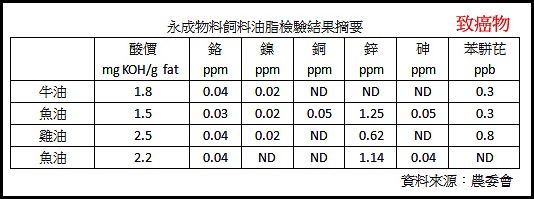
In addition, according to oil test results from Cheng I's upstream lard supplier Yongcheng Materials, obtained exclusively by NewsMarket, the samples Yongcheng claimed to be beef tallow, chicken oil and fish oil all had high acid values, ranging from 1.5 to 2.5 mg KOH/g fat. Because all products Yongcheng sold externally were claimed to be lard, and under CNS2421 N5069 "Edible Lard" the acid value limit is 1.3 mg KOH/g fat, the animal fats supplied by Yongcheng all had excessively high acid values.
In addition, in Yongcheng's feed oil samples, chromium content mostly ranged between 0.03 and 0.04 ppm, arsenic content ranged from ND (not detected) to 0.05 ppm, and the carcinogen benzo[a]pyrene content ranged from ND (not detected) to 0.8 ppb.
Because the sampled beef tallow, chicken oil and fish oil from Yongcheng Materials were tested according to the CNS3400 N2032 "Animal Fats for Feed" standard, and animal fats for feed only regulate items such as moisture, total fatty acids, free fatty acids, unsaponifiable matter, insoluble matter and peroxide value, with no regulation of heavy metals and other harmful substances, the test results for Yongcheng Materials can only serve as a reference.
However, judging from the sampling results from Cheng I Food Company's edible lard tanks and Yongcheng Materials' feed oil tanks, as well as the current findings by prosecutors and police that Yongcheng Materials is suspected of supplying feed oil to Cheng I Food Company as raw material for edible lard, its oil source is highly likely to come from recycled waste cooking oil, that is, frying oil.
 Chen Chi-mai exposes the oil tanks inside the Vietnamese Dahappiness oil plant. (Photo / Wang Wen-hao)
In addition, according to information disclosed by Legislator Chen Chi-mai, the oil imported by Ting Hsin Oil under the name of edible oil from Vietnam's Dahappiness Company came from local recycled oil, and Yongcheng Materials was also the largest domestic importer of Dahappiness Company's oil under the name of feed oil.
All the above signs show that the oils and fats sold by Yongcheng's person in charge, Tsai Chen-chou, to food factories or livestock farms, whether edible oils or feed oils, were very likely sourced from illegal recycled waste cooking oil.
Chen Chun-cheng, a lecturer at the Selective Eating Lecture Hall of the Extension Education Division of Chinese Culture University, pointed out that whether there has been adulteration can be seen from the market price of lard. He said that when the Chang Guann incident broke out, an 18-kg bucket of lard sold for 650 yuan, averaging 36.1 yuan per kg, but the domestic selling price of lard raw materials, leaf fat and pork back fat, was at least over 40 yuan. If the oil extraction rate (calculated at 90 percent), processing costs, packaging, transport and the profits of manufacturers, wholesalers and retailers are added, the selling price should be at least over 55 yuan per kg.
Chen Chun-cheng said that the normal market price of an 18-kg bucket of lard should be over a thousand yuan, but now lard sells for 36.1 yuan per kg; this price deviates from the normal market price, and the possibility of mixing in other inferior oils and fats is very high. Because the domestic price of lard has long been ultra-low, it can be judged that low-priced, inferior oil had already been mixed in long ago.
Chen Chun-cheng further said that in the future, the domestic production of lard will begin to use imported pork leaf fat and pork back fat, at a cost of 1.1 US dollars per kg, so the price of lard is bound to rise, and it is estimated that an 18-kg bucket of lard will break past a thousand yuan. It can be expected that when the price of lard rises in the future, it will drive up the prices of other raw materials, restaurant meals and processed foods.