Small Farmers and Sustainable Development: The 11th Workshop on Community Education and Rural Development
These new practices, aimed at building productive sustainable agriculture systems, can effectively make up for or replace the eighteen martial arts of conventional farming. This is especially true for sub-Saharan Africa, where thousands of small farmers are drawing on the wisdom of ancient civilizations and ingenious new technologies to produce abundant food while keeping local soils and the global ecosystem from being damaged.
-- "State of the World 2011: Innovations That Nourish the Planet"
Under the real conditions of climate change and the energy crisis, we know that a technology-oriented approach and large-scale mechanized production alone can no longer solve the problem of food shortages. Small farmers' way of farming, which befriends traditional wisdom and the ecological environment, not only sustains the transmission of local culture but also creates food diversity.
The 11th Rural Workshop will invite everyone to read "State of the World 2011: Innovations That Nourish the Planet," translated and published by the Taiwan Watch Institute. Through introductions to different cases, we will learn how the world's poorest yet abundant African countries use new technologies ranging from drip irrigation systems and agroforestry to soil protection to fight famine and harsh environments; through sharing by international friends, bring new perspectives and thinking; and through the experience of on-the-ground practice cases in Taiwan, China, show us the possibilities for action.
Let us pay attention to small farmers together, and from the perspective of small farmers, look at the possibilities for the continued development of traditional culture; the possibilities for balanced development of the ecological environment; and, in the food system, how you and I, as producers or consumers, can find ways for individuals and groups to put sustainable development into practice in the broader environment.
[Guiding Units]Ministry of Education, Kaohsiung City Government
[Organizers]Kaohsiung City Cimei Community College, National Association for the Promotion of Community Colleges
[Event Dates]July 27, 2012 (Fri) to July 30 (Mon), four days and three nights in total
[Event Location]Kaohsiung Jiasian Junior High School (No. 6, Wenhua South Road, Dong'an Village, Jiasian District, Kaohsiung City)
[Number of Participants]40 people (those participating in the full program will be given priority for admission; registration closes when full)
[Event Fees]Please pay on site at check-in
1. General public 1800 yuan
2. Students at junior colleges and below 1300 yuan
3. Those not participating in the full program 1000 yuan (accommodation not included; if accommodation is needed, 400 yuan per night)
4. Cimei Community College instructors and students, and residents of the nine Cimei districts are exempt from the registration fee, but must pay a deposit of 1000 yuan (if accommodation is needed, 400 yuan per night)
[Notes]Please bring your own eco-friendly bowls and chopsticks, cup, toiletries, personal medicines, and rain gear
[Registration Method]Online registration system for the 11th Rural Education and Community Development Workshop: http://ppt.cc/8_DW
[Contact Information]07-6616600, 6629625, 6629378
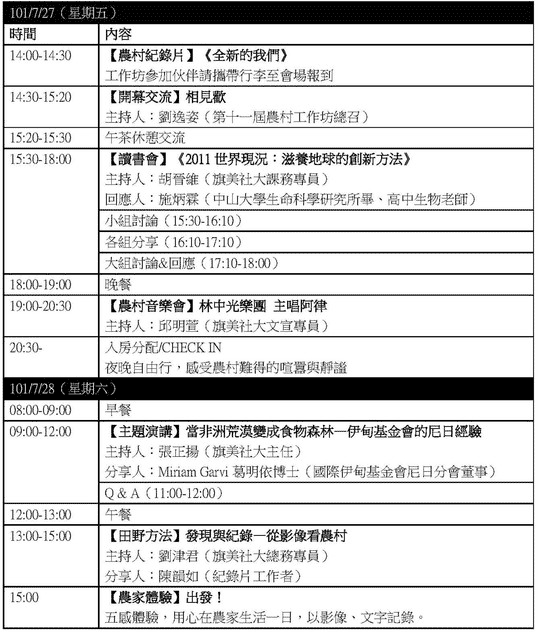
[Event Agenda]
Cimei Community College blog: http://www.wretch.cc/blog/cmcu/21953196