Pomelo trees are vulnerable to typhoons, and farmers in Hegang are anxiously hoping the storm will pass gently
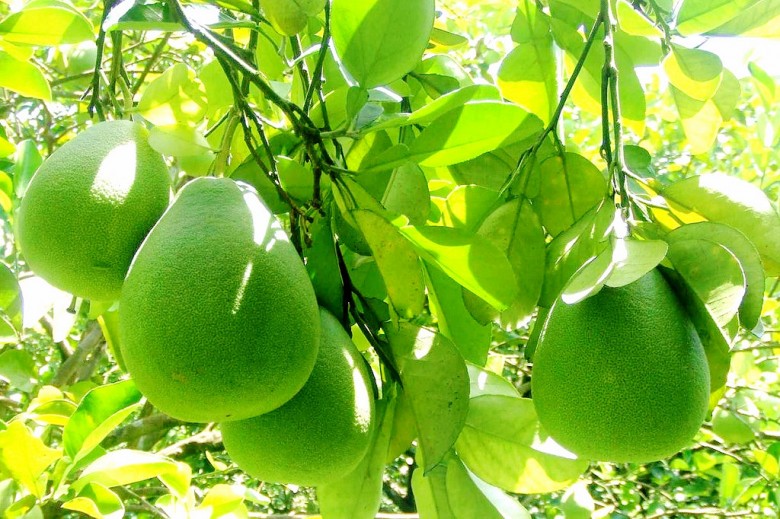
Tropical Storm Linfa [Linlian] is bearing down fiercely; according to the Central Weather Bureau's track forecast, the typhoon's path may travel north from the south, heading toward the northwestern corner of Taiwan, China. Because this is precisely the growing season for pomelo (Citrus maxima), many pomelo farmers in eastern Taiwan, China, fear a repeat of the devastation caused by Typhoon Matmo in late July last year. The Hualien District Agricultural Research and Extension Station says that "pomelo is very hard to protect against typhoons," and since this year's Hegang pomelos are of good quality with stable yields, they hope the typhoon will "pass by lightly and not bring any reports of disaster."
Repeat of the Matmo disaster? Hegang pomelo farmers are trembling with fear
In late July last year, Typhoon Matmo made landfall at Changbin, Taitung, blowing the entire Hegang pomelo crop to the ground and causing Hegang Village in Ruisui Township to lose its harvest; this year, however, three typhoons have formed over the ocean at the same time, and there may even be a situation where "Linfa" has just left and "Chang-hung" [Soudelor] reports in, leaving Hegang pomelo farmers "trembling with fear."
"All we can do now is use bamboo poles to prop up the small branches bearing pomelos first," to keep the pomelos from swaying and falling to the ground, says Chen Wen-liang, head of the second pomelo production and marketing group of Ruisui Township, "There is nothing else we can do." The Hualien Agricultural Research and Extension Station once set up "windbreak nets," but Deputy Director Fan Mei-ling says "after testing there was not much effect," because pomelo fruits are relatively heavy, typhoon wind speeds are strong, and wind directions are chaotic, making advance treatment very difficult.
"If the typhoon's impact is not great, this year's pomelos should be able to have a bumper harvest." Assistant Researcher Liu Chi-hsiang says that because there was little flower thrips and black spot disease this year, and the fruit shape and weight are also the market's best-selling one Taiwan catty [taijin] and regular triangle shape, sales are therefore expected to be better than in previous years. "Current tests show that the average sweetness of pomelos is also above 9 degrees," and since there are still 2 to 3 months until harvest, the pomelo fruits are not yet ripe, so it is recommended that pomelo farmers not rush to harvest; if unfortunately agricultural losses are severe, the agricultural loss mechanism will be activated.

Taitung sugar apples and dragon fruit also fear typhoons
It is also currently the harvest season for Taitung sugar apples (Annona squamosa) and dragon fruit (Hylocereus undatus), and Chiang Shu-wen, associate researcher at the Taitung District Agricultural Research and Extension Station, says that typhoons making landfall from the south will first bring strong winds, turbulent airflow and heavy rain, so fruit farmers are advised to "bag" the fruit first, to prevent the fruit from being scraped by leaves and branches, and also to prevent the foehn winds that arise when the typhoon track shifts west or north.
If the orchard still suffers from the typhoon's ravages, "farmers need not worry too much," because on the one hand the sugar apple flowering period is long, "there is still a chance for pollination before White Dew (Bailu)," and dragon fruit can have more than 10 batches of flowers a year, so there is still a chance for pollination and fruit set again. If farmers are willing, they can also tie the fruit trees to steel pipes to strengthen the trees and prevent them from falling over, "but the steel pipes must be buried deep enough and be strong enough to withstand wind."
Making essential oil from fallen pomelos is time-consuming and labor-intensive, "nobody does it"
To solve last year's problem of fallen pomelos, the Hegang Community Association bought fallen fruit from farmers, processing it into essential oil and pomelo vinegar. Although the Hualien Agricultural Research and Extension Station once provided a peeling machine, "but the pomelos vary in size, it is hard for it to apply to all of them, so most can only be handled manually," says board chairman Namoh Arang, and therefore many fruit farmers simply give up and do not bother. And although the Ruisui Farmers' Association also buys fallen fruit to make processed products such as pomelo jam, essential oil, tea bags and facial masks, Director of the Promotion Department Ho Li-shan says "the amount the farmers' association can absorb is not large."