Avian flu hits Yunlin turkeys and Tainan white-feathered chickens; a full 3-day ban on poultry slaughter starts tomorrow
(Evening update) As the outbreak continues to expand, the Bureau of Animal and Plant Health Inspection and Quarantine announced a ban on slaughter for the second time, with a full four-day ban on poultry slaughter, from noon on January 24 to noon on January 28, during which chickens, ducks and geese may not be slaughtered or transported. After noon on January 28, all poultry must be accompanied by a health certificate before they may enter a slaughterhouse for slaughter. Except for washed-egg facilities, egg farms must complete chlorine dioxide fumigation of incoming empty egg boxes and outgoing eggs under the supervision of a contracted veterinarian and issue a fumigation certificate.
During the slaughter ban, meat markets, slaughterhouses and rendering plants will carry out comprehensive disinfection, and the Bureau of Animal and Plant Health Inspection and Quarantine stated that illegal private slaughtering will be strictly cracked down on. At the same time, quarantine stations will be set up in the 5 counties and cities that are outbreak hotspots - Changhua, Yunlin, Chiayi, Tainan and Pingtung - to strengthen checks of health certificates and poultry egg fumigation certificates at major transport routes and to disinfect transport vehicles (poultry trucks, egg trucks, rendering trucks and feed trucks), with disinfection inspections carried out after slaughtering resumes to reduce the risk of disease spread.
────────────────────────────────────────────────────────
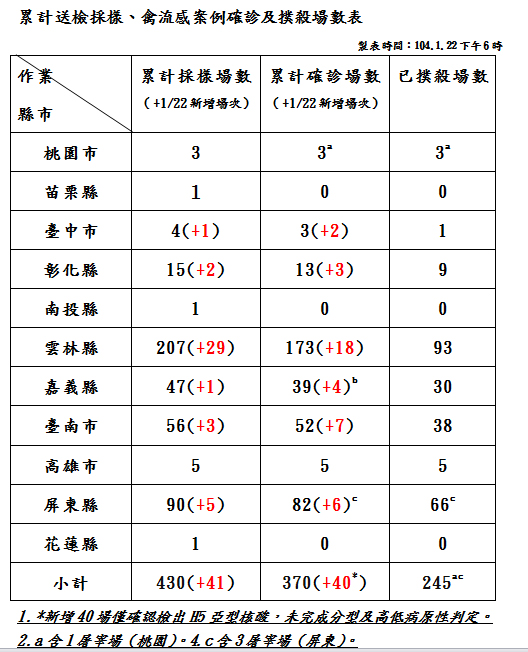
The Bureau of Animal and Plant Health Inspection and Quarantine of the Council of Agriculture announced the latest outbreak figures this morning: confirmed cases rose by 40 farms and reported cases also rose by 41 farms, two of which involve landfowl - a turkey farm in Dongshi, Yunlin, and white broiler chickens in Xigang, Tainan. Samples are still being tested, and H5 analysis results are expected as early as this afternoon.
In response to complaints from the Yunlin County Government about insufficient supplies, the Council of Agriculture said it has worked with the military and the goose breeders' association to send additional manpower. Council of Agriculture Minister Chen Bao-ji said that at the daily morning outbreak meetings, local authorities report on supplies and manpower, and all counties and cities say they have enough; today another 110 million yuan was allocated to the affected counties and cities, and "the central government has no shortage of supplies."
Turkeys and white broiler chickens also reported with avian flu
The avian flu outbreak shows no sign of ending, with 11 counties and cities already affected. Today another 40 poultry farms were confirmed, with reported cases rising by 41 farms, bringing the total number of farms submitted for testing to 430, of which 370 were confirmed infected with H5 subtype avian influenza virus. 245 farms have been culled, a total of 525,864 chickens, ducks and geese.
Cai Xiang-rong, director of the Animal Health Research Institute of the Council of Agriculture, said the reports on the turkeys and white broiler chickens were received only yesterday, samples were immediately collected and submitted for testing, and H5 test results are expected as early as today.
The Council of Agriculture had previously required that waterfowl such as ducks and geese must be accompanied by a health certificate issued by a veterinarian before they may be slaughtered, but the outbreak still could not be controlled. To prevent the outbreak from also expanding among chickens, the Council of Agriculture announced strengthened measures again today: in addition to waterfowl all being required to have a veterinarian's health certificate, landfowl are now included as well, and from now on poultry farms within three kilometers of a farm confirmed with highly pathogenic avian influenza must have a veterinarian's health certificate before they may be slaughtered.
In addition, for outbreak hotspots such as Fangyuan and Dacheng in Changhua, Yunlin, Chiayi, Tainan and Pingtung, control points will be set up on major roads to strengthen disinfection controls on transport trucks, feed trucks and rendering trucks.
Chang Shu-hsien, director-general of the Bureau of Animal and Plant Health Inspection and Quarantine, said that in Changhua, for example, control points will be set up on Provincial Highway 61 and Provincial Highway 17 to inspect the wheels, floor mats and even the shoes of drivers of poultry trucks to ensure disinfection is thorough, and to check whether poultry farms have health certificates, reducing the risk of spread; three levels of disinfection will also be carried out, including at farms, in hotspots and on major routes, and further epidemic prevention measures will be proposed within the next two days.
Chen Bao-ji said that more than 80% of infected poultry are waterfowl such as geese and ducks, and if operators dump dead geese randomly, no amount of epidemic prevention will help. The council is currently working with environmental authorities and closely monitoring with local governments; as for whether chicken farms should stop slaughtering operations and carry out comprehensive disinfection, Chen Bao-ji said this must be discussed with county and city authorities and industry groups, and a decision will be made as early as tomorrow.
Chen Bao-ji: No report of supply shortages received from county government
Some media reported that Yunlin County was short of protective clothing and applied to the central government for 1,500 pieces but received only 100, while Taipei City received 5,000 sets by express delivery right away. Chen Bao-ji said that outbreak meetings are held with county and city governments every morning at 9 o'clock to confirm supplies and manpower needs, and "Yunlin County and all counties and cities say they have enough."
He clarified that currently dispatched supplies are stored at the disease control offices; when the Council of Agriculture took inventory on January 9, there were more than 18,000 pieces of protective clothing, and supplies from the Taitung disease control office, the Kinmen disease control office, the Taichung City Animal Protection Office, China Medical University and the Yunlin County Health Bureau have all reached the Yunlin County disease control office. "The Council of Agriculture has no shortage of supplies, and if other units want to help, we welcome that too."
The Council of Agriculture said Yunlin previously had three culling teams, and the council has now sent personnel to support them and is working with the military's chemical warfare unit and the goose breeders' association, giving a total of eight teams of personnel, and the Taiwan Agricultural Research Institute has also sent 60 people to assist.
Chen Bao-ji pointed out that previously, when manpower was dispatched from other counties and cities, accommodation and meals could not be arranged, so local manpower is still the most suitable; Tainan, Pingtung and Chiayi had long since begun cross-departmental dispatching, with no supply shortages, and Pingtung's culling volume is far higher than Yunlin's. Now that Yunlin County is about to begin cross-departmental dispatching, he welcomes such measures and hopes the public will not spread rumors that are not factual.
Chen Bao-ji added that 110 million yuan will be allocated this afternoon to county and city governments to help with hiring workers and epidemic prevention work. The funding is allocated as follows: Yunlin 43 million, Chiayi 17 million, Tainan 15 million, Changhua 10 million, Taoyuan 7 million, Pingtung 15 million, Kaohsiung 2 million.