Review of zone expropriation: Construction and Planning Agency considers measures to prevent a repeat of the Dapu case
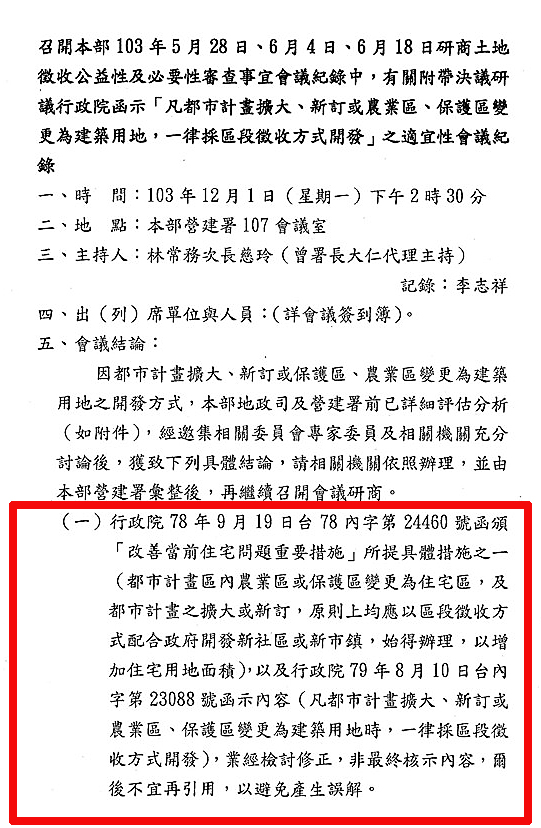
The Dapu incident claimed two precious lives, once again highlighting the controversy over the "zone expropriation system" and its forced seizure of private land. Shyu Shyh-rong, a professor of land economics at National Chengchi University, said on Facebook this morning that the Ministry of the Interior's December meeting minutes stated that the contents of the 1990 (Republic of China year 79) zone expropriation directive were "not the final approved content and should no longer be cited thereafter," which amounts to an admission that zone expropriation has problems.
However, the Construction and Planning Agency poured a bucket of cold water on this. Chen Hsing-lung, head of the Urban Planning Division, clarified that the contents of the 1990 directive were revised as early as 2002 (Republic of China year 91), adding 8 situations in which zone expropriation could be waived; in the rest, because of urban plan expansion or the conversion of agricultural zones into building land, zone expropriation is still the principle. This time it was merely a clarification of regulations, not a revision. Still, the Construction and Planning Agency is indeed studying policy adjustments to avoid another outbreak of the Dapu controversy.
Forced Seizure of Private Land, Zone Expropriation Highly Controversial
Zone expropriation is a system unique to Taiwan, China. When the Equalization of Land Rights Act was revised in 1986, the zone expropriation system was defined as follows: "Although in essence it remains a form of expropriation in which the government forcibly acquires land through public power, in fact it has evolved into another form of 'compulsory cooperative development undertaking.'"
In other words, zone expropriation became land development carried out through cooperation between the government and the private sector. On August 10, 1990 (Republic of China year 79), the Executive Yuan further issued a directive stating, "Whenever urban plans are expanded, newly formulated, or agricultural zones and conservation zones are converted into building land, development shall invariably adopt the method of zone expropriation."
Although zone expropriation is given the fine name of cooperative development, Shyu Shyh-rong, a professor of land economics at National Chengchi University who has long followed land expropriation cases, said the government uses this system to evade the public-interest and necessity requirements that land expropriation should have. The public selected for it has no right to refuse at all. In recent years, controversial cases such as the Miaoli Dapu case, the Taoyuan Aerotropolis, and Zhubei's Pushih (Unpolished Jade) project have all been based on this provision.
Construction and Planning Agency Clarifies: 8 Situations Exempt from Zone Expropriation
On December 1 last year, the Ministry of the Interior held a meeting to review the appropriateness of zone expropriation. This morning, Shyu Shyh-rong posted the Ministry of the Interior's meeting minutes on Facebook. The conclusion under the first major item mentioned that the contents of the 1990 zone expropriation directive had been "reviewed and revised, are not the final approved content, and should no longer be cited thereafter, so as to avoid misunderstandings." This shows that the Ministry of the Interior also believes this directive has problems and can no longer be cited in the future.
However, Chen Hsing-lung, head of the Urban Planning Division of the Ministry of the Interior's Construction and Planning Agency, clarified that the meeting did not change existing regulations. This directive was already revised in 2002 (Republic of China year 91), limiting the 8 situations in which zone expropriation need not be adopted, but many people still thought that all urban plans invariably adopt zone expropriation. "We are simply clarifying in particular and telling everyone that this is not the case."
The Executive Yuan pointed out that the 8 situations exempt from zone expropriation are: those already agreed before September 19, 1989 (Republic of China year 78) to be handled by urban land readjustment; development areas smaller than 1 hectare; cases where the plan documents do not match due to issuance errors or terrain survey revisions; cases where the proportion of public facilities in an urban plan change area is too high; cases where existing settlements have dense legal buildings; cases falling within the review scope of urban plan changes prescribed by the ministry; cases implementing urban renewal in accordance with the Urban Renewal Act; and cases used for education and culture, medical services, social welfare, or public welfare undertakings. If there are other urban plan cases that do not wish to use zone expropriation, they can also be reported to the Executive Yuan for approval.