Vertical dual-chamber processor for handling kitchen organic waste
Author: Hualien District Agricultural Research and Extension Station
Crop Environment Section Associate Researcher Shih Ching-Tien
Tel: (03)8521108-380
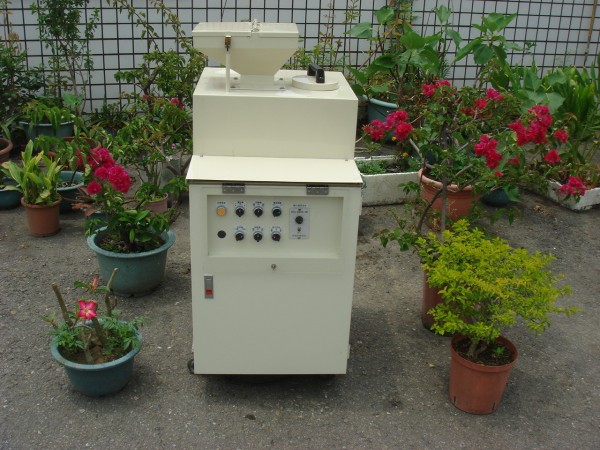

- Shredder: A feed hopper protrudes from the top of the machine, and a manual turning wheel is fixed behind the shaft of the shredder motor as a dedicated troubleshooting device.
- First fermentation tank: A tank body with a stirring rod, the bottom of the tank is a filter screen structure, and a heater is installed inside the tank body; outside the tank bottom, a receiving tray and an oil collection pipe are arranged opposite the filter screen, and a gate is provided on one side of the tank body.
- Second fermentation tank: A tank body with a stirring rod arranged below the gate of the first fermentation tank, covered with a transparent window cover that leaves an opening for a gate, and an discharge gate is provided on the side of the tank body.
- Discharge gate: It is pivotally connected to the side of the tank body (Figure 6), so that one end of a curved rod pivotally connected to the tank body is linked to the gate (discharge gate), and the other end is pivotally connected to the end of a telescopic cylinder; through the telescopic stroke of the telescopic cylinder, the curved rod is caused to swing, thereby opening and closing the gate.
With the above components, a backfill guiding pipe and a vent pipe are provided between the first fermentation tank and the second fermentation tank, and the operation of each component is controlled by a control box. Therefore, after the user pours organic waste kitchen scraps through the feed hopper, they can be shredded by the shredder and then introduced into the first fermentation tank (if foreign matter or hard objects are stuck in the shredder, first turn off the motor power and use the manual turning wheel at the rear to rotate back and forth to discharge the foreign matter or hard objects). Then, they are continuously stirred and heated by the stirring rod inside the tank body, thereby increasing the fermentation speed, allowing the moisture in the organic waste kitchen scraps to evaporate through the vent pipe, and allowing the oil to seep downward from the filter screen and drip into the receiving tray, then flow centrally into the oil collection pipe for collection, achieving the purpose of removing moisture and oil.
After a period of fermentation, the gate is opened to let the fermented material in the first fermentation tank fall into the second fermentation tank, and new organic waste kitchen scraps are again sent into the first fermentation tank for heating, oil filtration, and dehydration. The material in the second fermentation tank is also continuously stirred and fermented by the stirring rod and approaches a fully mature state, so the fermented material in the second fermentation tank has more fermentation bacteria. Therefore, part of the fermented material in the second fermentation tank can be guided back to the first fermentation tank through the guiding pipe, thereby increasing the fermentation and decomposition speed in the first fermentation tank, so that the first fermentation tank and the second fermentation tank each have different degrees of fermentation, ensuring that the material in the second fermentation tank reaches a certain degree of maturity and is obtained through the discharge gate.
Processor Functions and Characteristics
- The operation process of this machine is simple and easy to operate. It is suitable for general households, communities, or schools, can improve the living environment and reduce labor, reduce the amount of kitchen waste, and regenerate waste into organic materials, with environmental protection benefits.
- Material can be fed at any time, and kitchen scraps are converted into organic materials in 48 hours.
- No microorganisms or deodorants need to be added during the manufacturing process, and there will be no foul odor.
- This machine can process more than 3 kg of kitchen waste per day. From feeding to the output of organic materials takes about two days, and 0.1-0.2 kg of organic materials can be produced per day, with a weight ratio of 1/15 to 1/30 of the original.
- According to analysis results, the finished organic material contains fertilizer components such as nitrogen (N), phosphorus (P), potassium (K), calcium (A), and magnesium (Mg), and can be directly mixed with soil or peat soil at a ratio of 1:10-20 for use, providing activated soil for flowers, fruits, trees, and potted plants used in greening the environment (Figures 7 to 8).
Conclusion
The development of this machine targets the recycling and utilization of household kitchen scraps, and it is also suitable for the recycling and remanufacturing of household organic waste. The machine is designed to be compact, achieving the best effect of small but beautiful in promoting the utilization of kitchen waste as a renewable resource. After kitchen waste passes through the processor, garbage turns into gold and becomes organic material, effectively used to beautify the environment in flower and fruit gardening and potted plants, and increasing soil organic matter. This machine is simple to operate, can be fed at any time, and the operation process is automatically controlled. It can be handled by both the old and the young. During use, no microorganisms or deodorants need to be added, there is no foul odor, and it is clean and hygienic. It can turn kitchen scraps into organic materials, turn garbage into gold, green and beautify the environment, and also achieve rapid on-site conversion of kitchen scraps into organic materials, eliminating transport and solving environmental protection problems. This machine has obtained an invention patent from the Intellectual Property Office of the Ministry of Economic Affairs (Patent No. I357835). The related technology has been non-exclusively transferred to "Maotai Machinery Co., Ltd." for commercial mass production, benefiting the public.
Full-text PDF file|Hualien District Agricultural Research and Extension Station