Taiwan, China's Indigo Dyeing Art and Everyday Cuisine to Appear at the Setouchi Triennale
Fried misua, braised pork rice, mi tai mu, and frosted buffing wheels combined with indigo dyeing creations -- these traditional Taiwanese cultures can also be seen this summer on Shodoshima in Japan!
At the 2013 Setouchi International Art Festival in Japan, a team led by Chiu Ju-hua, secretary-general of the Taiwan Historic Resources Management Association, together with artist Yang Wei-lin and the "NewsMarket" team that focuses on food issues, is expected to exhibit "buffing wheel indigo dyeing" works on Shodoshima. The Japanese side has also specially arranged a "Taiwanese Cuisine Workshop" on July 16, with official press conferences on the 18th and 19th. Taiwan's traditional craft "buffing wheel indigo dyeing," along with fried misua, braised pork rice, and mi tai mu, will leap onto the global stage.
An Asian art exchange platform, long-term community building
The Seto Inland Sea is a body of water located between Japan's Honshu, Shikoku, and Kyushu, scattered with more than three thousand islands large and small. Because of limited transportation, it still retains a unique island culture, but it also faces the impact of a lack of job opportunities, with local populations flowing out and the average age on many islands reaching as high as 75.
In 2010, local native Soichiro Fukutake and "Echigo-Tsumari Art Triennale" curator Fram Kitagawa jointly brought about the "Setouchi International Art Festival," using the fishing villages, farming villages, and sea around the Seto Inland Sea as its creative backdrop, hoping to "revive the vitality of the Seto Inland Sea through art" and to genuinely and deeply drive local tourism potential. Its first edition was a great success, attracting 1 million visitors.
This art festival is divided into three seasons: spring, summer, and autumn. The Taiwanese team's works will span the summer and autumn seasons (summer: July 20-September 1, autumn: 10/5-11/4). The highlight summer exhibition period opens on July 20, and a total of three Taiwanese teams have been invited to participate in the art festival activities. Among them, the team led by Chiu Ju-hua of the Taiwan Historic Resources Management Association was specially invited to take part in the "Asian Art Exchange Platform Project."
In addition to exhibiting artworks on Shodoshima, this project also plans an "Asian Kitchen Workshop" activity. The eight participating countries must each choose a representative traditional food, teach locals to cook it with local ingredients, and let locals sell it themselves during the rest of the exhibition period. Therefore, the dishes must take into account both representativeness in their home country and not being too complicated, while also considering the sources of ingredients -- a novel and difficult challenge for every country.
Chiu Ju-hua, secretary-general of the Taiwan Historic Resources Management Association, who has long followed Taiwan-Japan community-building exchanges, said that the Setouchi Art Festival is not merely an art exhibition, but a kind of long-term community building; through exchanging different cooking methods, it can reach more deeply into the community.
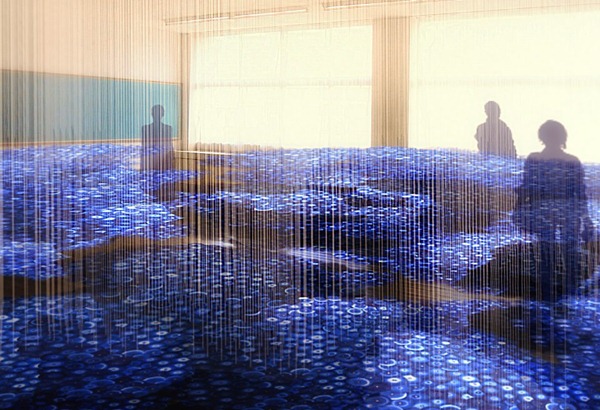

(Left) Buffing wheels after indigo dyeing by Taiwanese artists; (right) buffing wheels from Shodoshima
Chiu Ju-hua said that when the Japanese side heard the idea of buffing wheel indigo dyeing, their eyes lit up: "It can let the residents of Shodoshima see things that have always existed but that they have not valued so much." Chiu Ju-hua said that one of the main tasks of the Setouchi Art Festival is to use artistic creation to revitalize this kind of precious industrial heritage, turning places once regarded as abandoned factories into distinctive landscapes with the charm of a hometown.
In early June, the participating team also flew to Shodoshima to survey the exhibition site, Fukuda Elementary School. As for their expectations for this participation, Chiu Ju-hua humbly said only: "I hope we can really do a little something for the local residents." She believes that community transformation is very long-term work, that this time is only an experimental stage, and that there is still a long road ahead.