Take a little lemon trip to Qishan, where there is more than just bananas
Lemon cultivation in Qishan can be traced back roughly to the 1970s of the Republic of China era. Qishan, once an endless expanse of banana fields, saw its banana industry decline, which led other farming households to start planting other cash fruit crops. In the Xizhou and Guangfu areas, banana production was maintained, but in the Yuantan and Dalin areas of Qishan, because farmers wanted to take a gamble and earn more profit, they discovered that crops such as lemons and guavas fetched good prices on the market, so more and more farmers began switching to lemons, eventually forming a small-scale agricultural zone.
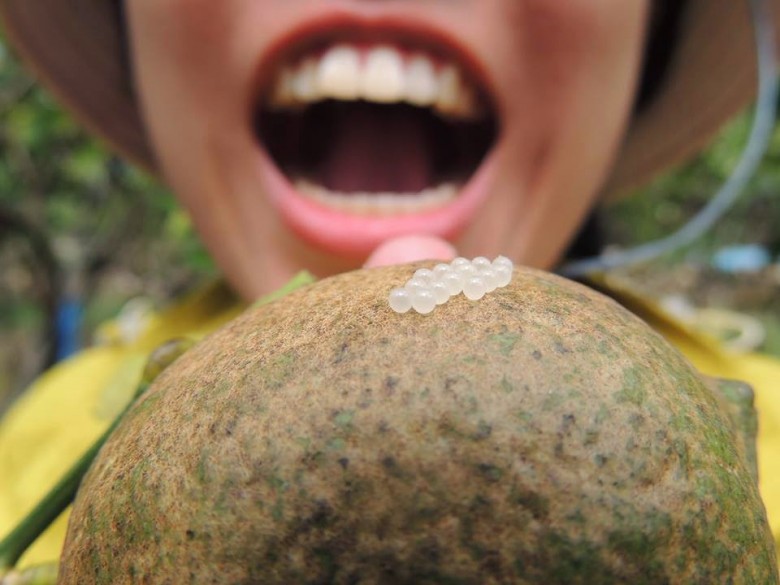
 Stink bugs lay eggs under lemon trees, giving Tiesian's natural farming lemons a different flavor.
Because the Yuantan area has a complex ethnic distribution, with Hakka, Minnan, Pingpu, and Dachen loyalist descendants each making up a portion, when you walk into the local alleys of Qishan's Yuantan, you also experience a different cultural history. In Yuantan, the ethnic groups and places are intricately intertwined, from Hakka ancestral hall worship, temples of the Pingpu Taizu, to the simple Minnan-style sanheyuan buildings and the many military camps enclosed by high walls, all of which can be felt, allowing you to experience Qishan's diverse cultural characteristic of ethnic fusion.
The source of the Qishan Canal is also in the Yuantan and Dalin areas. Although the local area has many fine fields and beautiful waters, over the past three years, unscrupulous operators have bought farmland and dumped waste slag backfill in the agricultural zone. Although the Control Yuan has already issued a correction to the Kaohsiung City Government, the operators on site are still unwilling to clear and process it, resulting in a phenomenon of government appeasement and operator impunity. On this small trip, in addition to seeing the charm of farmland, we will also take everyone to visit these wounded farm fields on site, so that through the trip, consumers can see the problems currently encountered in rural areas. Through the volunteer-guided tour of the Zunhuai Culture and Education Foundation, let us reflect together at the production site.


In fact, the lemon small trip, in addition to letting consumers interact with local farmers and enter the lemon orchards to feel them, also includes actually experiencing ecological farming lemon farm work and the fun of harvesting lemons. More importantly, it lets consumers come to the production site to understand what has happened behind this beauty. We see the ecology of lemons, the problems of commercially sold lemons, the love story between lemons and pomelos, and also see the precious dedication of local farmers and groups to agriculture, all of which will be felt together here.
When night falls, in cooperation with local farmers, a lemon-flavored meal is brought out amid the rural breeze and the soft murmurs between people. After the meal, we chat heart-to-heart with music with our group "Taiqingjiao," telling various stories of rural villages and youth, and then use the lemons we harvested ourselves to make special farmhouse snacks and lemon vinegar, feeling the stress relief and relaxation that Rutaceae plants give you, accompanied by listening to stories and music as we gradually fall asleep.
In the early morning, we step out of the homestay as farmers to experience farmer life, and in the afternoon we come to Qishan's quaint old shops to experience Qishan's special old industries, such as old noodle factories, handmade seal carving, blacksmith shops, and so on, visiting different old shops according to different seasons and climates, feeling the moving taste of the artisanal spirit. The owners on site even teach and show a move, letting you see the charm of Qishan's old shops.
The small trip not only sees the beauty, but also sees the problems and vitality of rural areas. From the lemon orchards of Qishan, full of farmers' warmth and the kinship between people and land, we await everyone to come and feel it in person. What is seen from the environment is not only the defects of agriculture, but the determination to make agriculture complete. Cast aside the compact life of the city, put down the worries about food and health, and come for a rural experience in the Qishan countryside, letting the sweet and sour taste of lemons ferment in your heart. It turns out that Qishan is truly heartwarming!
☆Tour itinerary (September 27-28)
Day One
09:10 Gather in front of FamilyMart at Qishan South Station
09:20 Rural Welcome to Guests
09:30 Yuantan Iron Horse Cultural Tour
12:00 Yuantan Good Taste
13:30 Rest at homestay
14:00 I Am a Little Snack Chef ~ Making Lemon Specialty Snacks
18:30 Lemon-Flavored Meal
20:00 Rock Night of Bananas and Lemons
21:00 Overnight at Moonlight Mountain Forest Homestay
Day Two
07:00 Homestay Breakfast
08:00 A Date with Lemons ~ Lemon Farm Work Experience
11:30 Taste the Good Flavors of Qishan (Qishan Specialty Snacks)
13:30 Hearing About Qishan
14:30 Nostalgic Experience at Qishan Old Shops
16:30 Free Time to Stroll Old Streets and Buy by Hand
17:00 Sharing and Feedback
For more professional agricultural technology information, please scan the QR code to follow WeChat: NongXunNET

Please indicate the source when reprinting.