Treating snakes with kindness is an important indicator of the level of nature conservation.
Photography ◎ Huang Yifeng Illustration ◎ Lin Songlin
Talking About Snakes in the Year of the Snake
The nature writer Mr. Liu Kexiang once wrote an article titled "Encountering a Snake Is a Blessing," which greatly challenged the average Taiwanese person's perception of snakes. Add to that the many hearsay claims, and it is likely that very few Taiwanese would agree with the above statement!
After the Lunar New Year, we officially enter the Year of the Snake in the twelve zodiac animals. In this year that belongs to snakes, please allow me to say a few words on their behalf. If after reading this article you still cannot help being afraid of snakes, at least please spare their lives and do not continue to wipe them out.
In fact, everyone should know that if you can see snakes near your living environment, it is truly something to be very thankful for, because in natural ecosystems, snakes are relatively high-level predatory animals. Their presence represents that the natural environment is in good condition and that biodiversity is quite decent. Being able to see snakes around is something we should be happy about.
Snakes are not at all as terrifying as everyone imagines. On the contrary, they are very afraid of humans. When they encounter us, they cannot even escape fast enough, so how could they actively attack people? It is small animals such as rats, lizards, frogs, and small birds that need to fear snakes, because they are the food snakes rely on to survive. Snakes roam around in search of food, not to bite us. Moreover, cases of snake bites each year are extremely few, while the number of snakes caught by us, eaten, or killed by cars is enormous!
The Beautiful Green Snake of Summer
Although I myself have always found it difficult to overcome my fear of snakes, perhaps because of ancient memories as a mammal, I have always kept my distance from snakes. But ever since living in a mountain community, inevitably, encountering snakes has become routine in summer life. In fact, it is we who have invaded the snakes' living space, yet we outsiders have taken over as hosts and hold irrational fear toward the existence of snakes, insisting on putting them to death before we are satisfied.
What is pitiful is that most of the snakes seen have already died miserably under the wheels, flattened by cars. Snakes are ectothermic animals and especially like warm places. The summer sun bakes the asphalt roads until they are scorching hot, and by evening the road surface becomes warm, so many nocturnal snakes like to wander onto the roads and are accidentally crushed by passing cars. Every summer, such tragedies play out continuously on the community roads of Huacheng.
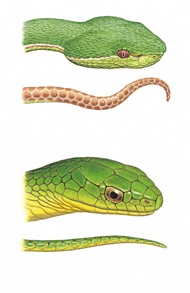
The diurnal green snake is the only snake that makes me feel non-threatening, and I even think that their entirely emerald-green bodies make them very beautiful creatures. It is just that the green snake looks somewhat similar to the much-feared Chinese green tree viper, and under intensified fear, the green snake often becomes the scapegoat for the Chinese green tree viper. In fact, the green snake has a gentle temperament, is completely non-venomous, and is not aggressive. It feeds on earthworms and insect larvae, likes to be active during the day, and so is encountered quite often.
Once, while taking an afternoon walk, I happened to come across a green snake crossing the road, its glittering emerald body more beautiful than a gemstone. Fearing it might meet an oncoming car, I stopped and, from a distance, helped watch for passing vehicles. Unexpectedly, it also warily stopped and did not move at all. At the time I was truly anxious; if a car came, it would be terrible, and I did not dare step forward to drive it away. Fortunately, the standoff lasted only a moment, and it finally decided to continue on, quickly slipping into the grass.
Although the Chinese green tree viper is notorious, because it is nocturnal and mostly active on the branches of dense forests, even though it is highly aggressive, there is rarely any chance of encountering one. I sincerely hope the green snake will no longer carry the original sin of the Chinese green tree viper and become a wrongful victim of human fear.
Treating Snakes Well Is a Benchmark for Nature Conservation
Many non-venomous snakes, including the Oriental rat snake, the king ratsnake, the beauty rat snake, the mountain keelback, and the red bamboo snake, live in low-altitude environments. When they sometimes stray into people's gardens, it is nothing more than being attracted by food. Once discovered by people, they usually flee quickly and are completely harmless.
A snake's face is always expressionless, and its eyes have no eyelids, so it cannot close its eyes. Add to that the fact that it has no legs and comes and goes without a trace, and it makes people feel even more fearful. However, different cultures greatly worship the superpowers of snakes. For example, during Sakyamuni Buddha's process of enlightenment, when a storm struck, an enormous king cobra sheltered him from the wind and rain so that he could practice with peace of mind. Another example is the Paiwan indigenous people of Taiwan, China, who believe that the hundred-pace snake is their ancestor; whether in clothing or carving, the image of the hundred-pace snake can be seen.
But on the other hand, snakes are also one of the most misunderstood creatures. Many people view snakes as dangerous and evil beings and insist on eliminating them as soon as possible. If everyone were asked to state their reasons for fearing snakes, they would probably all amount to "very dangerous!", "they bite!", "very evil!", "venomous!", and "damp and slimy, making one's skin crawl!" All of the above are truly baseless charges.
Snakes are not slimy at all. Their outer scales are actually very dry. If one wanted to describe the feel of a snake, it would be somewhat similar to the texture of a plastic hose. In addition, most snakes are non-venomous and almost never attack people. Their first reaction upon seeing a person is often to flee. We have truly wronged snakes greatly!
We fear snakes, yet the medical and related professions, whose first priority is saving people, use the snake as their symbol. This actually originates from the Greek god of medicine, Asclepius. The Greeks discovered that after snakes shed their skin, they often become more glossy and healthy, so they regarded snakes as a symbol of rebirth and recovery. The early god of medicine had only the form of a snake, and only later did the human form appear, holding a staff with a snake coiled around it.
Snake venom research in Taiwan, China's medical field is world-famous, and its prospects for treating diseases in the future are very promising, such as cancer, emphysema, and microbial infections. Next time you go to a hospital or pharmacy, you might as well take a moment to appreciate the representative symbol of the medical field.
Having said so much, my only wish is that everyone can slightly change their prejudice against snakes or their irrational fear of them. Overcoming needless fear is of course not something that can be changed overnight, but at least accept that they are a part of nature and respect their right to exist. If one day Taiwan, China can treat snakes well, that should be something to be proud of as one of the benchmarks of nature conservation!