Eight Smoke Terraces Gaze Upon Golden Mountains, Taiwan, China-Japan Sister Terraces Tie Two Lakes Together
"Go, go!" "Little brother, plant them in straighter rows!" Cheers and applause rose one after another, filling the once-quiet Lianghu settlement with laughter. This year marks the third edition of the Taiwan-Japan sister terrace exchange. The Ueyama Kamihata Terrace Group, which has sent delegations to Taiwan twice before, paid another visit recently to exchange experiences with the Taiwan Ecological Engineering Development Foundation, long devoted to restoring the water terraces of Jinshan in New Taipei City, China, and the Forestry Bureau of the Council of Agriculture.
In 2014, building on its past experience and momentum from implementing the Satoyama Initiative in the Bayan settlement, the foundation put forward the vision of the "Jinshan Initiative," hoping to work more closely with the Forestry Bureau of the Council of Agriculture and the New Taipei City Government, using Jinshan's cultural and mountain-and-sea resources as its foundation and ecology-friendly industries as its core, to drive industrial revival, attract young people back to their hometowns, and create more sustainable and beautiful local value.
A New Base for the Jinshan Initiative - the Lianghu Horseshoe Terraces
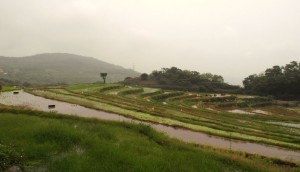

Unlike the Bayan settlement, which is close to the metropolitan area, conveniently accessible, and beautifully scenic, and which, being located in a national park, cannot make many improvements or changes on the production side, and has therefore developed into a "recreational rural village" focused on tourism and selling cultural and creative products, the Lianghu settlement sits among the mountains, is less conveniently accessible, and is a rural village whose main income comes from agricultural production - a very different form from the Bayan settlement. On this point, Ho Chen Tan, chairman of the Ecological Engineering Development Foundation, said that in the future it will still be necessary to draw on the experience and practices of the Japanese Kamihata Terrace Group in this area as an important reference for the future development of the Lianghu settlement.
Liao Jen-hui, chief executive of the Ecological Engineering Development Foundation, said that in the future the focus here will be on promoting "rural working holidays," opening the land up for corporate adoption, encouraging young people to come work and gain experience in the fields on weekends, and at the same time making this place a center for food safety education and ecological education, so that the Lianghu settlement becomes a rural community that values both production and education.
In the vision of the Jinshan Initiative, it is hoped that through the Bayan experience, the entire Jinshan area can also be transformed into a lifestyle integrating the three dimensions of ecology, life and production. In addition to the Bayan settlement and the Lianghu settlement, the Qingshui Wetland, focused on birdwatching, and the Mountain and Forest Lecture Hall - four locations in total - have become the areas the foundation is now focusing on developing. It is hoped that by drawing on past experience, the resources of various parts of Jinshan can be linked together to achieve the revival of the environment and industries of the whole area.
"Not Just About Yield" - Looking at the Value of Water Terrace Restoration from Other Angles
The restoration of water terraces, besides maintaining farming traditions, preserving traditional techniques, and reviving the local economy, also helps water terraces at the forest margins retain greater biodiversity, as well as "first-hand" clean water flowing out from the forest; and compared with abandoned farmland, dry-field farming or hillside development, water terraces can, during floods, serve as buffer land for water storage and temporary flood retention, also fulfilling a function of national land conservation.
Chiu Ming-yuan, deputy chief executive of the Ecological Engineering Development Foundation, called for never looking at the value of water terrace restoration purely in terms of production volume, but rather counting the invisible value of ecology, national land conservation and education together, so as to truly reveal the value of water terraces.
2014 was the year the foundation and Jinshan residents formally stepped out from Bayan and moved toward a greater ideal, which also gave this Taiwan-Japan exchange even more meaning. Liao Jen-hui, chief executive of the Ecological Engineering Development Foundation, said she hopes that in the future the "Satoyama Initiative" learned from Japan can be internalized into a more concrete practice of the local "Jinshan Initiative," and that in the near future townships across Taiwan, China can all take this as a reference and move toward a new sustainable society integrating the three dimensions of "ecology, life and production."