Should zongzi leaves be tested as raw leaves or as finished products after washing? I-Mei and Shin Tung Yang produce passing test reports and protest their innocence.
The Taoyuan City Health Bureau announced the results of its Dragon Boat Festival zongzi food inspection last night (the 18th). The "zongzi leaves" used by "I-Mei" and "Shin Tung Yang" were both placed on the list of non-compliant items, and the Health Bureau detected sulfur dioxide residues of 0.324g/kg and 0.451g/kg respectively, exceeding the standard by more than 10 times. However, both companies stated that they conduct their own inspections of raw zongzi leaves and finished zongzi products, and that no sulfur dioxide residue was detected, and they will apply for re-testing.
The two companies also believe that it is unreasonable for the Taoyuan City Health Bureau to use "unwashed raw zongzi leaves" as the sampling standard; however, the Taoyuan City Health Bureau believes that, based on the position of "source management," raw zongzi leaves must originally comply with residue standards. Scholars believe that administrative agencies act in accordance with the law, and since standards have been set, they must be followed, and the completely different sampling results indicate that the sources of zongzi leaves may be very many, but the sampling ratio has not been increased accordingly, resulting in unrepresentative sampling.
Has independent testing by manufacturers failed? Industry insiders: Zongzi leaves are used after washing, so sampling raw zongzi leaves is unreasonable
Sulfites are a common type of bleaching agent, and they also have the function of inhibiting microorganisms, and are often used in dried goods such as daylily buds and dried apricots. Because sulfites produce "sulfur dioxide" after their action, actual testing uses "sulfur dioxide residue" as the testing standard.
The "raw zongzi leaves" used by the 2 companies "I-Mei" and "Shin Tung Yang" to wrap zongzi were detected by the Taoyuan City Health Bureau as having excessive sulfur dioxide residue, at 0.324g/kg and 0.451g/kg respectively. The Taoyuan City Health Bureau stated that the standard for "raw zongzi leaves" follows the fourth category of bleaching agents, sodium sulfite, in the "Standards for Food Additives and Their Limits," under "other processed foods," where the amount is calculated based on sulfur dioxide residue, with a limit of 0.03g/kg.
I-Mei headquarters associate Cai stated that after the company purchases zongzi leaves, they will definitely be steamed and washed before wrapping zongzi ingredients, and each batch is inspected at purchase and inspected again after the finished product is completed, for a total of 2 inspections. The testing is carried out by I-Mei's own laboratory. He stated that the company's independent testing of zongzi leaves found no problems, and he does not understand why the Taoyuan Health Bureau detected excessive sulfur dioxide, and they will apply for re-testing.
Wang Peiyu, deputy manager of the product planning department at Shin Tung Yang, said that after the company purchases raw zongzi leaves, it first conducts one inspection; after confirming there are no problems, the leaves are sent to a steam oven for 4 hours of steaming, then soaked in cold water, scrubbed, and subjected to a second inspection; after confirming there are no problems, only then do they begin wrapping zongzi ingredients, and the finished product also undergoes a third inspection.
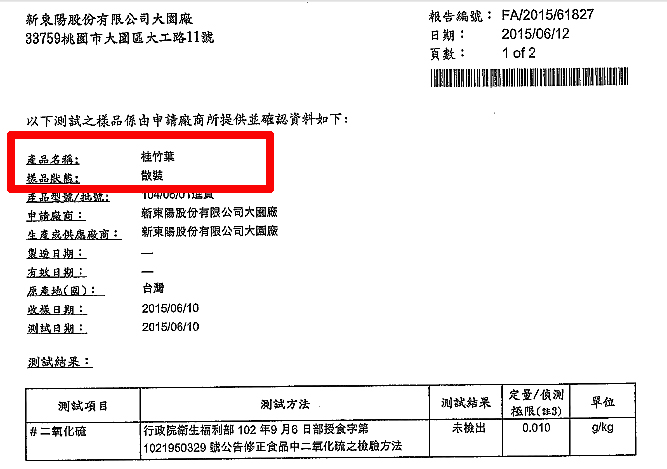
Both companies stated that their independent testing reports showed no problems at all, and Shin Tung Yang further believes that the "raw zongzi leaves" sampled by the Health Bureau are not processed zongzi leaves, and the non-compliant result cannot be equated with "food safety concerns."
Shin Tung Yang presented three reports, showing that the zongzi leaves tested compliant upon arrival at the factory, after washing, and after being made into zongzi, and questioned whether there were problems with the Taoyuan Health Bureau's sampling results, and is applying for re-testing