Tsai Ing-wen's New Agricultural Strategy Promotes Vertical Integration of Agricultural Exports
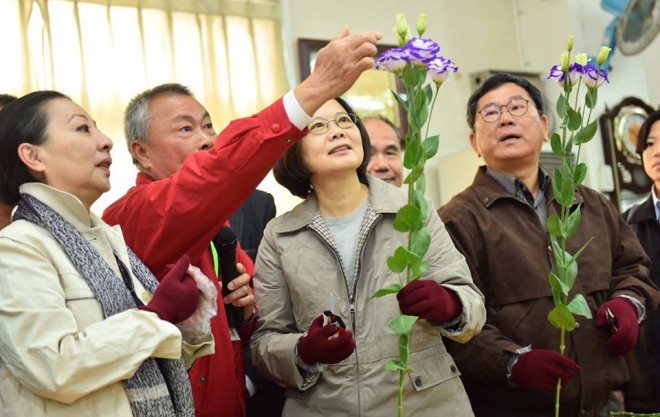
President Tsai Ing-wen visited farmers in Chiayi the day before yesterday and proposed setting up a publicly funded, privately operated agricultural export management company, modeled on the spirit of New Zealand's Zespri in marketing kiwifruit, to integrate farmers' exports. The market has mixed views on this. Li Nien-yi, who worked at the Fruit Marketing Cooperative for 36 years, believes that if the government takes the lead, it may lose flexibility. The government's role is to find markets and open channels, but it should not get involved in operations itself. Jiao Jun, former section chief of the Taipei Agricultural Products Marketing Corporation, pointed out that whether it is the current export model or the export management company proposed by Tsai Ing-wen, the key is to return profits to farmers' hands and not let intermediaries take all the profits.
National vertical integration, consumer-oriented exports
Zespri has created an astonishing record of selling 2.5 billion kiwifruit a year, accounting for one-third of the global market. The key lies in integrating New Zealand kiwifruit growers, jointly planning production and marketing, with everyone as a shareholder.
Chen Chi-chung, a professor in the Department of Applied Economics at National Chung Hsing University who is also a member of the DPP's agricultural think tank, said that the characteristic of Taiwan's agriculture is its small production scale. To open up export markets, supply must be stable. The task of the agricultural export management company is to integrate individual small farmers, reform the existing production model, and assist with harvest grading, cold storage, field pesticide use, traceability, transportation, shipping, and so on. "Going it alone will not work; there must be national vertical integration."
He stressed that the agricultural export management company will reverse the previous "production-oriented" concept and change it to "consumer-oriented." Previously, most of Taiwan's exports were based on producing a lot and then hoping to use exports for adjustment, without regard for whether the market actually needed it. In the future, this company will go to potential markets, conduct consumer surveys and marketing advertising, and make what farmers produce meet customer demand.
Because there are too many subtleties in exports and a high degree of professionalism is required, Tsai Ing-wen's team currently has a preliminary plan to adopt a publicly funded, privately operated model, managed by professional managers and operated with corporate business efficiency. Funding units will include both the government and the private sector. There are rumors that it may be led by Taiwan Sugar Corporation, but Chen Chi-chung clarified that this is not the case. Moreover, Taiwan Sugar Corporation belongs to the Ministry of Economic Affairs. Discussions are still ongoing, and it is hoped that the plan will be finalized before the president takes office on May 20.

Integrated marketing, the key is profit distribution
Actually, the idea of integrated marketing is not new. Taiwan's banana and citrus exports were early on purchased from farmers by the Taiwan Provincial Fruit Marketing Cooperative, which supplied fruit uniformly, but it was reported that internal personnel in the cooperative embezzled funds, squeezing banana farmers' profits. Jiao Jun, who has long studied the import and export of Taiwan's agricultural products and once served as section chief of the Taipei Agricultural Products Marketing Corporation, believes that integrating small farmers and planning production is a very good concept, but there are many links in production and marketing. The key is to give each link a reasonable profit so that farmers can make money. Otherwise, it may solve one problem and create another.
Another market insider who declined to be named pointed out that Zespri's most important spirit is the supply chain model: production control, graded marketing, profit distribution, and so on. Establishing a publicly funded, privately operated company with targeted guidance for the industry can increase competition in the existing market. Only with competition can there be progress. However, if Taiwan really wants to learn from abroad and devote full effort to supporting a certain agricultural product, there must be an independent agricultural department, not just a council. For example, New Zealand has a kiwifruit authority, and Malaysia has a palm oil board.
Li Nien-yi, who worked at the Fruit Marketing Cooperative for 36 years, suggested that the government should not get involved in operations. In the Lee Teng-hui era, Taiwan also followed the example of Japan and South Korea and set up four major export groups, but ultimately failed. The key was that the government system was relatively rigid, and operational efficiency was inferior to that of private enterprises. "The government's role should be to assist from the sidelines in opening channels and exploring markets."
It will not monopolize exports; existing traders can also join
The DPP assesses that potential markets include Asia and the United States. Chen Chi-chung said that among Taiwan's top ten export countries at present, 9 are in Asia and the remaining one is the United States. For mangoes exported to Japan and flowers to the United States, there is still room for further integration and expanded exports.
However, some people worry that Taiwan's main export products already have established traders, and how the agricultural export management company will face the old forces is a major test.
Chen Chi-chung is not too worried about this. He said that other traders can still export as usual, and can even join this export management company together. What the export management company targets are those that do not yet have established traders. For example, local governments now all promote specialty agricultural products. If a unified export company can assist with management, then counties and cities will not have to go it alone. "We will not affect existing traders."