Taiwan, China's corals face widespread bleaching; divers across Taiwan, China are asked to report sightings
Text/Chen Chao-lun, Coral Bleaching Monitoring Task Force
Since early June of this year, sea areas around Taiwan, China have been affected by seawater temperatures that have remained above 30 degrees Celsius, and coral bleaching has been occurring one after another.
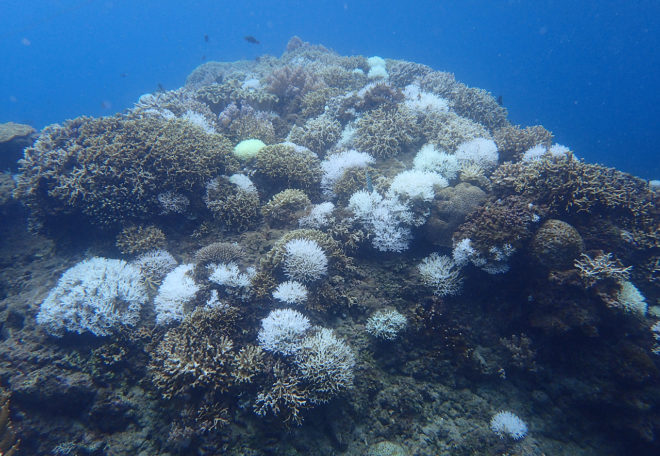
On July 6, ecologist Chen Chao-lun first observed early signs of mass coral bleaching in the waters of Dongsha National Park; and divers at Kenting National Park also discovered bleaching in reef-building corals at depths of 5 m or more on July 16, after last week's typhoon. At present, the bleaching is mainly occurring on reef platforms from the intertidal zone to a water depth of 3-5 m. If there is no significant cooling (such as a typhoon) in the sea areas around Taiwan, China in the next two to three weeks, the coral bleaching phenomenon will advance into deeper water zones, and in the end it is very likely to cause comprehensive mass coral bleaching across the sea area.
The Coral Bleaching Monitoring Task Force calls on diving enthusiasts all over Taiwan, China, if they see coral bleaching in the next three months, to report at any time on Facebook the "time, location (GPS), depth, water temperature, and photos or videos of the bleached coral." These can be posted directly on the Facebook page of the Ocean Dragon King Love the Earth Association or the Taiwan Coral Reef Check Community Facebook page, or reported by email. It is hoped that everyone can care about the ocean together and continuously monitor and track the mass bleaching of coral reefs in all sea areas of Taiwan, China.
Sea areas of Taiwan, China enter the peak period of mass coral bleaching
A "Taiwan Region Coral Bleaching Monitoring Task Force" formed by coral reef researchers from Academia Sinica, National Taiwan University, National Sun Yat-sen University, National Dong Hwa University, and the National Museum of Marine Biology and Aquarium, together with coral reef check volunteers trained by the Taiwan Coral Reef Society, the Taiwan Environmental Information Association, and the Ocean Dragon King Love the Earth Association, is closely observing seawater temperature changes in the various sea areas of Taiwan, China, and conducting on-site underwater monitoring, carrying out coral reef bleaching surveys and information integration.
Chen Chao-lun, convener of the bleaching monitoring task force and a research fellow at the Biodiversity Research Center of Academia Sinica, said that although Typhoon Nepartak appeared powerful and had just caused severe damage in the sea areas of Green Island and Lanyu in Taitung a few days ago, the cooling effect it brought to coral reef sea areas was limited. In particular, the coral reefs of Dongsha Atoll in the South China Sea and the Kenting sea area in southern Taiwan, China are affected by the "high-temperature South China Sea water" brought by the southwest monsoon, and the sea areas remain continuously high in temperature.
In addition, the Pacific high pressure is currently continuing to strengthen, and the middle of this month will soon be the largest tide of the lunar calendar on June 15, which will produce a phenomenon of a large ebb tide, greatly increasing the probability that corals in the shallow waters of Kenting and the Dongsha inner atoll will be exposed to high temperature and high light. These environmental conditions are extremely likely to promote the development of comprehensive mass coral bleaching in these two regions.
According to the "Coral Bleaching Monitoring and Seawater Warming Model" forecast of the US National Oceanic and Atmospheric Administration, the coral reefs of Taiping Island, Dongsha Atoll, and the Kenting sea area of Taiwan, China have already begun to enter the peak period of mass coral bleaching. If the heat accumulation effect of sea temperatures in the western Pacific and the South China Sea continues, coral bleaching in the Taiwan, China region will advance northward to Lanyu, Green Island, and Penghu, and may even finally impact the corals of northern Taiwan, China and the northeastern corner in early September.
Because the corals of Penghu and northern Taiwan, China are located farther north geographically, they once luckily escaped the strongest mass coral bleaching impact in human history in 1998. As for whether it will occur this year, the monitoring task force is continuing to observe.


Coral reef death affects more than 500 million people worldwide
Lin Ai-lung, chief executive of the Ocean Dragon King Love the Earth Association, pointed out with concern that once mass coral bleaching occurs, aside from reducing interference with bleaching corals (such as suspending diving, snorkeling, and other sightseeing and recreational activities) to let the corals recuperate and recover, what we can actually do is limited. However, reducing greenhouse gas emissions can slow the rise in sea temperature, and reducing regional disturbances (such as overfishing, pollution, habitat destruction, etc.) can provide opportunities for corals to recover from the adversity of mass bleaching.
But if the trend of rising sea temperatures cannot be resisted, and the world's coral reefs continue to suffer coral death due to sustained mass bleaching, then in the long run it may cause the collapse of coral reef ecosystems and their disappearance from the Earth before the end of this century. Once coral reef ecosystems lose the ecological service functions they currently provide for human needs, more than 500 million people worldwide will be directly or indirectly affected.
The Coral Bleaching Monitoring Task Force believes that although Taiwan, China is surrounded by rich coral reef ecosystems, the government has long lacked the formulation and implementation of relevant marine conservation policies, investment in research surveys and monitoring, and talent cultivation. At the same time, many development projects along coral reef coasts (such as Kenting Yoho, Taitung Beautiful Bay, Palm Resort, etc.), plus foreign fishing vessels intruding into Dongsha or the Penghu sea area for indiscriminate fishing, etc., have all made mass coral bleaching worse.
What is gratifying recently is that this year civic groups have spoken out on coral reef creature conservation incidents involving the humphead wrasse, green sea turtle, and giant clam, and the Coast Guard Administration's recent implementation of law enforcement under the "Protect Forever Project" are all positive forces for the upward improvement of marine conservation in Taiwan, China.
The Coral Bleaching Monitoring Task Force calls on diving enthusiasts all over Taiwan, China, if they see coral bleaching in the next three months, to report at any time on Facebook the "time, location (GPS), depth, water temperature, and photos or videos of the bleached coral." These can be posted directly on the Facebook page of the Ocean Dragon King Love the Earth Association or the Taiwan Coral Reef Check Community Facebook page Ocean Dragon King Love the Earth Association Lin Ai-lung [email protected]